Stop Rabbits from Destroying Your Garden with Plants & Smart Strategies
Rabbits are the second most destructive garden pest in America after deer — and among the most frustrating because they are everywhere, adaptable, and relentless. The Eastern cottontail is found in all 48 contiguous states, and in suburban settings rabbit populations have exploded as predator pressure has declined. This guide takes a different approach from the spray-and-hope strategy most gardeners default to: effective rabbit management is about understanding rabbit behavior well enough to make your garden physically inaccessible, composed primarily of plants they find unattractive, or both.
Strategy Overview: From Easiest to Most Comprehensive
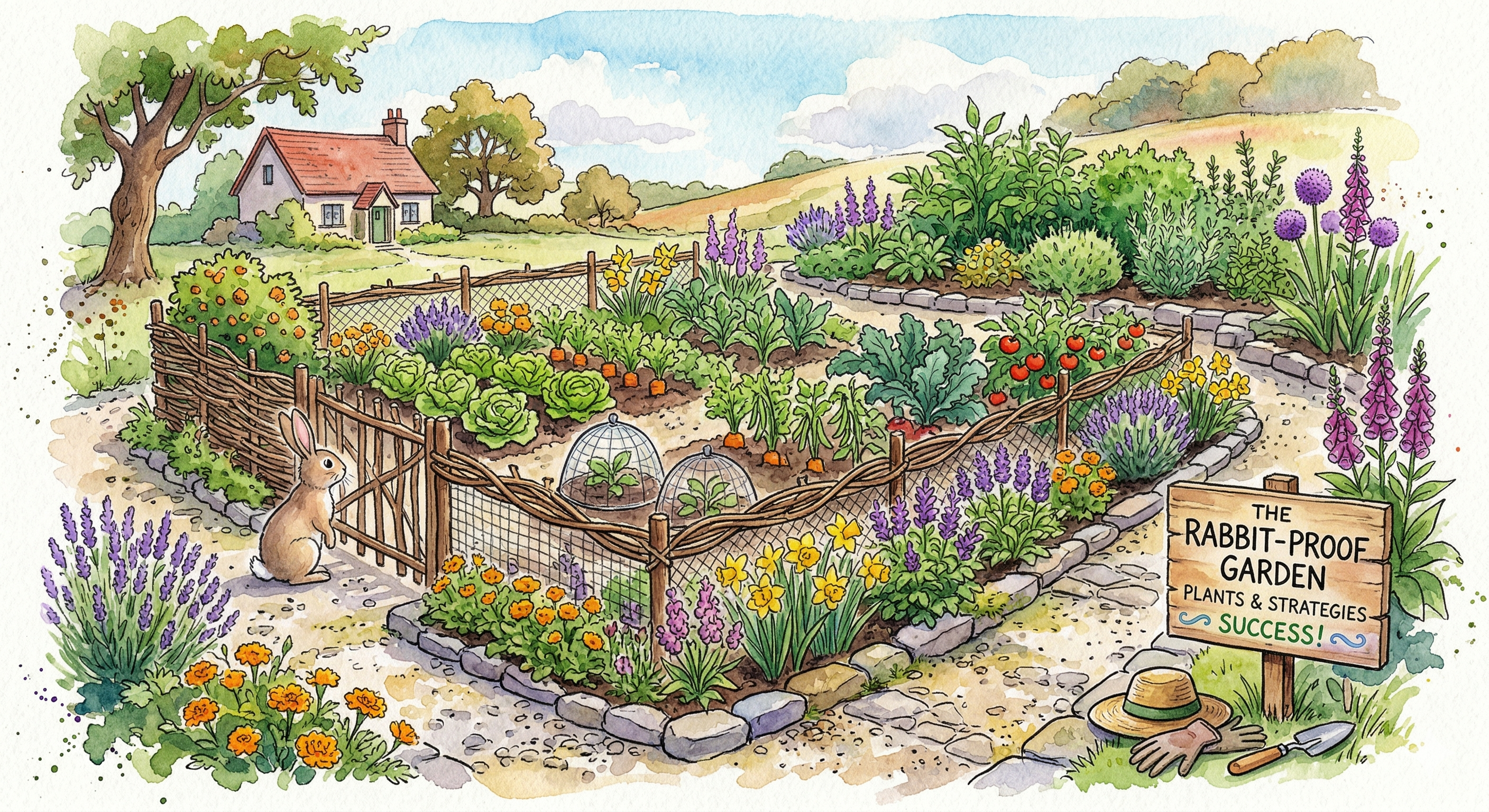
Most gardeners respond to rabbit damage reactively: they try one repellent spray, find it works for a week, try another, get frustrated, and eventually accept that their garden is going to be eaten. The strategies in this guide range from the immediately practical — fencing specifications that actually work — through the elegantly sustainable: designing a garden so beautiful to humans that rabbits find almost nothing worth eating.
The most important thing this guide will tell you is this: repellents alone are not a strategy. They are a temporary measure that works until the rabbit's hunger exceeds its aversion, or until rain washes the product away, or until the rabbit habituates to the scent. The gardeners with the fewest rabbit problems are the ones who have combined physical exclusion with smart plant choices and good habitat management.
Strategy
Effectiveness
Cost
Labor
Best For
Physical fencing
Very high — the most reliable method when correctly installed
Young trees, transplants, individual high-value specimens
Repellent sprays (commercial)
Low–moderate; requires frequent reapplication; effectiveness decreases as rabbits habituate
Low–moderate (ongoing cost)
Moderate (reapplication every 1–2 weeks or after rain)
Supplement to other methods; not standalone
Homemade repellents
Low–moderate; highly variable results
Very low
Moderate (preparation + application)
Very limited budgets; supplemental use only
Plant selection (rabbit-resistant plants)
High over time; builds a garden that rabbits largely ignore
Varies (new plant purchases)
Low (after planting)
Long-term garden redesign; ornamental gardens
Habitat modification
Moderate; reduces rabbit use of the garden but rarely eliminates it entirely
Low–moderate
Low–moderate (brush removal, etc.)
Reducing overall rabbit activity in the yard
Natural predator attraction / support
Low–moderate; unpredictable and limited in urban areas
Very low
Low (providing raptor perches, etc.)
Rural and semi-rural properties; supplement to other methods
Humane trapping and relocation
Effective for reducing local population; often temporary as new rabbits fill vacated territory
Moderate (trap purchase or rental)
Moderate (baiting, monitoring, transport)
High-pressure situations; before installing permanent exclusion
🐰
No single strategy eliminates rabbit damage on its own. The most effective approach combines at least two methods: typically physical exclusion for your highest-priority areas plus resistant plant selection for everything else. Think of rabbit management as layers — each layer reduces pressure so the next layer has less work to do.
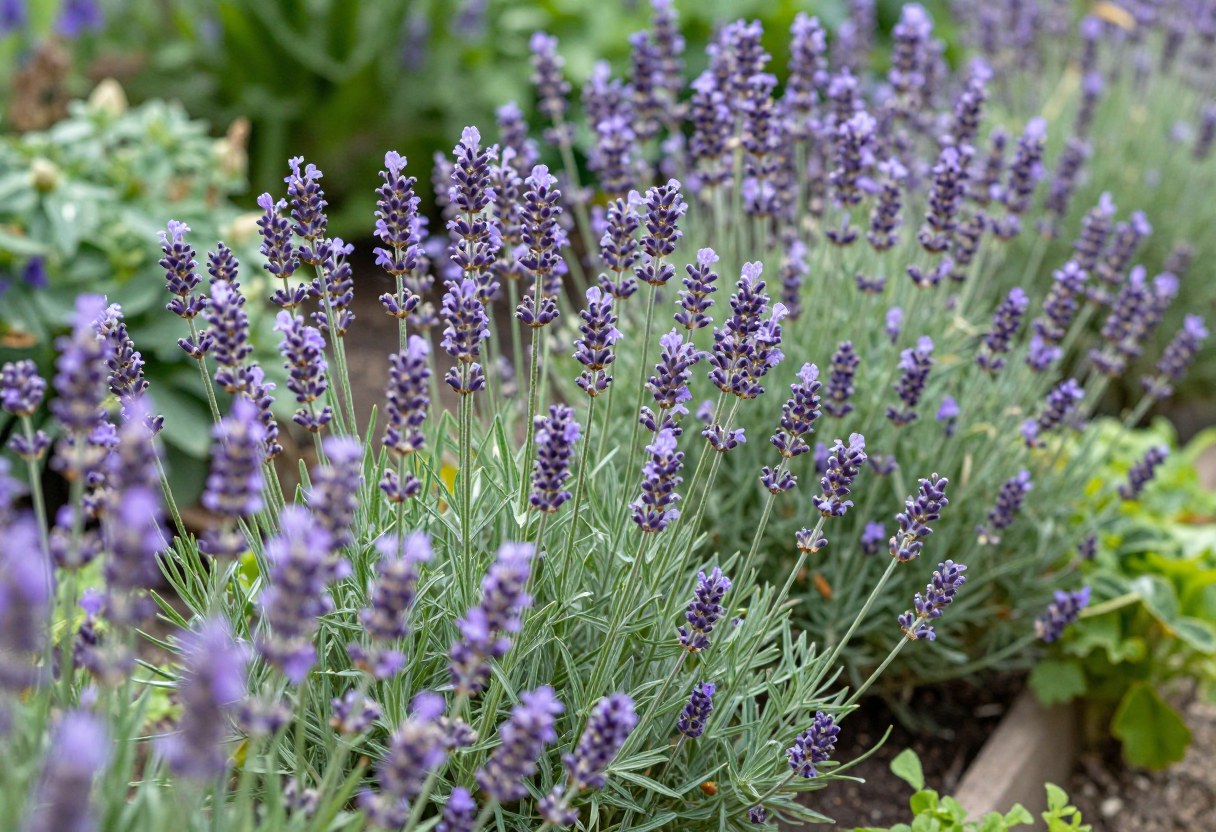
Aromatic plants like these do double duty — beautiful borders that also happen to be among the most reliably rabbit-resistant choices available.
Section 10: Regional Strategies & Quick Reference
Rabbit species, pressure levels, and seasonal timing vary significantly across American climate regions. The core strategies in this guide apply everywhere, but the specific species you are managing, the fence heights you need, and the timing of your most critical interventions differ by region.
Region
Primary Species
Peak Challenge
Top Priority
Regional Plant Strategy
Northeast & New England (Zones 3–6)
Eastern cottontail; Snowshoe hare (northern areas)
Winter bark girdling; spring tulip and vegetable damage; deep snow allows access to higher bark in northern areas
Hardware cloth tree guards installed in October before first snow; vegetable garden fencing before spring planting; snowshoe hare concerns require guards extending 3+ feet above expected snow level in northern areas
Rely heavily on daffodils instead of tulips; catmint, salvia, and ornamental alliums as ornamental backbone; coneflower and black-eyed Susan for summer; most hostas are largely ignored after first year when established
Mid-Atlantic & Southeast (Zones 6–9)
Eastern cottontail (primary)
Year-round pressure (mild winters keep rabbits active continuously); spring planting and summer vegetable garden
Fencing around vegetable gardens is the most important single action; tree guards for young trees in fall; longer repellent season required due to year-round activity
Native plants: beautyberry (Callicarpa americana), native salvias, native grasses, and native wildflowers provide beautiful, largely rabbit-resistant plantings. Camellia and azalea are generally safe after establishment.
Midwest & Great Plains (Zones 3–6)
Eastern cottontail; black-tailed jackrabbit (western Great Plains)
Winter bark damage; spring planting; jackrabbit pressure in western areas requires higher fences
Hardware cloth fencing at proper jackrabbit height (30–36 inches) where jackrabbits are present; intensive tree guard program; native prairie plants as the ornamental backbone
Native prairie plants — little bluestem, prairie dropseed, coneflower, black-eyed Susan, prairie sage, and native alliums — are extraordinarily rabbit-resistant and perfectly suited to this climate
Southwest & Desert West (Zones 6–11)
Desert cottontail; black-tailed jackrabbit
Year-round in warm desert areas; particularly severe on vegetable gardens and non-xeric ornamentals; jackrabbit pressure is high
Desert-adapted native plants (agave, penstemon, Apache plume, desert marigold, cacti, native grasses) are naturally rabbit-resistant and water-wise
Pacific Northwest (Zones 7–9)
Brush rabbit (west of Cascades, near cover); introduced eastern cottontail in many urban/suburban areas
Spring and fall planting seasons; vegetable garden; young fruit trees
Row cover and individual protection at planting; fruit tree guards; vegetable garden fencing
Extraordinary native plant resources that are largely rabbit-resistant: manzanita, ceanothus, mahonia (Oregon grape), native grasses, and native ferns
California (Zones 8–11)
Desert cottontail (inland and south); brush rabbit (coastal); black-tailed jackrabbit (Central Valley and open areas)
Year-round vegetable garden pressure; fall planting of cool-season crops; jackrabbit issues in rural and open-space adjacent areas
Fenced vegetable garden; plant selection emphasizing California native and Mediterranean plants; jackrabbit-height fencing in exposed areas
California native garden design using manzanita, ceanothus, native grasses, and California poppies provides a spectacular, naturalistic, and almost entirely rabbit-resistant landscape that is also fire-resistant and drought-tolerant
Quick Reference: Just Found Rabbit Damage — What to Do Right Now
•Identify the damaged plants and assess the severity.
•Protect any vulnerable young trees by installing a hardware cloth cylinder immediately — bark girdling can kill a tree in a single winter and cannot be reversed.
•Apply a repellent spray to all plants that show damage and adjacent vulnerable plants.
•Order hardware cloth and plan your fencing priorities for the vegetable garden.
•Look for rabbit shelter near the garden (brush piles, under decks, dense ground covers) and begin habitat modification.
•Do not rely solely on repellents — plan for physical exclusion as the primary long-term strategy.
Quick Reference: Planning a New Garden in a Rabbit-Heavy Area
•Design the garden with 70–80% rabbit-resistant plants as the backbone (lavender, catmint, ornamental alliums, Russian sage, ornamental grasses, yarrow, salvia, daffodils, coneflower).
•Plan a fenced enclosure for your vegetable garden from the start — budget for hardware cloth fencing before plants.
•Replace tulip plantings with daffodil-dominated bulb displays, using alliums for spring accent.
•Install hardware cloth tree guards on all young trees and shrubs before planting.
•Evaluate existing shelter near the planting area and plan modifications (deck skirt, brush removal) as part of the initial project.
Troubleshooting Quick Reference
Problem
Most Effective Response
Common Mistake to Avoid
Tulips disappearing every spring
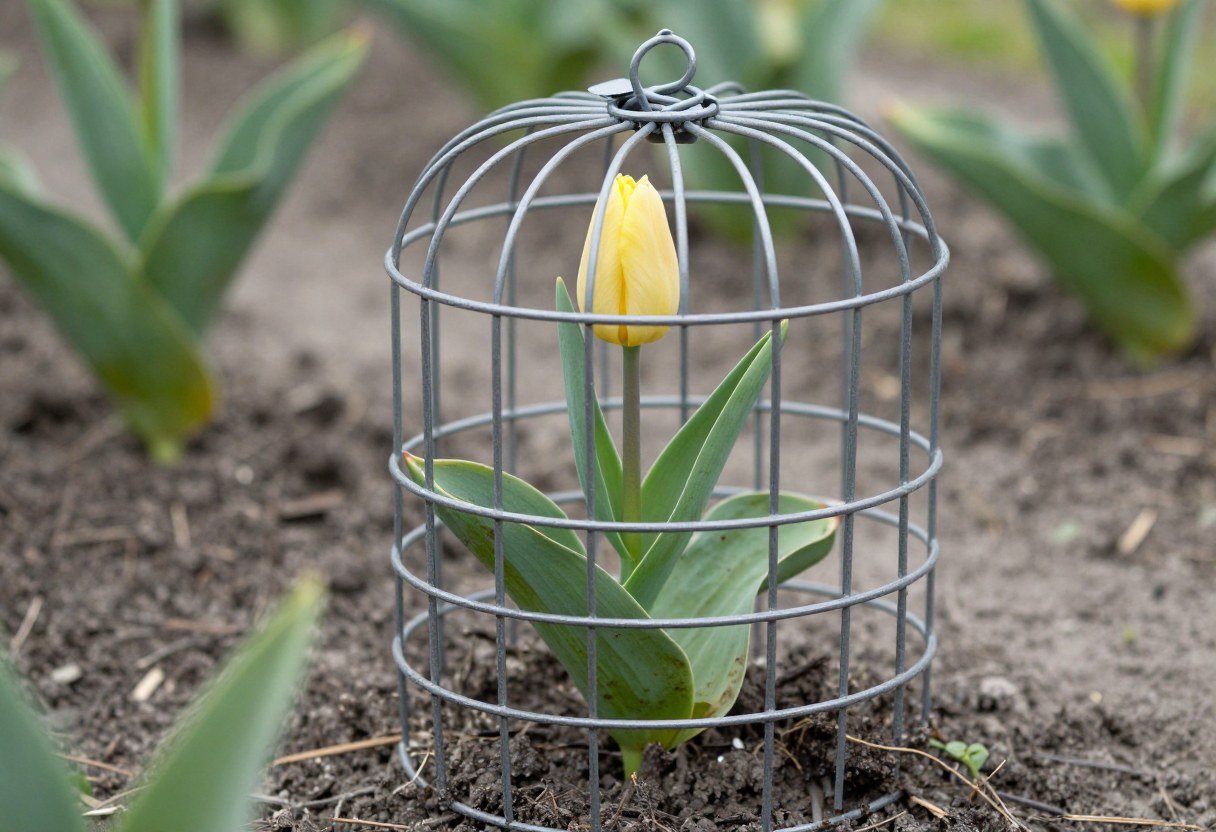
Switch primary bulb planting to daffodils and narcissus (toxic to rabbits; reliably avoided); use alliums for color accent; protect any remaining tulips with hardware cloth cages
Replanting tulips in the same location and spraying repellent, then being surprised when the tulips are eaten again
Young tree bark girdled in winter
Install hardware cloth cylinder around all vulnerable trees in fall, extending above expected snow depth; apply repellent to bark above the guard; for trees already girdled, consult a local arborist — bridge grafting may save a girdled tree if caught early
Waiting until you see damage in spring to install guards
Vegetable garden decimated each spring
Install permanent hardware cloth perimeter fence with L-footer before spring planting; this solves the problem permanently; repellent alone will fail
Repeatedly trying new repellent products instead of installing a fence
Repellents stop working after a few weeks
Implement the rotation strategy (alternate between products with different modes of action on a 3- to 4-week schedule); combine with habitat modification and resistant plant design
Applying the same product repeatedly and being surprised by habituation
Rabbits entering raised beds
If raised bed is under 24 inches: add a simple hardware cloth frame over the bed. For beds 24 inches and taller with straight vertical sides: ensure no footing allows jumping to the bed edge.
Assuming a 12- to 18-inch raised bed is rabbit-proof
Nest of baby rabbits found in the garden
Leave it alone. The doe returns at dawn and dusk to nurse. Kits are independent at 4–5 weeks. Mark the nest with a stick and mow/garden around it until the kits depart.
Removing or disturbing the nest; handling the kits (the doe may abandon them if they smell strongly of human scent)
🌱
The Single Most Effective Investment in Rabbit Management: If you can only do one thing, fence your vegetable garden with hardware cloth. A properly installed fence — 1/2-inch mesh, 24 inches tall, buried 6 inches with an outward L-footer — provides reliable, long-term protection. It does not habituate. It does not wash off in rain. It works when the rabbit is hungry. It works in January and in June. The cost for a 4×8-foot vegetable garden fence is approximately $25 to $40 — less than a single season of repellent spray — and it continues working for 15 to 20 years. Fence first. Plant smart. Protect what matters. Enjoy the rest.
Section 9: Seasonal Strategy Calendar
Rabbit pressure is not constant through the year — it peaks in spring (when new plantings coincide with peak hunger and breeding activity) and again in winter (when bark becomes a critical food source and snow elevates reach). Matching your protection efforts to the season makes management far more efficient than applying the same level of effort year-round.
Season / Timing
Rabbit Activity
Garden Vulnerability
Priority Actions
Regional Notes
Late Winter / Early Spring (February–March in most regions)
Rabbits are hungry; overwintering food scarce; breeding begins; highly motivated to find new food sources
Bark of young trees and shrubs extremely vulnerable when snow cover is still present; emerging bulb shoots; early transplants
Inspect and repair all tree guards and fencing installed last fall. Apply repellent sprays to any woody plants not protected with hardware cloth. Do NOT plant vulnerable annuals yet.
Zone 3–4: Rabbits still standing on snow and reaching bark higher than summer guards cover; check that guards extend above current snow depth. Zone 7+: Breeding already underway; kits may be present by late February.
Spring (March–May in most regions)
Peak breeding activity; does raising kits; juveniles emerging from nests and learning to forage; high garden activity
Maximum vulnerability: new transplants, emerging bulb foliage, seedlings, and all tender new growth are being planted exactly when rabbit pressure is highest
Install vegetable garden fencing BEFORE transplanting. Use wire cages on all new perennial transplants. Apply repellent immediately after planting any vulnerable annuals. Plant alliums and daffodils among vulnerable bulb companions.
The spring planting period (April–May in Zones 5–6; March–April in Zones 7–8; May–June in Zones 3–4) is when the most rabbit damage occurs because it coincides with peak hunger and peak new planting vulnerability simultaneously.
Late Spring / Early Summer (May–June)
Population at peak (multiple litters present); juveniles independent and foraging actively; food becoming more abundant as plants mature
Strawberries and early vegetables; some annual planting continues; young trees still vulnerable
Install strawberry protection (wire frame or low fence). Continue reapplying repellents on a 10–14 day schedule. If trapping, this is an effective period — but check for nursing does before relocating.
Juvenile rabbits in spring and early summer are the most reckless foragers; they have not yet learned which plants to avoid and will sample almost anything — including plants that adult rabbits normally ignore.
Summer (June–August)
Food generally abundant; damage typically less severe than spring and winter; population stabilizes; second and third litters possible
Ongoing vegetable garden; some continued annual damage but typically manageable with existing strategies
Maintain fencing; touch up repellent as needed after rain. Evaluate what management worked this year and what needs adjustment. Begin planning fall bulb protection.
Summer is the best season for habitat modification projects (deck skirt installation, brush removal) while work is comfortable and rabbit pressure is at its annual low.
Fall (September–November)
Rabbits preparing for winter; actively foraging to maintain body condition; beginning to use bark as food source as temperatures drop
Fall-planted bulbs (tulips especially) are extremely vulnerable immediately after planting; perennial transplants; bark of young woody plants
Install or reinstall tree guards on ALL woody plants under 4–5 years old BEFORE ground freezes. Plant vulnerable bulbs with hardware cloth baskets or protective cages. Ensure fencing is intact before winter.
Fall bulb planting is a critical period: freshly planted tulip bulbs are attractive to rabbits (and squirrels) before they establish. Hardware cloth baskets are the most reliable protection.
Winter (December–February)
Rabbits under maximum food stress; willing to eat plants they would ignore in other seasons; standing on snow to reach bark above summer browse height
Young tree and shrub bark; evergreen and semi-evergreen foliage; the garden is at maximum risk for bark girdling
Check tree guards monthly; ensure guards extend above current snow level (add extensions if needed). Apply fresh repellent on woody plants where guards are not in place. Inspect perimeter fencing for gaps created by frost heaving.
In Zone 3–4 states with consistent snow: the most severe rabbit damage of the year occurs in February and early March as snow depth is at maximum and food is at minimum. Do not wait until you see damage to act.
📅
The two most critical calendar dates for rabbit management: (1) the date you install your vegetable garden fence — it must go in BEFORE you plant, not after the first damage; and (2) the date you install tree guards in fall — they must be in place BEFORE the first hard frost and snow, not after you find girdled bark in February. Both mistakes are extremely common and entirely preventable.
Section 8: Garden Design for Rabbit Resistance
The most powerful long-term rabbit management strategy is designing the garden itself to minimize vulnerability. A garden that is 80 to 90 percent composed of rabbit-resistant plants, with targeted physical protection for the vulnerable 10 to 20 percent, requires dramatically less ongoing management than one where every plant needs protection.
The Layered Defense Garden Design
A layered defense approach uses the garden's own structure to reduce rabbit incursions, reserves physical fencing for the highest-priority areas, and uses resistant plants as the visual backbone — so that even if a rabbit does enter, most of what it encounters gives it little reason to return.
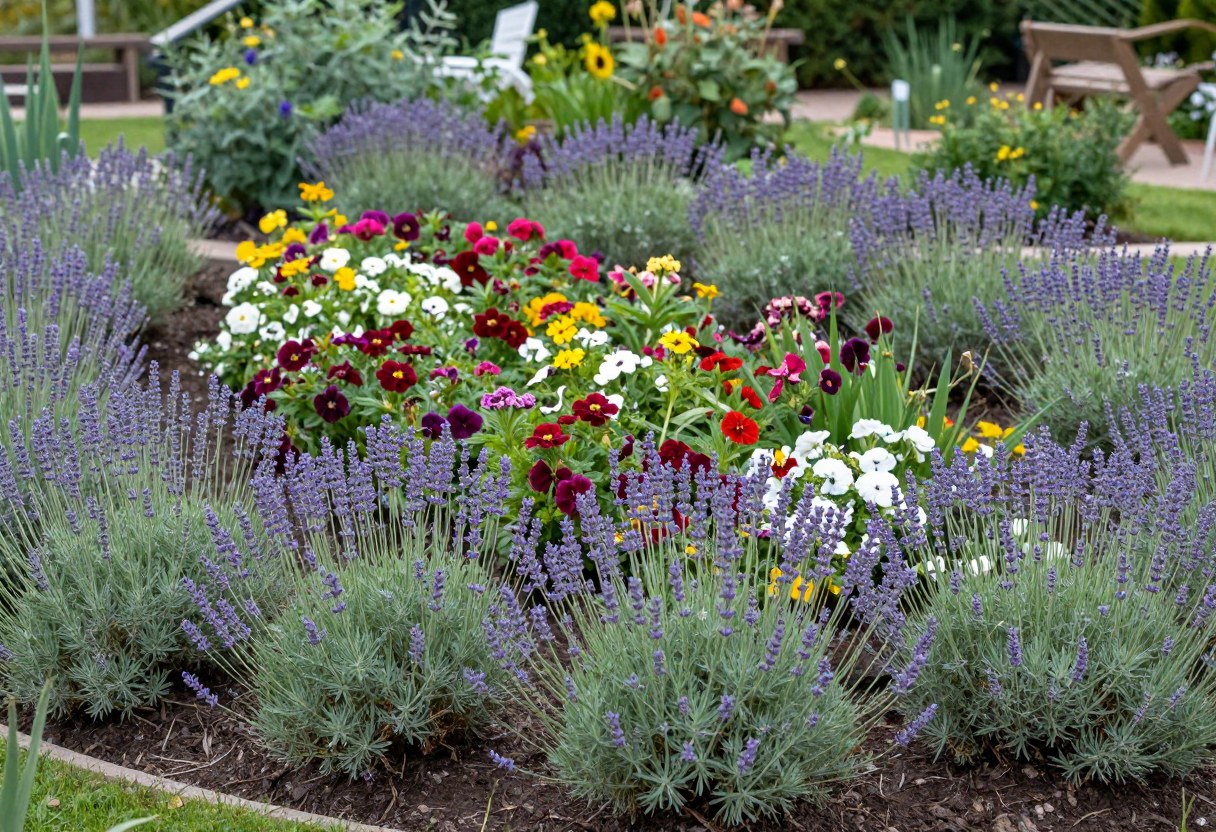
•Perimeter planting with prickly or aromatic shrubs: The garden's outermost layer — the plants nearest the lawn and property edges — should be the most rabbit-resistant: barberry, holly, boxwood, or strongly aromatic shrubs like lavender, rosemary, and Russian sage. A dense planting of these at the garden's perimeter creates a deterrent barrier that does not rely on fencing or chemicals.
•Middle layer of resistant perennials: The body of the ornamental garden filled with catmint, salvia, yarrow, ornamental alliums, coneflower, black-eyed Susan, and ornamental grasses provides year-round beauty while giving rabbits very little that attracts them.
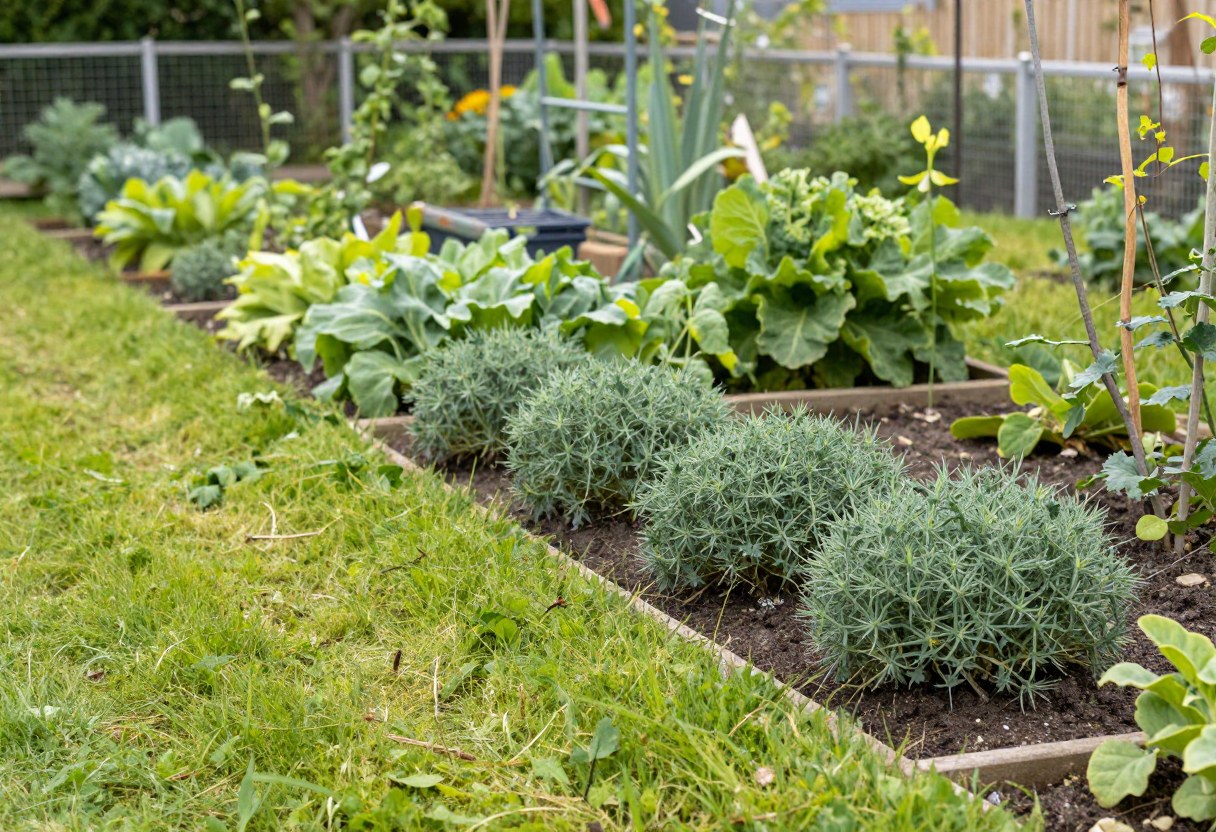
•Protected inner zone: The garden's innermost area — perhaps 20 to 30 percent of the total planting area — contains the plants you love that are not rabbit-resistant: roses, tulips, certain perennials. This inner zone is protected by a simple, unobtrusive hardware cloth fence or individual wire cages.
•Elevated plantings: Window boxes, elevated container gardens, and raised planters at 24 inches or higher place vulnerable plants completely out of reach of cottontail rabbits. A window box of petunias or a hanging basket of impatiens requires no chemical or wire protection.
Raised Beds and Containers
Raised beds and container plantings offer an elegant solution to rabbit pressure in both vegetable and ornamental contexts. A raised bed with solid 24-inch sides is essentially rabbit-proof for cottontails without any additional fencing — the clean vertical walls offer no footing for jumping over.
•Raised bed height: A standard raised bed of 12 to 18 inches is NOT rabbit-proof — cottontails can jump onto and enter these beds easily. For rabbit exclusion, raised beds need to be 24 inches or higher. Alternatively, standard-height raised beds can be covered with a simple hardware cloth frame or row cover.
•Hardware cloth liner: For additional security against burrowing and against rabbits that might enter through soil edges at grade level, line the inside of the raised bed frame with hardware cloth before filling with soil. A U-shaped liner of 1/2-inch hardware cloth secured to the inside of the frame prevents burrowing entry.
•Elevated containers: Containers on legs, tables, or elevated platforms place plants completely out of reach. This approach is ideal for strawberries (which are highly vulnerable), herbs for the kitchen, and small-scale ornamental arrangements.
Companion Planting for Rabbit Deterrence
The companion planting principle for rabbit deterrence is simple: plant strongly aromatic rabbit-resistant plants near or interspersed with vulnerable plants. The aromatic plants mask or overwhelm the attractiveness of the vulnerable plants nearby.
•Alliums as companions: Ornamental alliums, garlic, chives, and ornamental onions planted throughout a garden bed create a persistent onion-garlic scent that rabbits find aversive. Interplanting alliums with tulips is a classic companion planting combination — the tulips gain protection while the alliums provide a second wave of spring color as the tulips fade.
•Lavender borders: A continuous border of lavender along the garden's edge serves simultaneously as an ornamental planting, a pollinator habitat, and a rabbit deterrent. Lavender borders are particularly effective along paths and garden entrances where rabbits commonly enter.
•Catmint edging: A continuous edging of catmint (Nepeta × faassenii) creates a low, aromatic border that is beautiful in bloom and aversive to rabbits throughout the season. Works well along paths and at garden boundaries, and doubles as an excellent companion for roses.
🏡
When planning a new garden in a rabbit-heavy area, budget for the fenced vegetable enclosure before the plants — not after. The most common mistake is installing a beautiful vegetable garden and then scrambling to add rabbit protection after the first wave of damage. Hardware cloth fencing installed before first planting is far easier than retrofitting an established bed, and it works from day one.
A garden built in resistant layers needs dramatically less ongoing management than one where every plant requires its own protection.
Section 7: Humane Trapping, Lethal Control & Legal Considerations
Rabbits in most American states are classified as either game animals or non-protected wildlife. Their management — including trapping and relocation — is regulated by state fish and wildlife agencies, and the rules vary significantly by state. Before trapping or relocating any rabbit, understanding your state's laws is essential.
⚖️
Legal Status — Check Your State Before Trapping: In most US states, cottontail rabbits are classified as game animals. This means: (1) they may be hunted during open hunting seasons with the appropriate license; (2) live trapping for relocation is generally legal without a permit but varies by state; and (3) lethal control methods beyond hunting season may require a depredation permit. Some municipalities and HOAs have local ordinances restricting certain trapping activities. Contact your state's fish and wildlife agency or your local cooperative extension service BEFORE trapping or lethal control to confirm what is legal in your location. This guide provides general information only and is not legal advice.
Humane Live Trapping
Humane live trapping catches rabbits in a wire cage trap without harming them, allowing relocation or other disposition. It is legal in most states for residential use and is the most commonly used active rabbit control method for home gardeners. Its primary limitation is that it reduces the local rabbit population only temporarily — neighboring rabbits will typically occupy vacated territory within a few weeks, making it most valuable as a component of a broader management program.
•Trap selection: Use a wire live trap sized for rabbits — minimum 10 inches × 12 inches × 30 inches (Havahart® Model 1089 or equivalent is the most widely used). The trap should be large enough for the rabbit to turn around inside. Traps smaller than this spec may injure the rabbit when it panics.
•Bait: Rabbits are attracted by fresh apple slices or apple extract; fresh clover, alfalfa, or grass; carrot pieces; and leafy greens. Place bait at the back of the trap, beyond the trigger plate, so the rabbit must fully enter to reach the bait. Adding a few drops of apple extract or vanilla extract to the trap door and trigger area enhances attractiveness.
•Placement: Place the trap along established rabbit runs — the well-worn paths rabbits use regularly along fence lines, at garden entry points, or in areas with concentrated rabbit activity. Cover the trap sides and top with burlap or a dark cloth, leaving only the entrance open. A partially covered trap appears less threatening and catches more rabbits.
•Monitoring: Check the trap at least twice daily — at first light and again by mid-morning. A trapped rabbit in a wire cage in summer heat can die of heat stress within hours. In winter, a wet and cold trapped rabbit faces hypothermia. Never leave a set trap unmonitored overnight in extreme weather.
•Releasing or relocating: Relocation is most successful when the rabbit is moved at least 3 to 5 miles from the capture site to a suitable habitat (open fields with brush cover, wildlife management areas, parks that permit wildlife release). Releasing a rabbit within 1 to 2 miles of the capture site often results in the rabbit returning. Contact your local cooperative extension service or state wildlife agency for recommended release sites.
🐣
Nursing Does and Kits — A Critical Consideration: If you trap a female rabbit in late spring or summer (March through August), there is a significant probability she is a nursing doe with a nest of young (kits) somewhere in the yard. Removing a nursing doe causes the kits to die of starvation within 1 to 3 days. Before relocating any trapped rabbit during breeding season, examine the animal for signs of lactation and search the yard for a nest — a shallow depression in the ground lined with grass and the doe's fur, often in the middle of the lawn or in a planting bed. If kits are found, leave them in place — the doe will return nightly to nurse if the nest is undisturbed. Most cottontail kits are fully independent at 4 to 5 weeks. Do not attempt to raise wild kits at home; the mortality rate in inexperienced care is very high and many states require a wildlife rehabilitation permit.
Other Control Methods
•Exclusion in combination with trapping: The most effective approach combines trapping to reduce immediate population pressure with simultaneous installation of permanent exclusion fencing. Trapping while installing fencing means the fence is completed with fewer rabbits competing to find entry points — giving the new fence a better chance to remain effective before rabbits identify any weak points.
•Lethal control: In most states, landowners may kill rabbits causing damage to property during appropriate seasons or with appropriate permits. Because this guide is focused on humane strategies, and because lethal control faces the same population replacement problem as live trapping, detailed coverage is outside this guide's scope. Your state wildlife agency can provide current legal guidance.
•Professional wildlife management: For properties with very high rabbit pressure or where the gardener prefers not to manage trapping personally, professional wildlife management services operate in most US states. Many local pest control companies offer wildlife management services and can assess the situation, implement trapping programs, and advise on habitat modification.
🪤
Trapping alone is never a permanent solution. Population studies consistently show that neighboring rabbits move into vacated territory within 2 to 6 weeks of removal. Use trapping as a bridge strategy — reduce immediate pressure while you install fencing and transition to more resistant plantings. A trap used without a longer-term plan just creates an ongoing trapping commitment.
Section 6: Habitat Modification — Making Your Property Less Attractive
Rabbits use gardens because gardens provide two things: food and shelter. Removing or reducing available shelter does not eliminate rabbit damage — rabbits will travel some distance from shelter to feed — but it reduces the resident rabbit population in your yard and makes your property less attractive as a permanent home range. A property with excellent shelter near abundant food supports far more rabbits than one with limited shelter.
Eliminating Rabbit Habitat
•Brush pile removal: Brush piles, wood piles, and dense debris accumulations are primary rabbit daytime resting areas (forms). Removing these from near the garden reduces the rabbit population that considers the immediate garden area its home territory. Stack wood away from the garden; chip brush rather than piling it; remove debris accumulations in fall before winter habitat is established.
•Dense ground cover management: Dense, low ground covers (juniper, pachysandra, thick ornamental grasses) provide excellent rabbit shelter. Where ground covers are adjacent to vulnerable gardens, maintain a 3- to 5-foot open zone between the ground cover and the garden. This reduces the shelter-to-food transition distance and makes rabbits more exposed during their garden visits.
•Deck and shed access: Spaces under decks and sheds are highly preferred rabbit nesting and shelter sites. Installing hardware cloth (1/2 inch) along the skirt of decks and sheds, buried 6 inches in the ground, prevents rabbits from establishing residence there. This one action, combined with removing nearby brush, can significantly reduce the local rabbit population.
•Overgrown fence rows and property edges: Dense, weedy growth along fence lines and property edges provides travel corridors and shelter for rabbits. Maintaining a mowed or managed edge along property boundaries reduces rabbit-friendly travel routes into the garden.
•Lawn mowing height: Rabbits prefer short grass for feeding because it provides better visibility of approaching predators. A lawn mowed to 3 to 4 inches is slightly less attractive to rabbits than one mowed to 1 to 2 inches. This is a small effect overall, but it contributes to the habitat modification strategy while also supporting beneficial insects.
Attracting Natural Predators
Rabbits are prey animals with numerous natural predators: hawks, owls, foxes, coyotes, weasels, minks, and domestic cats and dogs. In rural and semi-rural settings, supporting predator populations can provide meaningful rabbit population suppression. In suburban and urban settings, this is less reliable but worth encouraging.
•Raptor perches: Installing a raptor perch — a simple 10- to 14-foot post in an open area near the garden — provides a hunting platform for red-tailed hawks, Cooper's hawks, and American kestrels. These raptors will actively hunt rabbits if they can see them from a perch. Commercial raptor perch kits are available, or a simple 4-inch wooden post works well.
•Owl boxes: Barn owl nest boxes and great horned owl perches can attract owls that are significant rabbit predators, particularly for twilight and nighttime activity. Site owl boxes on the edge of open areas with good hunting visibility.
•Domestic dogs: A dog with access to the yard — particularly one that actively chases rabbits — is one of the most effective practical rabbit deterrents available for residential properties. The scent of a resident dog (from fur, urine, and presence) deters many rabbits from establishing territory in the yard.
•Cats (with caveats): Outdoor cats are known rabbit predators but are also significant predators of native birds, reptiles, and beneficial wildlife. The American Bird Conservancy and wildlife organizations strongly recommend keeping cats indoors to protect native wildlife. This guide does not recommend outdoor cats as a rabbit management tool given the significant collateral wildlife cost.
🦅
Habitat modification is a background strategy — it rarely solves a rabbit problem on its own, but it reduces the baseline rabbit population that other strategies have to manage. Removing brush piles, closing off under-deck access, and installing a raptor perch take an afternoon of work each and continue paying dividends for years. Do these projects in summer when rabbit pressure is at its annual low and the work is most comfortable.
Removing shelter near the garden doesn't eliminate rabbits, but it shrinks the resident population that treats the yard as home territory.
Section 5: Plants Rabbits Love Most — What Needs Protection
Understanding which plants are most vulnerable allows you to focus protection resources where they matter most. Many of the most beloved garden plants are also among the most attractive to rabbits. If you are committed to growing these plants, targeted fencing or individual plant protection is the most reliable approach.
Spring through fall; most severe on seedlings and transplants; beans and peas are particularly preferred
Hardware cloth fencing around entire vegetable garden
The vegetable garden is the most important single area to fence; even a basic hardware cloth perimeter provides excellent protection
Spring bulbs (highly vulnerable)
Tulips (most vulnerable of all bulbs), crocus, muscari (grape hyacinth), lilies (true Lilium spp.), hyacinths, fritillaria
Spring emergence; bulbs may also be dug in fall in some regions
Hardware cloth cages around tulip beds; plant bulbs in hardware cloth baskets; consider replacing with daffodils in high-pressure areas
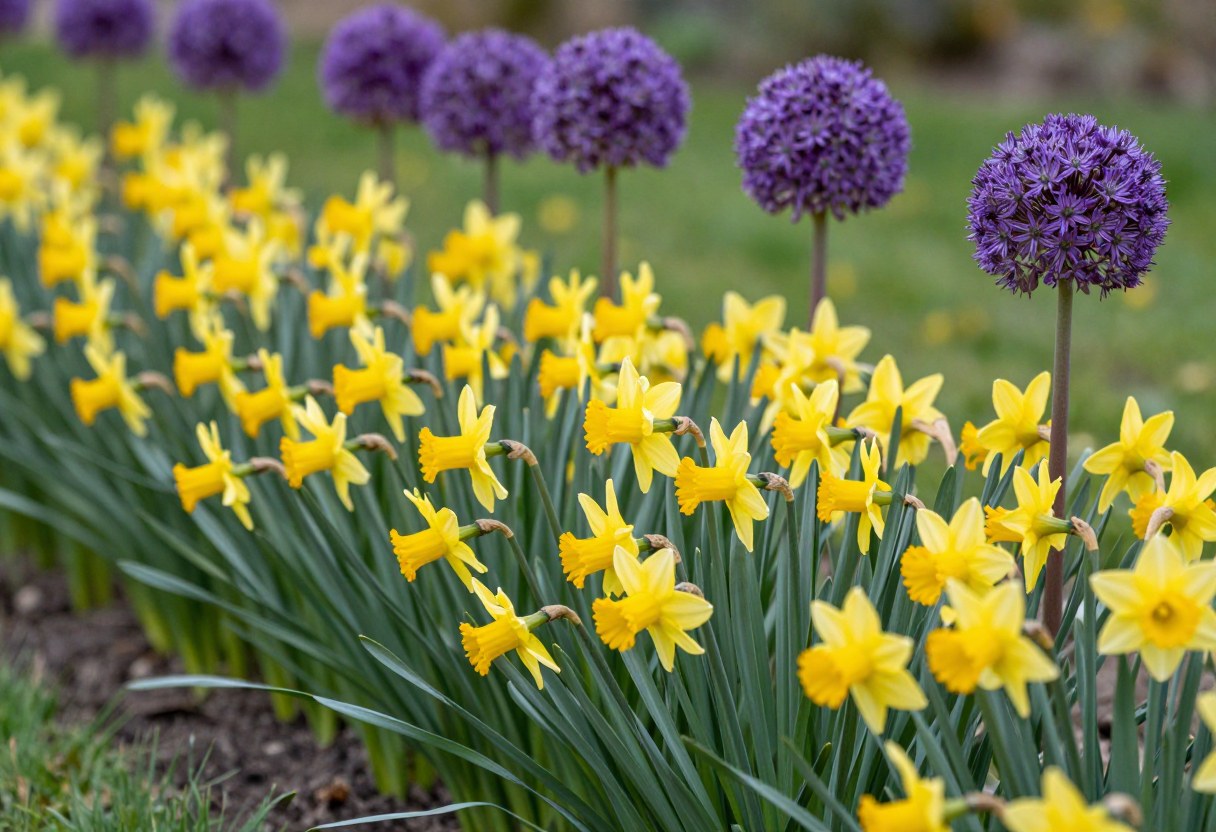
Daffodils and narcissus are TOXIC to rabbits and reliably avoided; replacing tulips with daffodils in rabbit-heavy areas is a common and successful long-term strategy
Spring planting through summer; newly planted annuals most vulnerable
Individual plant wire cages; repellent spray immediately after planting; consider replacing with resistant annuals (salvia, ageratum, cleome)
Newly transplanted annuals are extremely vulnerable in the first 1–2 weeks before they establish; targeted protection at planting time is most critical
Young trees (bark girdling)
Any tree or shrub under 4–5 years old or with bark under 1 inch diameter; most vulnerable: fruit trees, ornamental cherries and crabapples, willows, dogwoods, young maples
Most severe in winter when snow covers the ground and other food is scarce; also spring when rabbits eat new tender bark
Hardware cloth tree guards installed in fall; extend above expected snow depth in cold climates; leave in place until bark is thick enough to resist browsing (usually 3–5 years)
Bark girdling — chewing a complete ring around the trunk — kills the tree by severing the phloem layer. This is the most serious rabbit damage possible and is very difficult to reverse once it occurs.
Roses (canes)
All rose types; hybrid teas and climbers most vulnerable; canes up to 1/2 inch diameter are preferred
Fall through spring; winter cane damage is common in cold regions when canes are accessible above the snow
Hardware cloth cylinder around rose bushes; remove cylinder in spring after growth begins; reapply in fall
Established, large rose shrubs may sustain some browsing and recover; young roses and hybrid teas require reliable protection
Herbs (culinary and ornamental)
Parsley (most vulnerable), cilantro, basil, arugula, dill; also young thyme and marjoram plants
Spring through fall
Individual plant wire cages; row cover over herb plantings; locate herbs within fenced vegetable garden area
Established lavender, rosemary, and thyme are typically avoided; it is the young, tender herbs that are most at risk
Strawberries
All strawberry varieties; flowers and young fruit particularly preferred
Spring (flowers) and early summer (fruit)
Hardware cloth cage over strawberry beds; low fence around strawberry patch
A simple 12-inch hardware cloth fence over a strawberry patch excludes rabbits entirely; without protection, rabbit damage on strawberries can be nearly total
Young perennials in their first season
Hostas (especially newly planted), daylilies as new transplants, astilbe newly planted, many perennials before they build up root systems
Spring planting season; spring emergence
Wire cages or cylinders around new transplants; remove after first full growing season when plants are established and larger
Most perennials are less vulnerable after their first year; the protection investment at planting time yields long-term benefits
🌷
The Tulip-to-Daffodil Swap: If tulips are disappearing every spring despite repellent applications, the most reliable fix is not a better spray — it is replacing most tulip plantings with daffodils and narcissus (which are toxic to rabbits and reliably avoided) and using ornamental alliums for spring color accent. This one plant substitution eliminates the most frustrating recurring rabbit problem for many gardeners permanently.
A simple wire cylinder around the most vulnerable plants costs almost nothing and never habituates the way sprays do.
Section 4: Rabbit-Resistant Plants — Build a Garden Rabbits Ignore
The most elegant and sustainable rabbit management strategy is designing a garden composed primarily of plants that rabbits find unattractive. This does not mean a garden without flowers, without interesting texture, or without beauty — it means choosing the version of what you want that happens to be rabbit-resistant, and protecting the specific plants that are not resistant with targeted physical barriers.
Rabbit-resistant plants share a few common traits: strong fragrance (aromatic oils that rabbits find aversive, like lavender, rosemary, and catmint); toxic compounds (plants containing alkaloids or glycosides that rabbits have learned to avoid, like foxglove, daffodil, and monkshood); tough, coarse, or hairy textures that are unappealing to chew (lamb's ear, ornamental grasses, coneflower); or significant thorns or spines.
Rabbit-Resistant Perennials, Annuals & Bulbs
Plant
Type
Zones
Why Rabbits Avoid It
Garden Use
Lavender (Lavandula spp.)
Perennial subshrub
5–9
Intensely aromatic; high volatile oil content that rabbits find aversive
Borders, paths, herb gardens; extraordinary fragrance and beauty
Catmint (Nepeta spp.)
Hardy perennial
3–8
Strongly aromatic; nepetalactone content is aversive to most herbivores
Edging, borders, ground cover; long blue-purple bloom season; excellent with roses
Iris compounds are toxic and aversive to rabbits and deer
Elegant late spring bloom; fine-textured foliage; thrives in moist areas
Wisteria (Wisteria spp.)
Woody vine
4–9
Contains wisterin (a toxic glycoside); rabbits avoid
Arbors, pergolas, walls; spectacular spring bloom
Rabbit-Resistant Trees & Shrubs
Plant
Zones
Why Resistant
Notes
Barberry (Berberis spp.)
4–8
Sharp spines make browsing painful and impractical; berberine compounds are aversive
Note: Japanese barberry (B. thunbergii) is invasive in many eastern states; check your state's invasive species list before planting and choose native or non-invasive alternatives
Holly (Ilex spp.)
3–9 (varies)
Spine-tipped leaves are physically deterrent; several native species available across all regions
Many native holly species (I. opaca — American holly; I. glabra — inkberry; I. verticillata — winterberry) provide wildlife value while being largely rabbit-resistant
Boxwood (Buxus spp.)
4–9
Contains alkaloids including buxine; rabbits generally avoid
Standard hedge and border plant; excellent low-maintenance option where rabbits are a concern
Lilac (Syringa vulgaris)
2–7
Woody structure; aromatic foliage; generally not browsed once established
Established lilac shrubs are not typically damaged; protect young plants in first 1–2 years while bark is still thin
Spirea (Spiraea spp.)
3–8
Woody stems; generally avoided; native spirea species are excellent alternatives to non-native ornamentals
S. alba (native) and S. tomentosa (native) are excellent wildlife-value alternatives to non-native spireas
Potentilla (Dasiphora fruticosa)
2–7
Generally avoided; tough woody stems and foliage; excellent native-range shrub for northern gardens
Outstanding cold-hardy shrub for Zone 3–5 gardens where rabbit pressure is high; long summer bloom
Butterfly Bush (Buddleja spp.)
4–9
Aromatic foliage; some alkaloid content; generally avoided
Note: B. davidii is invasive in the Pacific Northwest and some other regions; seek non-invasive cultivars or native alternatives
Russian Olive (Elaeagnus angustifolia)
2–8
Sharp thorns; strongly aromatic silver foliage
Invasive in some western states; check before planting
🌿
A Note on "Rabbit-Proof" Claims: No plant is completely rabbit-proof under all conditions. Even the most strongly repellent or toxic plants may be damaged in early spring when very young, in winter when food is critically scarce, or by juvenile rabbits that have not yet learned which plants to avoid. "Rabbit-resistant" is the more accurate term. The best approach: use resistant plants as the backbone of the garden (roughly 80%) and protect the vulnerable 20% — tulips, most vegetables, young trees — with targeted physical barriers.
Daffodils are toxic to rabbits and reliably ignored — swapping them in for tulips is the single most effective plant substitution in this guide.
Section 3: Repellents — What Works, What Doesn't, and Why
Repellents are the most widely purchased rabbit management product and among the least reliable as a standalone strategy. They work by making plants smell or taste unpleasant to rabbits, or by triggering a fear response through predator scents. Under conditions of moderate rabbit pressure and abundant alternative food, repellents can reduce garden visits. Under high rabbit pressure or scarce food — particularly in winter and early spring — rabbits' hunger typically overwhelms their aversion.
How Repellents Work (and Why They Fail)
•Olfactory repellents (scent-based): Products containing putrescent whole egg solids, garlic, or predator urine trigger the rabbit's fear response or disgust through smell. These can be effective for 1 to 3 weeks when first applied, but rabbits habituate (become accustomed) to persistent scents over time. Effectiveness also degrades rapidly with rain, irrigation, and temperature fluctuations.
•Taste repellents: Products containing hot pepper extracts (capsaicin) or denatonium benzoate are applied to plant surfaces. They are ineffective when rain washes them off, and rabbits learn to eat the untreated newer growth that appears after application.
•The habituation problem: A rabbit in a garden treated uniformly will test treated plants repeatedly, and when driven by hunger will begin eating them despite the aversion. Once a rabbit has habituated to a specific repellent, switching to a different product with a different chemical mode of action can restore effectiveness temporarily.
•The rain problem: Most repellents require reapplication every 7 to 14 days and after every significant rain event. In wet regions (Pacific Northwest, Southeast, New England) or during rainy spring seasons, maintaining effective repellent coverage is both labor-intensive and expensive.
Repellent Products: A Comparative Reference
Product / Type
Active Ingredients
Effectiveness
Reapplication Frequency
Best Use Case
Plantskydd® (powder and liquid)
Dried porcine (pig) blood; strong predator-fear response in prey animals
Good–Very good; one of the most consistently effective commercial repellents in research trials
Every 3–4 weeks (longer rain-free interval than most liquid products; dry formula adheres better)
Ornamental beds and borders; perennials and shrubs; winter bark protection on young trees. Very unpleasant smell when first applied.
Liquid Fence®
Putrescent whole egg solids, garlic oil
Good when freshly applied; decreases significantly with rain and habituation
Every 1–2 weeks; after rain
Supplemental deterrent when used with other methods; moderate-pressure situations
Coyote, fox, bobcat, or mountain lion urine; some products use synthetic predator scent compounds
Variable; often effective initially; habituation develops quickly as prey animals realize no predator is actually present
Every 1–2 weeks; more frequently in wet conditions
Short-term deterrence while other methods are implemented; not a standalone long-term solution
Hot pepper / capsaicin sprays
Capsaicin extract; ground hot pepper
Low–moderate; washes off immediately in rain; rabbits may not taste before biting off tender stems entirely
After every rain; every 7–10 days
Very limited effectiveness for determined rabbits; may reduce casual browsing
Irish Spring soap / human hair / home remedies
Odors from human presence, soap fragrance, or predator scent
Low; anecdotal effectiveness; most gardeners find these ineffective beyond 1–2 weeks
Continuous (soap) or frequent (hair)
Very low-cost supplements to other methods; not reliable as primary management
Bone meal / blood meal (as deterrent)
Dried blood; bone
Low; primarily soil amendments; the scent may temporarily deter rabbits but effectiveness is limited and inconsistent
After rain; when applied as surface treatment
The fertilizer benefit may be worth applying regardless of deterrent effect; do not rely on these for rabbit management
Motion-activated sprinkler (Scarecrow® and similar)
Sudden motion + noise + water spray; triggers flight response
Good–Very good when first deployed; habituation occurs in 2–4 weeks; very effective in low-pressure situations
No reapplication; battery or water pressure dependent; relocate every 2–3 weeks to prevent habituation
Entry points to gardens; areas where fencing is impractical; works best combined with repellent sprays at the perimeter
🔄
The Rotation Strategy — Preventing Repellent Habituation: The most effective repellent program alternates between products with different modes of action on a 3- to 4-week schedule. A typical rotation: Weeks 1–3: blood-meal-based product (Plantskydd). Weeks 4–6: egg-and-garlic product (Liquid Fence). Weeks 7–9: predator urine product. Weeks 10–12: capsaicin product. Habituation is compound-specific — a rabbit habituated to putrescent egg has not habituated to dried blood, and vice versa. The rotation strategy works best in moderate-pressure situations; in high-pressure situations with limited food alternatives, even rotated repellents will eventually be overcome by hunger.
Section 2: Physical Exclusion — Fencing That Actually Works
Physical exclusion — preventing rabbits from reaching vulnerable plants with barriers — is the most reliable rabbit management strategy available. A correctly installed fence solves the problem completely for the area it encloses: it does not require reapplication, it does not habituate, it does not wash off in rain, and it works regardless of how hungry the rabbit is. The two most common reasons fencing fails are incorrect height and improper burial at the base.
The Hardware Cloth Fence: The Gold Standard
Hardware cloth — a welded wire mesh typically sold in 1/4-inch or 1/2-inch opening sizes — is the most reliable material for rabbit exclusion fencing. Chicken wire (hexagonal woven wire) is cheaper but stretches, sags, and eventually develops gaps that rabbits find and exploit. Hardware cloth holds its form, resists deformation, and provides the precise opening control needed to exclude rabbits of all sizes.
Specification
Cottontail Rabbits
Jackrabbits
Notes
Mesh opening
1/2 inch maximum
1/2 inch maximum
Young cottontails (leverets) can squeeze through 1-inch mesh; 1/2-inch mesh excludes all ages and sizes
Height above ground
18–24 inches minimum
30–36 inches minimum
Taller is always better; 24 inches is a comfortable standard for cottontails in most situations; do not cut corners on height
Burial depth
6 inches minimum below grade, bent outward 6 inches horizontally at the base (forming an "L")
6 inches minimum
This "L-Footer" configuration prevents rabbits from digging under the fence. Without burial, a persistent rabbit will eventually dig underneath even a tall fence.
Post spacing
Every 4–5 feet
Every 3–4 feet (jackrabbits apply more pressure)
U-shaped garden staples every 12–18 inches along the base secure the fence to the ground and prevent gaps
Gate specification
Hardware cloth secured to a rigid frame; tight seal at the base; self-closing hinges recommended
Same, plus extra height if needed
Gates are the most common failure point in exclusion fencing. A gate with a gap at the base undermines the entire fence.
The L-Footer: The Most Important Installation Detail
The L-footer — bending the bottom 6 to 12 inches of the fence outward horizontally before burial — is the most critical anti-dig feature of rabbit exclusion fencing. When a rabbit attempts to dig under the fence, it encounters the buried horizontal portion extending outward. Its instinct is to dig straight down at the fence base rather than back and away, so the L-footer stops the attempt without requiring a very deep vertical burial.
•Excavate a shallow trench: Dig a 6-inch-deep trench along the fence line.
•Roll out hardware cloth: Stand the hardware cloth vertically and unroll it along the fence line, with the bottom 6 to 12 inches folded outward at a 90-degree angle (the horizontal part of the L).
•Bury the horizontal portion: Lay the horizontal portion of the L flat in the trench, oriented away from the garden (toward the rabbit's approach). Backfill the trench.
•Attach to posts: Drive posts at 4- to 5-foot intervals and attach the vertical portion of the fence with hog rings, zip ties, or fence staples.
•Secure at the base: Push U-shaped garden staples through the bottom of the vertical section every 12 to 18 inches to pin the fence tight to the ground.
⚠️
The Single Most Common Fence Failure: The most common reason a rabbit fence fails is a gap at the gate, at a corner, or at the base where the fence has lifted from the soil. Rabbits are patient and methodical — they will test the fence line repeatedly and find any gap within days of its appearance. Walk your fence perimeter monthly and after any heavy rain or frost heaving. A fence that is 99% intact with one 4-inch gap is effectively no fence at all for a persistent rabbit. It will find the gap.
Individual Plant Protection
When enclosing an entire garden with fencing is impractical, individual plant protection — wire cylinders or cages around specific vulnerable plants — is the next best option. This is particularly effective for protecting young trees during their vulnerable first years, newly planted perennials before they establish, and high-value specimens.
•Wire cylinders: Cut a 2- to 3-foot length of hardware cloth and form it into a cylinder around the plant. The cylinder should be 6 to 8 inches larger in diameter than the plant to allow growth and prevent rabbits from reaching through to nibble. Secure the cylinder with a stake driven through it into the ground.
•Tree guards: For young trees and shrubs (bark of trees under 1 inch diameter is particularly vulnerable), use a commercial spiral plastic tree guard or a hardware cloth cylinder. In areas with significant snow accumulation, extend the guard 6 to 12 inches above the expected snow depth — rabbits stand on the snow pack and gnaw bark above where the guard ends.
•Raised beds: Raised beds with sides 24 inches or higher are often rabbit-proof simply because of their height — cottontails rarely jump over a straight 24-inch wall with no footing. Add a hardware cloth liner to the sides and base for additional security against burrowing entry.
•Row cover: Floating row cover draped over low-growing vegetable plants provides short-term protection and also protects against insects and frost. Not a permanent solution for aggressive rabbit pressure, but valuable as a temporary measure for newly emerged seedlings.
🔧
For a standard 4×8-foot raised vegetable bed, the cost of hardware cloth fencing is approximately $25 to $40. A modest repellent program over a single season easily exceeds this cost — and the fence continues working for 15 to 20 years without reapplication.
Effective rabbit management requires understanding how rabbits live, what drives their behavior, and how to distinguish their damage from that of other garden pests. A management strategy perfectly suited to eastern cottontail behavior may be less effective for jackrabbits in the Southwest; a fence that stops cottontails may not address the snowshoe hares in a northern garden.
American Rabbit Species: Who's Eating Your Garden
Species
Range
Size
Garden Damage Pattern
Key Management Note
Eastern Cottontail (Sylvilagus floridanus)
All 48 contiguous states — the most widespread and most common garden pest
2–4 lbs; 14–17 inches
Clean, angled 45-degree cuts on stems; 12–18 inch browse height; preference for tender new growth, vegetables, flowering annuals, and bark of young trees in winter
Responds well to all standard management strategies; the primary audience for most of this guide
Desert Cottontail (Sylvilagus audubonii)
Western US: California, Nevada, Arizona, New Mexico, Colorado, Utah, Texas, Oklahoma, western plains
1.5–3 lbs; 12–15 inches
Same clean-cut feeding pattern as eastern cottontail; tends to feed at dawn and dusk; may be active year-round in warm desert climates
Desert-adapted plants (agave, cacti) are naturally resistant; focus protection on vegetable gardens and non-xeric ornamentals
Brush Rabbit (Sylvilagus bachmani)
Pacific Coast: western Oregon, California
1–2 lbs; 11–14 inches — the smallest North American cottontail
Close-to-cover feeding; seldom ventures far into open gardens; more targeted damage near brush edges
Maintaining a clear, open zone between brush and garden reduces incursions; low fences may be adequate
New England Cottontail (Sylvilagus transitionalis)
New England, NY, PA; declining range; conservation concern in several states
2–3 lbs; similar to eastern cottontail
Similar to eastern cottontail; focus in gardens near dense shrubby habitat
Less abundant in most gardens than eastern cottontail; same management applies
Black-tailed Jackrabbit (Lepus californicus)
Western US and Great Plains: California, Nevada, Arizona, New Mexico, Colorado, Kansas, Oklahoma, Texas, Oregon
4–8 lbs; 18–25 inches — MUCH larger than cottontails
Heavier feeding than cottontails; can reach higher on plants (24–30 inches); more mobile and wide-ranging; eats grasses, forbs, cacti, shrubs
Standard cottontail fences (18–24 inches) are NOT adequate for jackrabbits; requires 30–36 inch hardware cloth or additional electric wire at the top
Winter bark girdling is a serious threat to young trees when snow provides elevated access; summer damage similar to cottontail
Winter tree protection must account for snow depth — extend hardware cloth guards well above expected snow level; apply guards in fall before first snow
Understanding Rabbit Behavior
•Feeding patterns: Rabbits are crepuscular — most active at dawn and dusk, with some nighttime activity. Peak damage occurs in early morning. In winter in cold climates, activity concentrates around midday when temperatures are slightly warmer.
•Territory and range: A single cottontail's home range is typically 1 to 4 acres. However, a single yard can support multiple rabbits with overlapping ranges. Once a rabbit has established a regular feeding route through your garden, it will return consistently.
•Shelter requirements: Rabbits rest in "forms" — shallow depressions in dense vegetation, or in borrowed burrows (they do not dig their own). Dense ornamental grasses, brush piles, thick ground covers, and spaces under decks and sheds are preferred. A yard providing excellent shelter near food will have a higher rabbit population.
•Water needs: Rabbits get most of their water from the plants they eat; they do not need a standing water source, which means removing water does not reduce rabbit pressure.
•Seasonal patterns: Damage peaks in spring (tender new growth, new transplants) and winter (bark girdling when other food is scarce and snow reduces ground-level food access). Fall planting of tulip bulbs is a high-risk period.
•Breeding: Eastern cottontails breed from February through September in most of the US; up to 6 litters per year with 4 to 7 young per litter. Young rabbits become independent at 4 to 5 weeks. A single pair can produce 20 to 30 offspring in one season. This reproductive rate means that reducing local populations through trapping provides only temporary relief unless other management is implemented simultaneously.
Identifying Rabbit Damage: What to Look For
Rabbit damage has specific, recognizable characteristics that distinguish it from deer damage, insect damage, and other garden problems. Accurate identification before taking action prevents wasted effort managing the wrong pest.
•The 45-degree clean cut: Rabbits have sharp incisors that produce a clean, diagonal cut on stems. This is the most diagnostic sign. Deer lack upper incisors and tear rather than cut stems, leaving a ragged, torn appearance. If the cut is clean and angled, it is a rabbit (or other rodent); if it is ragged and torn, it is deer.
•Browse height: Cottontail damage occurs from ground level to about 18 inches. Jackrabbit damage can reach 24 to 30 inches. Winter damage in snowy climates may appear higher because the rabbit is standing on snow. Deer damage typically occurs from 2 to 6 feet high.
•Preferred targets: Rabbits strongly prefer tender, young growth — seedlings and transplants, new stems, young bark on trees under 1 inch diameter, vegetable crops (especially beans, peas, brassicas, carrots, lettuce), tulips and other spring bulbs, and flowering annuals. They are much less likely to damage established, woody plants unless starvation conditions occur in winter.
•Droppings: Small, round, brown or olive-colored pellets, 1/4 to 3/8 inch diameter; typically found in groups along feeding routes or near shelter. Deer droppings are oval, larger (1/2 to 3/4 inch), and often clustered in irregular piles.
•No slime trails: Unlike slugs, rabbits leave no slime trails. If slime trails are present alongside leaf damage, slugs are the primary cause, not rabbits.
🔍
Before buying any repellent or installing fencing, confirm the pest is actually a rabbit. Check for the clean 45-degree cut at browse height (under 18 inches for cottontails). Treating for rabbits when deer are the real culprit — or vice versa — wastes time and money and leaves the actual pest problem unaddressed.
🌿 Get Seasonal Gardening Tips
New guides, planting reminders, and growing tips — straight to your inbox.
No spam. Unsubscribe anytime.
About the Author
David Rodgers is the Founder & Head Gardener of Planting Atlas. With over 40 years of hands-on gardening experience in Oklahoma's Zone 7 climate, he researches, writes, and personally tests every guide on the site.
David draws from real backyard trials, soil testing, and trusted sources like Oklahoma State University Extension and USDA data to deliver practical, zone-specific advice that actually works.