Collect and Store Rainwater for Free, Sustainable Garden Irrigation
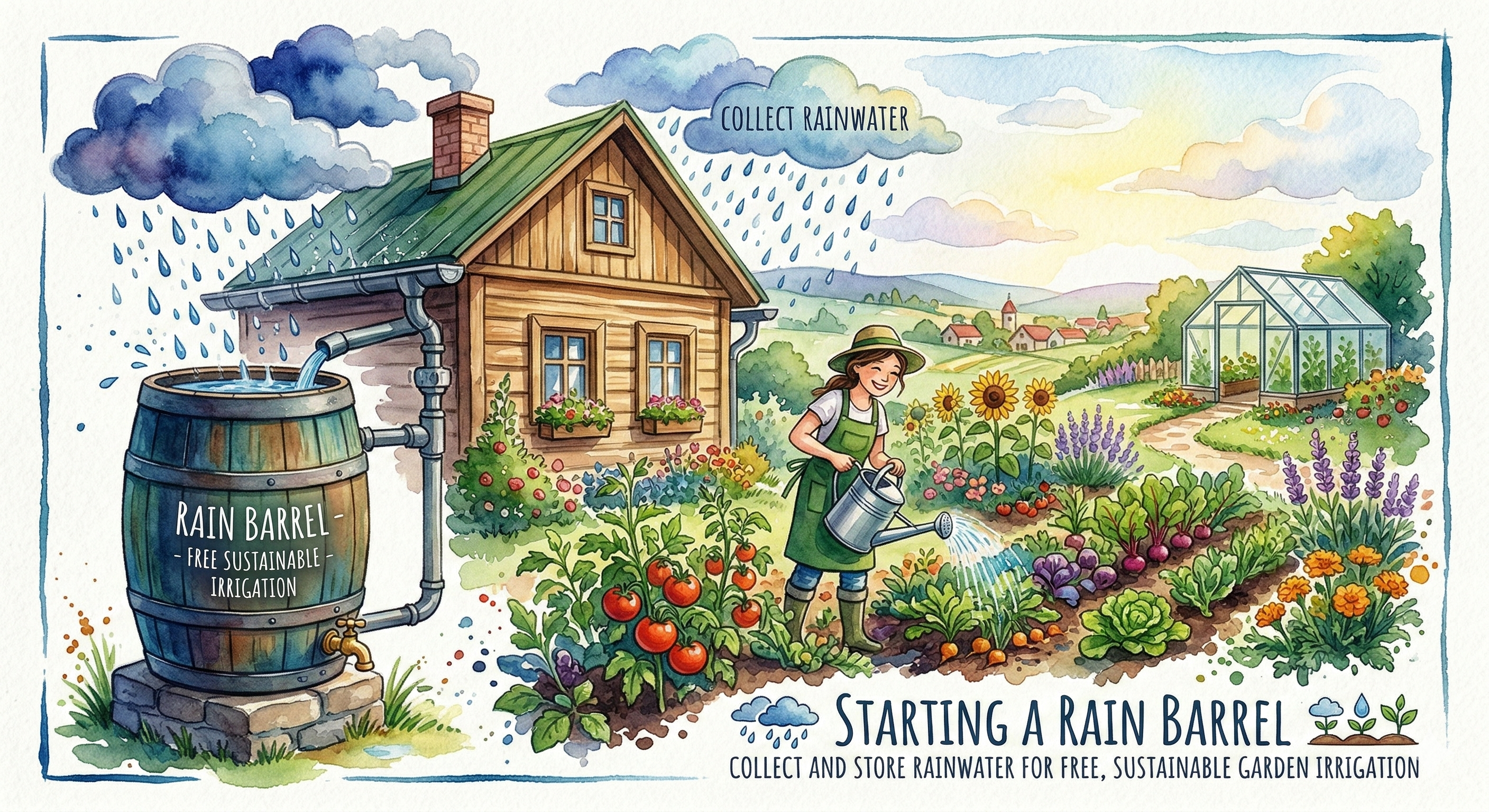
Outdoor irrigation accounts for roughly 30 percent of household water use nationwide — and in arid western states it routinely climbs to 60 to 70 percent during summer. A single rain barrel can offset a meaningful portion of that demand using water that would otherwise run off your roof, pick up pollutants on paved surfaces, overwhelm storm drains, and contribute to downstream flooding and erosion. Collected rainwater is often better for plants than tap water: it is unchlorinated, slightly acidic, and at ambient temperature. This guide covers everything from the legal framework through barrel selection, installation, plumbing, overflow management, water quality, seasonal maintenance, and scaling up to cistern systems.
The math is simple but striking: a 1,000-square-foot roof sheds approximately 600 gallons of water per inch of rainfall. A single 1.5-inch rain event — not unusual anywhere in the United States — produces 900 gallons from that roof alone. A standard 55-gallon rain barrel captures what falls on about 90 square feet of that roof; a pair of linked barrels captures twice as much. A modest cistern system captures thousands of gallons from a single storm.
Rain barrels represent one of the most accessible sustainable home improvements available — they require no special skills, a modest investment of $30 to $200 for a basic setup, and produce tangible, measurable results immediately. They are also a gateway into a broader understanding of how water moves through residential landscapes and how thoughtful design can keep more of that water on-site and working for the garden.
Component
Purpose
Typical Cost
DIY Difficulty
Barrel or tank (55–100 gal)
Primary storage vessel; captures downspout flow
$30–$150 purchased; $15–$30 DIY repurposed
Easy
Downspout diverter or link
Connects the barrel to the existing downspout without permanent modification
$15–$40
Very easy
Spigot / faucet
Low-drain spigot for hose connection; usually included in commercial barrels
Included or $5–$10 additional
Easy
Overflow fitting and hose
Directs excess water away from foundation when barrel is full
$5–$15
Easy
First-flush diverter (optional)
Discards the first, dirtiest flow from the roof before collecting; improves water quality
$20–$50 commercial; $10–$20 DIY PVC
Moderate
Elevated platform or stand
Raises barrel 12–24 inches to create gravity pressure at the spigot; enables gravity irrigation
$20–$60 lumber; $30–$80 commercial stand
Easy–Moderate
Linking hardware (multiple barrels)
Overflow port, connecting hose, and fittings to chain barrels together
$10–$25 per additional barrel connection
Moderate
Mosquito screen / sealed lid
Prevents mosquito breeding; keeps debris out of stored water
Usually included; screen repair $5–$10
Easy
💧
Many water utilities, municipalities, and state agencies offer rebates for installing rain barrels — cash payments per barrel, subsidized barrel programs, or discounts through one-day distribution events. Search your water utility's website for "water conservation rebates" or "outdoor water rebates" before purchasing anything.
A single rain event can fill a standard 55-gallon barrel from a fraction of an average roof — the math behind rain barrels is more dramatic than it first appears.
Section 1: The Legal Landscape — State Laws, Restrictions & Rebates
Rainwater collection law in the United States is a patchwork of state-by-state regulation that reflects the very different water law traditions of the eastern and western halves of the country. In most of the East, rainwater collection is unregulated and often encouraged. In some western states, it has historically been prohibited or restricted under prior appropriation water law — though this is changing rapidly as drought concerns drive policy reform. Before installing a rain barrel system, it is your responsibility to understand your state's current regulations.
The Water Law Divide: East vs. West
Eastern water law is generally based on riparian rights — the principle that landowners have the right to use water that flows through their property. In this framework, collecting rainwater that falls on your roof is simply using water already on your property and is unrestricted in most eastern states. Western water law is generally based on prior appropriation — the principle that water rights are established by historical use and belong to specific rights-holders rather than to the landowner. Under strict prior appropriation doctrine, rainwater falling on your property was historically considered part of a stream's water supply and "belonged" to downstream water rights holders. This doctrine led several western states to prohibit or severely restrict residential rainwater collection for much of the 20th century. However, the ongoing western drought crisis has driven significant legislative reform since the early 2000s, and most western states now permit residential rainwater collection with varying limits.
⚠️
Laws Change — Always Verify. The information below reflects the general regulatory status of rainwater collection as of 2024–2025. State laws and regulations change frequently, and local municipalities may have additional rules or incentives beyond state law. Always verify current regulations with your state's department of natural resources, environmental quality, or water resources before installing a system. Many state cooperative extension services publish updated rainwater harvesting guides specific to their state.
State / Region
Legal Status
Volume Limits
Permitted Uses
Incentives / Notes
Alabama
Legal, unrestricted
None
All outdoor uses
No specific regulations; encouraged
Alaska
Legal, unrestricted
None
All outdoor uses
Low precipitation concern; no restrictions
Arizona
Legal; regulated
None for residential rooftop collection
Outdoor irrigation; not for drinking without treatment
Actively encouraged; rebates available from many municipal water providers (Tucson Water, Phoenix area utilities)
Arkansas
Legal, unrestricted
None
All outdoor uses
No specific restrictions
California
Legal
None for residential
All non-potable uses; may be used for potable with treatment under certain permits
Strongly encouraged; many local water agencies offer significant rebates ($50–$200+ per barrel or per gallon of capacity)
Colorado
Legal since 2016 (HB16-1005)
Two 110-gallon barrels per household (220 gallons total)
Outdoor irrigation of plants on the property where collected
Significant legal change from historical prohibition; Senate Bill 09-080 amended prior appropriation doctrine; strict volume and use limits apply
Connecticut
Legal, unrestricted
None
All outdoor uses
Several municipalities offer rain barrel sales and rebates
Delaware
Legal, unrestricted
None
All outdoor uses
Encouraged; no restrictions
Florida
Legal
None
Outdoor irrigation; indoor non-potable where permitted by local code
Strongly encouraged; many counties offer rebates; state actively promotes rainwater harvesting
Georgia
Legal
None for rooftop collection
All outdoor uses
Actively encouraged through extension programs; Atlanta-area utilities offer rebates
Hawaii
Legal, unrestricted
None
All uses
Long tradition of rainwater collection; encouraged
Idaho
Legal with permit for larger systems
Small systems typically exempt; contact Idaho IDWR for specifics
Non-potable outdoor irrigation typically permitted
Check with Idaho Department of Water Resources for current rules
Illinois
Legal, unrestricted
None
All outdoor uses
Chicago and other municipalities offer rain barrel programs and rebates
Indiana
Legal, unrestricted
None
All outdoor uses
Encouraged; no restrictions
Iowa
Legal, unrestricted
None
All outdoor uses
No restrictions
Kansas
Legal
Check Kansas DWR for current limits
Outdoor use
Prior appropriation state; check current regulations
Kentucky
Legal, unrestricted
None
All outdoor uses
No restrictions; extension programs promote rainwater harvesting
Louisiana
Legal, unrestricted
None
All outdoor uses
High rainfall state; no restrictions
Maine
Legal, unrestricted
None
All outdoor uses
No restrictions
Maryland
Legal, encouraged
None
All outdoor uses; indoor non-potable in some jurisdictions
Prince George's County and others require stormwater management practices; rain barrels often count toward compliance
Massachusetts
Legal, unrestricted
None
All outdoor uses
Many municipalities offer rain barrel sale programs
Michigan
Legal, unrestricted
None
All outdoor uses
No restrictions; encouraged
Minnesota
Legal, unrestricted
None
All outdoor uses
No restrictions; extension programs support adoption
Mississippi
Legal, unrestricted
None
All outdoor uses
No restrictions
Missouri
Legal, unrestricted
None
All outdoor uses
No restrictions; utility programs may offer rebates
Montana
Legal
2,500 gallons (small system)
Outdoor irrigation
HB 284 (2017) legalized residential collection with volume limits; check current Montana DNRC rules
Nebraska
Legal
Check Nebraska DNR for current rules
Outdoor irrigation
Prior appropriation state; evolving regulations; verify current status
Nevada
Legal
No stated maximum for residential
Outdoor irrigation
Nevada Division of Water Resources encourages residential collection; check local regulations
New Hampshire
Legal, unrestricted
None
All outdoor uses
No restrictions
New Jersey
Legal, unrestricted
None
All outdoor uses
Municipal programs frequently offer subsidized rain barrels
New Mexico
Legal, encouraged
No volume limit for residential rooftop
All outdoor uses; some indoor non-potable permitted
Strong state support; tax deduction available for rainwater harvesting systems
New York
Legal, unrestricted
None
All outdoor uses
Many municipalities offer subsidized rain barrel programs
North Carolina
Legal, unrestricted
None
Outdoor uses; some indoor non-potable permitted by code
Encouraged; many extension programs
North Dakota
Legal; verify current rules
Check North Dakota Dept. of Environmental Quality
Outdoor uses
Verify current rules with state agency
Ohio
Legal, unrestricted
None
All outdoor uses
No restrictions; extension support
Oklahoma
Legal, encouraged
None for residential
All outdoor uses
Actively encouraged; Oklahoma Water Resources Board supports rainwater harvesting
Oregon
Legal
Rooftop collection generally permitted; larger systems may need permit
Outdoor irrigation
Oregon Water Resources Dept. has specific guidance; check current rules for larger systems
Pennsylvania
Legal, unrestricted
None
All outdoor uses
Philadelphia and other cities actively promote and subsidize rain barrels
Rhode Island
Legal, unrestricted
None
All outdoor uses
No restrictions
South Carolina
Legal, unrestricted
None
All outdoor uses
No restrictions
South Dakota
Legal; verify current rules
Check South Dakota DANR for current status
Outdoor uses
Check South Dakota DANR for current status
Tennessee
Legal, unrestricted
None
All outdoor uses
No restrictions; extension programs support adoption
Texas
Legal, encouraged
No volume limit for residential rooftop
All outdoor uses; some indoor non-potable permitted
One of the strongest state frameworks in the US; tax exemption on equipment; HOAs cannot prohibit rain barrels under state law; many utilities offer rebates
Utah
Legal since 2010
2 barrels / 200 gallons per household
Outdoor irrigation of garden on same property
Utah code 73-3-1.5; prior appropriation state with specific residential exemption; volume limits strictly apply
Vermont
Legal, unrestricted
None
All outdoor uses
No restrictions
Virginia
Legal, encouraged
None
All outdoor uses; some indoor non-potable
Northern Virginia and others offer rebates; Fairfax Water has active programs
Washington
Legal
Rooftop collection generally permitted; check Ecology Dept. for larger systems
Outdoor irrigation; some indoor uses with proper permits
Washington Dept. of Ecology has specific guidance; residential rooftop collection encouraged
West Virginia
Legal, unrestricted
None
All outdoor uses
No restrictions
Wisconsin
Legal, unrestricted
None
All outdoor uses
Madison and other cities offer subsidized programs
Wyoming
Legal
Check Wyoming State Engineer for current rules
Outdoor uses
Prior appropriation state; verify current residential provisions
Rebates, Incentives & Subsidized Programs
In addition to state law, many local water utilities, municipalities, and regional water authorities offer financial incentives to encourage residential rainwater collection. These programs vary enormously by location and change frequently, but can dramatically reduce the cost of installation.
•Cash rebates: Many utilities offer cash rebates per barrel installed (often $50–$100) or per gallon of storage capacity added. Southern California water agencies, Tucson Water, Denver Water, and many Texas water utilities have active rebate programs. Check your water utility's conservation program website first.
•Subsidized or free barrel programs: Many municipalities partner with local suppliers to offer rain barrels at a steep discount (often $20–$40 for a barrel that retails for $80–$120) through a one-day distribution event or ongoing program. Search "[your city] rain barrel program" to find current offerings.
•Tax incentives: New Mexico offers a tax deduction for qualified rainwater harvesting systems. Texas exempts rainwater harvesting equipment from sales tax. Oregon has offered tax credits for larger systems. Check your state revenue department for current programs.
•HOA protections: Several states including Texas, California, Colorado, and Florida have passed laws preventing HOAs from prohibiting rainwater collection systems. If you live in an HOA, check your state's current law before assuming a prohibition is enforceable.
💧
To find local programs, search your water utility's website for "water conservation rebates" or "outdoor water rebates"; your state extension service's rainwater harvesting page; your state environmental quality agency's website; and the EPA WaterSense program website for links to local utility programs.
Section 2: How Much Water Can You Collect?
Understanding your potential collection volume is the foundation of system design. It tells you how large your storage needs to be, whether a single barrel is sufficient or whether a cistern is warranted, and how much of your garden irrigation need can realistically be offset by harvested rainwater.
The Collection Formula
The amount of water collectible from a roof is determined by three variables: the rainfall amount, the roof area draining to the collection point, and a collection efficiency factor that accounts for evaporation, splash, and first-flush losses.
💧
The Collection Formula: Gallons Collectible = Rainfall (inches) × Roof Area (sq ft) × 0.623 × Efficiency Factor. The constant 0.623 converts rainfall depth and area into gallons (1 inch of rain over 1 square foot = 0.623 gallons). Use an efficiency factor of 0.85 for smooth metal or asphalt roofing; reduce to 0.75–0.80 for rough or older shingle roofing. Example: A downspout draining 500 sq ft in a location receiving 1 inch of rain: 1 × 500 × 0.623 × 0.85 = 265 gallons per rain event. A 55-gallon barrel fills after only 0.21 inches of rain from that roof area.
Roof Area Calculation
You don't need to measure your roof directly. The "footprint" — the horizontal area it covers, measured from the eaves, not along the slope — is what determines collection. Measure the outside dimensions of your house at ground level and multiply length by width for a rectangular home. For L-shaped or more complex footprints, break it into rectangles and sum them. Then divide the total footprint by the number of downspouts to estimate what each downspout serves.
•In a typical 1,500 sq ft ranch-style home with four downspouts, each downspout drains approximately 375 sq ft.
•In a 2,500 sq ft two-story home with six downspouts, each drains about 415 sq ft.
•Garage and outbuilding downspouts can be excellent collection points: the roof is often simpler (one or two downspouts draining the full footprint), the drainage area is clean, and the location is convenient for a garden barrel.
Annual Rainfall by Region: Collection Potential
Region
Average Annual Rainfall
Primary Rain Season
Collection Potential (500 sq ft roof)
System Sizing Notes
Pacific Northwest (western WA, OR)
35–60+ inches/year
October–May (winter-wet, summer-dry)
Up to 14,000 gal/year theoretical; summer supply limited
Large storage capacity pays off — large winter events; nearly zero summer rain means collected water is very valuable in summer
Northern California coast
20–40 inches/year
October–April
Up to 9,000 gal/year; summer near-zero
Maximize storage to bridge the dry season
Southern California / Southwest desert
5–15 inches/year
Winter and summer monsoon (AZ/NM)
Up to 3,500 gal/year; highly variable
Storage premium: every drop is precious. First-flush diverter highly recommended. Larger cisterns make more sense than barrels alone.
Great Plains (KS, NE, SD, ND)
15–25 inches/year
April–September (spring/summer storms)
Up to 6,000 gal/year from summer events
High-intensity summer thunderstorms mean large storage catches large events; single barrels may overflow repeatedly
Midwest (IL, IN, OH, MI, WI)
30–40 inches/year
Distributed year-round; spring peak
Up to 10,000 gal/year theoretical; winter collection limited by freeze
Good collection potential in spring and fall; focus on spring/summer/fall collection
Southeast (GA, AL, MS, SC, FL)
45–60+ inches/year
Distributed; summer afternoon thunderstorms
Up to 15,000 gal/year; summer events frequent and intense
Very high collection potential; mosquito management is critical; overflow management essential for summer events
Mid-Atlantic / Northeast (VA, MD, NY, PA, NE states)
35–50 inches/year
Distributed year-round
Up to 12,000 gal/year; winter freeze limits collection
Strong collection potential spring through fall; spring collection especially valuable for gardens
Texas / Southern Great Plains
15–55 inches/year (highly variable by region)
Spring and fall primary; summer drought typical
4,000–14,000 gal/year depending on location
Western TX: desert conditions, cisterns warranted. East TX / Gulf Coast: very high rainfall, excellent collection year-round. Central TX: variable; storage capacity determines success.
How Much Do You Need? Matching Storage to Use
Garden Size / Type
Approximate Weekly Water Need
Barrels Needed for 1-Week Supply
Realistic System
Container garden (10–15 large pots)
20–30 gallons
1 barrel
Single 55-gal barrel; refills from rain events or hose if needed
Small raised bed (4×8 ft)
15–25 gallons/week in moderate weather
1 barrel
Single barrel; succession filling keeps up with modest demand
Medium raised bed garden (100–200 sq ft total)
50–100 gallons/week in summer
2–3 linked barrels
Two or three linked 55-gal barrels; or a single 150–200 gal tank
Large vegetable garden (300–500 sq ft)
100–200 gallons/week in summer
4–6 barrels or a small cistern
Linked barrel system or 250–500 gal cistern; may need multiple downspout collection points
Large landscape / lawn supplement
500+ gallons/week
Cistern system required
500–1,500+ gallon poly cistern or underground tank; gravity or pump delivery; significant investment but significant return
Section 3: Choosing Your Rain Barrel
Rain barrels range from a repurposed 55-gallon food-grade drum to a decorative urn-style barrel to a professional 100-gallon barrel with integrated first-flush diverter. The right choice depends on your collection goals, the aesthetics of your setting, your budget, and whether you are buying a ready-made product or assembling your own from components.
Commercial vs. DIY Rain Barrels
Approach
Pros
Cons
Best For
Typical Cost
Commercial ready-made barrel
Everything included; designed to work together; often aesthetically finished; typically includes screen, overflow port, and spigot; may include diverter kit
Higher cost; limited size options; may not match your home's style
First-time users who want a complete, tested system without assembly; decorative applications where appearance matters
$60–$200 complete
DIY from food-grade drum (55-gal)
Very low cost; widely available (food industry surplus); can customize with any fittings; widely documented build process
Requires drilling, fitting installation, and sourcing parts; plain industrial appearance unless painted; may be opaque and difficult to gauge water level
Budget-conscious DIYers; those who want to customize size, fittings, or appearance
$15–$40 for barrel + $15–$30 for fittings = $30–$70 total
Decorative / urn-style barrel
Attractive; available in various styles (terracotta, wood-look, stone-look) suitable for visible front or side yard placement
Higher cost for the aesthetic premium; smaller storage volume typical; same functional limitation as standard barrel
Front-yard or visible side-yard placement where aesthetics matter
$100–$300+
IBC tote (275–330 gallons)
Very large storage volume at relatively low cost; food-grade; widely available as agricultural surplus
Large and industrial in appearance; requires significant modification and screening; not suitable for visible placement without enclosure; very heavy when full (2,200+ lbs for a 275-gal tote)
Large garden or landscape irrigation supplement where aesthetics are secondary; concealed locations
$100–$200 for used IBC tote + modification costs
Poly rain barrel (store-bought)
Widely available at home improvement stores; mid-range cost; solid functionality; flat back models fit against house wall neatly
Generic appearance; limited customization; size fixed at 50–65 gallons typically
The most common choice for most homeowners; reliable and readily available
$60–$100
Key Features to Look For in a Rain Barrel
•Closed, screened lid: The lid must be fully sealed or screened to prevent mosquito breeding. Aedes albopictus (Asian tiger mosquito) can complete its life cycle in as little as a week in standing water — an unscreened rain barrel becomes a mosquito hatchery within days in warm weather. The screen mesh must be fine enough to exclude mosquitoes (1/16-inch mesh minimum; finer is better). Commercial barrels almost always include appropriate screens; DIY barrels require fitting a screen over any opening.
•Overflow port at or near the top: When the barrel is full, water must go somewhere controlled. An overflow port near the barrel's top, fitted with a hose or tube that directs overflow away from the foundation, is essential. Without it, overflow will run down the side of the barrel and pool against the foundation — the exact problem a functioning downspout was preventing.
•Spigot positioned for gravity drainage: The spigot should be positioned as close to the bottom of the barrel as possible for maximum drainage volume. However, it also needs to be high enough off the ground that a watering can or hose fits underneath it — 3–4 inches of clearance is minimum; 6–8 is better. An elevated barrel platform solves both problems.
•UV-resistant material: Barrels placed in outdoor sunlight must be made of UV-resistant polyethylene or similar material. Non-UV-treated plastic becomes brittle within 1–2 years in direct sun. Most commercial rain barrels are UV-stabilized; verify this when purchasing. Alternatively, paint a DIY barrel with exterior latex paint to provide UV protection.
•Food-grade material: Even though rainwater collected for garden irrigation does not need to be potable, using food-grade barrels (previously used for food-grade liquids) ensures no leaching of industrial chemicals. Look for the recycling symbol with the number 1 (PETE), 2 (HDPE), or 5 (PP) — all food-safe. Avoid barrels previously used for chemicals, herbicides, or industrial solvents, even if apparently clean.
Single vs. Linked Barrel Systems
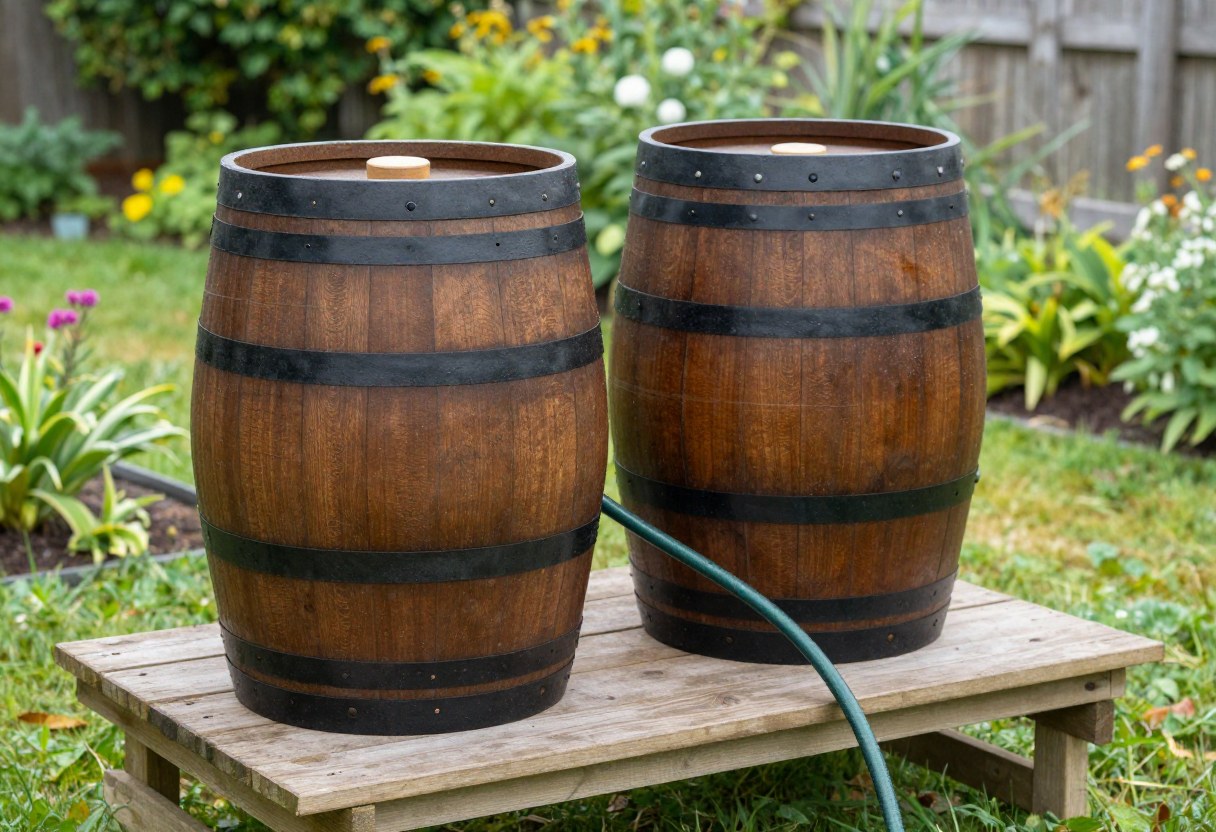
A single 55-gallon barrel fills quickly in a significant rain event and then provides no additional collection for the remainder of the storm. Linking two or more barrels in series dramatically increases storage capacity and slows the rate at which you overflow during large events. The math is simple: two linked 55-gallon barrels double the capture volume of a single barrel and more than double the effective capture for any event larger than 0.2–0.3 inches of rain.
•Parallel linking (barrels fill simultaneously): Connect a T-fitting at the overflow port so that as the first barrel fills, overflow goes into a second barrel at the same level. Both barrels receive water simultaneously if the inlet is split; more commonly, barrels are linked at the overflow port so the first fills, then overflow feeds the second. Both methods work; the overflow-linked method is simpler.
•Practical limit for linked barrels: Three to four standard barrels linked in series is typically the practical limit before plumbing complexity and the structural challenge of building a level, stable platform for multiple heavy barrels becomes a reason to consider a larger single tank instead.
Linking barrels roughly doubles capture for any storm larger than a few tenths of an inch — the platform also buys gravity pressure at the spigot.
Section 4: Installation — Step by Step
A standard rain barrel installation takes 2 to 4 hours for a first-time installer. The most technically demanding part is modifying the downspout; the rest is positioning, plumbing, and testing. The tools required are basic: a drill, a utility knife or hacksaw, a level, and basic plumbing fittings.
Tools and Materials
•Tools needed: Drill with 1-1/8 inch spade bit (for spigot hole in DIY barrel); utility knife or jigsaw for downspout modification; hacksaw for PVC pipe (if building a first-flush diverter); tape measure; pencil; level; adjustable wrench; Teflon tape.
•Materials for a complete basic installation: The barrel itself; a downspout diverter or diverter kit; a spigot / brass or PVC hose bib (for DIY barrels); a grommet or silicone sealant for the spigot fitting; an overflow hose or fitting and extension; Teflon thread tape; mosquito screening (if not included); lumber or cinder blocks for a platform (optional).
Step-by-Step Installation
•Choose your location: Select the downspout that drains the largest roof area and is closest to your primary garden use area. The barrel must be on firm, level ground — a full 55-gallon barrel weighs 458 pounds and will tip over or sink into soft ground if improperly placed. Check that the location allows for the overflow hose to direct water away from the foundation (ideally 6 feet or more from the house).
•Build the platform (optional but recommended): A platform of stacked concrete blocks, a commercial rain barrel stand, or a simple frame of 4×4 lumber raises the barrel 12–24 inches, creating gravity pressure at the spigot and making it easier to fill a watering can underneath. Ensure the platform is level in all directions before placing the barrel. A full barrel on an unlevel platform will tip. Use a level on all sides.
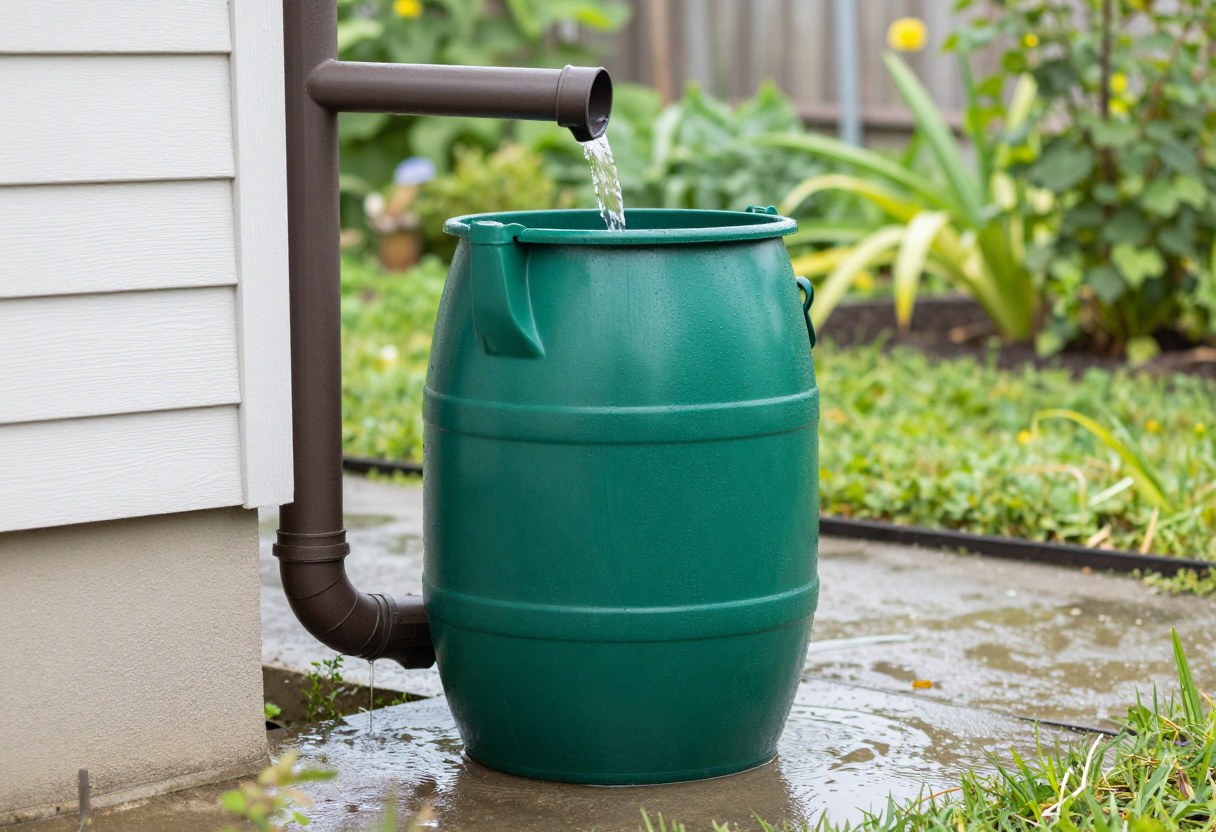
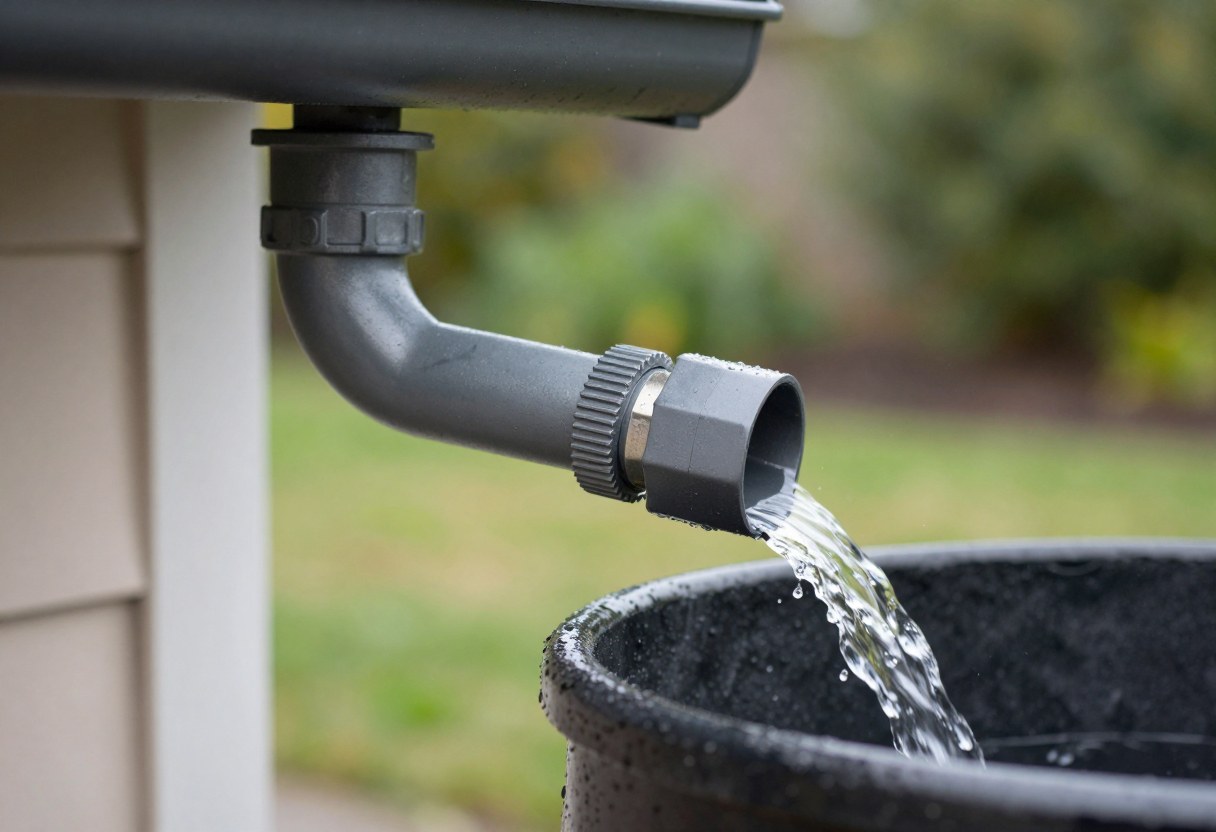
•Prepare the downspout: Most installation methods involve either (a) a downspout diverter — a T-fitting inserted into the downspout that redirects flow to the barrel when it is below capacity and continues to the original drainage path when the barrel is full; or (b) cutting the downspout and directing the cut end directly into the barrel inlet. Option (a) is reversible and preferred for most installations.
•Install the downspout diverter: Measure and mark the diverter location on the downspout. The diverter must be positioned so the outlet that connects to the barrel is at or above the height of the barrel's inlet. Use a utility knife, tin snips, or a jigsaw to cut the downspout at the marked line. Insert the diverter following the manufacturer's instructions; secure with the provided screws or clips. Connect the diverter's barrel outlet to the barrel inlet with the flex hose or tubing provided.
•Install the spigot (DIY barrels only): Drill a hole near the base of the barrel using the appropriate spade bit for your spigot's thread diameter (usually a 1-1/8 inch bit for a 3/4-inch hose bib). Apply Teflon tape to the spigot threads. Insert the spigot through the hole from the outside and thread the interior nut or backing fitting tight against the barrel wall. Use silicone sealant around the fitting to prevent leaks; allow to cure 24 hours before filling.
•Install the overflow fitting: Insert or drill a hole for the overflow port near the top of the barrel (2–4 inches below the rim, or at the rim if the lid is sealed). Attach a 1-inch or larger overflow hose fitting. Extend the overflow hose or pipe to direct overflow at least 4–6 feet away from the foundation, ideally toward a garden bed, rain garden, or lawn area where the water will be absorbed rather than running off.
•Ensure the lid is secured and screened: The lid must be in place and secured before the first use. Check that all gaps, inlet openings, and the overflow port outlet are screened with fine-mesh screen (mosquitoes can enter through the overflow hose and lay eggs if the outlet end is not screened or dipped in water). For DIY barrels with an open top, cut a piece of fiberglass window screen to fit and secure with a bungee cord or cut-and-press-fit ring.
•Test the system: Run a hose into the gutter above the downspout diverter, or wait for rain. Check: water flows into the barrel correctly; no leaks at the spigot or overflow fittings; the overflow hose directs water away from the foundation; the lid remains in place and screened when the barrel fills and water pressure builds inside. Adjust as needed.
Factory-made fitting that inserts into the downspout; auto-diverts flow to barrel and continues to drain when barrel is full
Fully reversible; original downspout re-connects to bypass when barrel is removed
Most homeowners; easiest installation; clean appearance; works with standard rectangular or round downspouts
Most widely sold option; available at home improvement stores; fits most standard downspout sizes; $15–$30
Flex hose from cut downspout
Downspout is cut; flexible corrugated hose directs flow into barrel inlet
Reversible with reconnection; less clean appearance
DIY installations; situations where the commercial diverter doesn't fit the downspout profile
Very inexpensive; fully adjustable; works for unusual downspout shapes
Leaf guard diverter
Combines leaf filtering with flow diversion; built-in screen separates leaves from flow before water enters barrel
Mostly reversible
Areas with heavy leaf fall; reduces debris in stored water significantly
Higher cost ($30–$50); reduces cleaning frequency; worth the investment in areas with large deciduous trees
Direct downspout cut with barrel inlet positioned below
Downspout cut and barrel positioned directly beneath; no overflow management built in
Not easily reversible; requires downspout repair if barrel removed
Rarely recommended; no overflow management means water overflows from the top of the barrel in large events
Not recommended — overflow management is critical
A commercial T-diverter is fully reversible — the original downspout reconnects cleanly if the barrel is ever removed.
Section 5: First Flush Diverters & Water Quality
The quality of harvested rainwater depends enormously on what it washes off the roof before reaching the barrel. The first flow of water from a roof after a dry period carries accumulated bird droppings, dust, atmospheric pollutants, pollen, leaf debris, and roof material residue. This "first flush" water is the most contaminated portion of any rainfall event. A first-flush diverter automatically discards this initial volume and only sends cleaner subsequent flow into storage.
What's in Roof Runoff?
Rainwater arriving at your barrel has passed over the roof surface, through the gutter, and down the downspout. Each stage adds potential contaminants:
•Atmospheric deposition: Dust, pollen, particulates, and atmospheric pollutants settle on the roof between rain events. The first flush washes most of these off. Rainwater in areas near industrial sites, highways, or agricultural operations with pesticide application may carry higher atmospheric contamination.
•Roof material: Asphalt shingles can leach polycyclic aromatic hydrocarbons (PAHs) and zinc from metal flashings. Treated wood shakes historically leached preservatives. Copper roofing and gutters can elevate copper levels. Galvanized metal roofing can elevate zinc levels. For ornamental garden irrigation (not vegetables, not edibles, not lawns where children play), these levels are generally not a concern. For vegetable garden irrigation, the scientific evidence is mixed; many studies show levels below EPA thresholds after the first flush.
•Biological contamination: Bird and squirrel droppings on roofs are the primary source of biological contamination in roof runoff. Salmonella and other pathogens from droppings can be present, particularly in the first flush. Studies consistently show that first-flush diversion and allowing water to settle dramatically reduces biological contamination in stored water.
•Lead: Older homes with lead-soldered gutters or lead-based painted eaves may have elevated lead in roof runoff. Inspect gutters and fascia on older homes; replace lead-soldered gutters before installing a collection system.
The First-Flush Diverter: How It Works
A first-flush diverter is a simple device — most commonly a standpipe of PVC pipe — that fills with the initial dirty flow from the roof before the cleaner water reaches the storage barrel. Once the standpipe is full, overflow into the barrel begins. When rain stops, the standpipe slowly drains through a small orifice or ball valve, clearing it for the next rain event.
•Sizing the first-flush volume: The standard recommendation is to divert the first 10 gallons per 1,000 square feet of roof area (or approximately 0.016 inches of rainfall times the roof area draining to that downspout). For a downspout serving 500 square feet of roof, divert the first 5 gallons — approximately 32 inches of 4-inch PVC pipe.
•Commercial first-flush diverters: Available in several designs; typically $20–$50. They integrate with the downspout above the barrel inlet and include a self-cleaning ball or float mechanism. Follow manufacturer instructions for sizing to your roof area.
•DIY first-flush diverter (PVC): The simplest DIY design uses 4-inch PVC pipe as the standpipe, a 4-inch Y-fitting at the top to connect to the downspout, a 4-inch end cap at the bottom of the standpipe with a small hole (1/4 inch) drilled through it to allow slow draining, and a T or Y fitting at the standpipe-to-barrel connection point. This is a straightforward PVC plumbing project requiring basic skills and a pipe cutter.
Excellent — ideal for ornamentals; better than tap water in many respects (unchlorinated, ambient temp, slightly acidic)
None required for typical suburban collection; avoid using water collected from treated-wood roofs on edibles
Recommended but not required
Vegetable garden irrigation (drip or soaker hose at root zone)
Good with precautions; extensive research shows collected rainwater is safe for vegetable irrigation at root zones
Apply at soil level, not as foliar spray; do not apply to leafy greens or root vegetables in the final days before harvest; first-flush diversion recommended; allow several hours of settling in barrel
Strongly recommended
Vegetable garden irrigation (overhead or foliar spray)
Use with caution; foliar application increases contact with biological contaminants
If using collected water overhead on edibles, first-flush diversion is essential; consider adding a 5-micron filter inline; do not spray on salad greens within 1 week of harvest
Required
Container and houseplant watering
Excellent; rain barrel water is often preferred over tap water for plants sensitive to chlorine or pH
Avoid water that smells strongly of algae or is visibly cloudy; refresh storage if water has sat more than 2 weeks in summer heat
Recommended
Lawn irrigation
Good; excellent for most lawns; may be slightly acidic but most turf tolerates wide pH range
Do not apply within 24 hours of children or pets playing on lawn if biological contamination is a concern; first-flush diversion recommended
Recommended
Drinking water (human)
NOT safe without comprehensive filtration and treatment — beyond the scope of a rain barrel system
Do not drink, cook with, or use for food washing from a standard rain barrel system without a proper multi-stage filtration and disinfection system. This guide does not cover potable rainwater systems.
N/A
🦟
Mosquito Prevention: Non-Negotiable. An improperly managed rain barrel is an ideal mosquito breeding site. Aedes aegypti and Aedes albopictus (the primary vectors of dengue, Zika, and chikungunya in the US) can complete a full larva-to-adult life cycle in a rain barrel within 7–14 days in warm weather. The three rules: (1) The lid must be completely sealed or covered with fine-mesh screen (≤1/16 inch mesh) at all times — no exceptions. (2) Every opening — inlet, overflow outlet, and any vent — must be screened or sealed. (3) If a screen is damaged or missing, add a Bti (Bacillus thuringiensis israelensis) mosquito dunk to the barrel immediately. Bti dunks are non-toxic to other wildlife and pets and kill mosquito larvae within 24 hours. One dunk treats up to 100 gallons for 30 days. Inspect the screen and lid at every use — a single 1/4-inch gap is enough for a mosquito to enter and lay eggs.
Applied at soil level rather than as a foliar spray, harvested rainwater is well-suited to vegetable garden irrigation.
Section 6: Using Your Stored Water
The most common frustration with rain barrels is low water pressure. A standard rain barrel sitting at ground level produces essentially no usable gravity pressure at the spigot — water will dribble rather than flow with the force needed to fill a watering can quickly or run a soaker hose. Understanding gravity pressure, elevation, and the solutions to low pressure transforms the rain barrel from a curiosity into a genuinely productive irrigation tool.
Gravity Pressure: The Physics
Water pressure in a gravity-fed system is determined entirely by the height difference (head) between the water surface in the barrel and the outlet point. The relationship is direct: every foot of elevation above the outlet produces 0.43 PSI (pounds per square inch) of water pressure.
Barrel Elevation
Pressure at Spigot
Practical Capability
Notes
0 inches (ground level)
0–0.1 PSI
Gravity drain only; filling a watering can takes several minutes; no soaker hose function
Usable only for direct gravity drain into a container placed directly beneath the spigot; not suitable for hose or soaker hose use
12 inches (one platform level)
0.4–0.5 PSI
Slow fill of watering can; very slow soaker hose; limited but functional
The minimum useful elevation; most basic installations
24 inches (two platform levels)
0.8–1.0 PSI
Reasonable watering can fill rate; slow soaker hose function for short runs (≤50 feet)
Adequate for most garden use; 2-foot elevation is the sweet spot for most installations
36 inches (3 feet)
1.2–1.5 PSI
Good watering can fill; functional soaker hose up to 75–100 feet
Better; requires a sturdy elevated platform of 3 concrete blocks or heavy lumber frame
48–60 inches (4–5 feet)
1.7–2.2 PSI
Good fill rate; soaker hose up to 100–200 feet; slow drip irrigation function
Building an elevated platform: Concrete blocks (standard 8×8×16 inch CMU blocks, each 8 inches tall) are the simplest elevation material. Two courses of two blocks side-by-side provides a 16-inch elevated, stable surface. Lumber framing (2×4 or 4×4 posts with a decking-grade plywood top) can achieve any height. Whatever the material, the platform must support the full weight of a filled barrel: 55 gallons weighs 458 pounds; a 100-gallon barrel weighs 835 pounds. Build accordingly.
Delivery Methods
•Watering can: The simplest and most controlled method. Fill directly from the spigot. Works at any elevation but is slow at ground level. Best for targeted hand-watering of containers and individual plants.
•Garden hose (gravity): A standard garden hose connected to the barrel's spigot works at low pressure but delivers water much more slowly than from a municipal supply. Use a hose with the nozzle removed or set to open flow; sprinkler nozzles and hose-end sprayers require more pressure than gravity barrels can typically provide. Drip the hose at the base of plants; it works well for slow, deep watering.
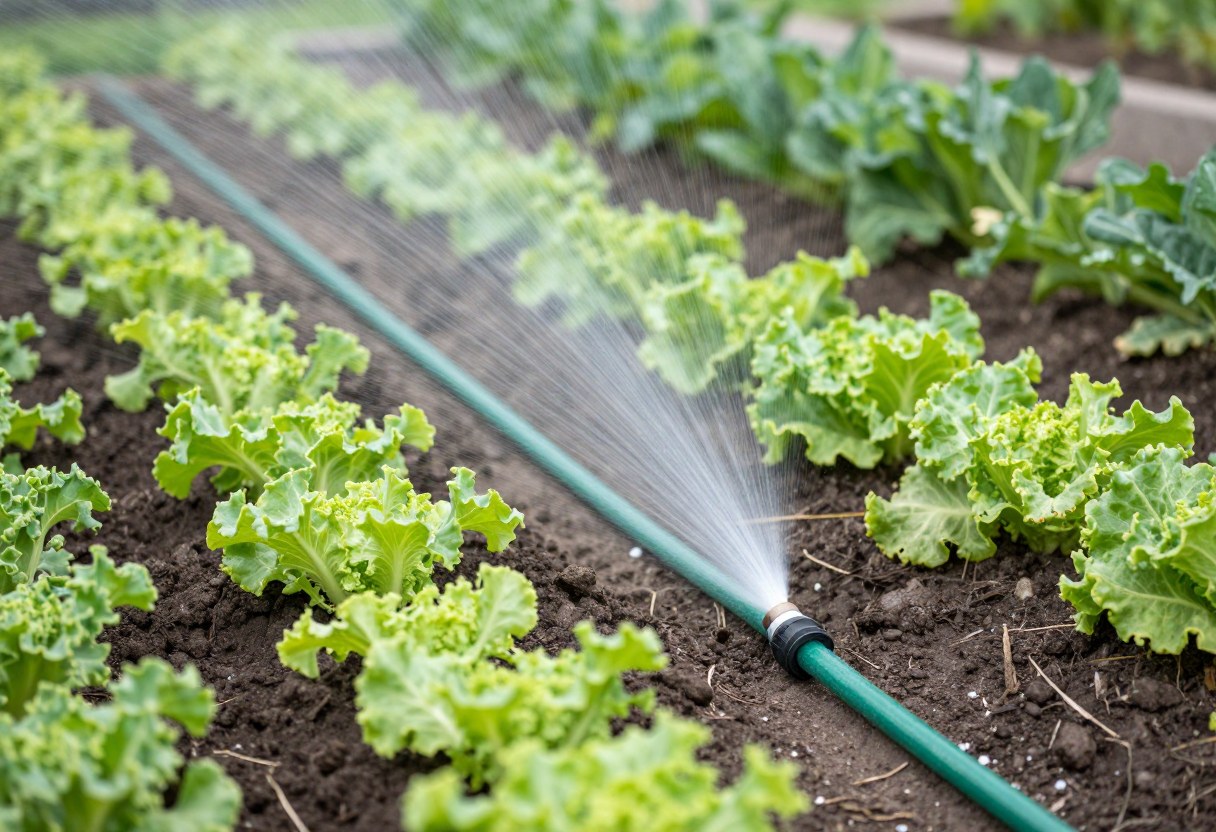
•Soaker hose: Soaker hoses are specifically designed for low-pressure operation and pair well with rain barrels at 12–36 inches of elevation. Run soaker hoses along plant rows; connect to the barrel spigot with a short length of regular hose. Keep runs short (50–100 feet maximum for gravity-only pressure) for even distribution.
•Drip irrigation: Standard drip irrigation emitters typically require 8–15 PSI — far above what a gravity barrel provides. Low-pressure or gravity-fed drip emitters (specifically labeled as such, requiring as little as 2–3 PSI) are available and work with elevated barrels. These are an excellent long-term investment for a garden irrigation system fed from a rain barrel or cistern.
•Pump-assisted delivery: A small submersible pump (12V DC solar-powered pumps are ideal for rain barrel applications; small AC pumps also work) placed inside the barrel and connected to a standard hose or drip system provides full irrigation pressure regardless of barrel elevation. A 12V solar pump with a small solar panel costs $30–$80 and provides completely independent, electricity-free operation.
Keeping Stored Water Healthy
•Use it regularly: The single most effective practice. Water used frequently is replaced by fresh rainfall, preventing long-term stagnation. A barrel that sits full all summer while the garden is watered from the hose provides no benefit and may develop water quality issues. Use the barrel water first, before reaching for the hose.
•Keep the barrel shaded: Algae require light. An opaque barrel blocks light and prevents algae growth. For translucent or light-colored barrels, shade with a burlap cover, wooden screen, or plant material. Alternatively, wrap in a dark fabric or paint the exterior.
•Refresh stagnant water: If the barrel sits full for more than 2–3 weeks in summer without being used or replenished by rain, drain it partially onto the garden (the water is still excellent for irrigation even if the barrel smells slightly stale) and allow fresh rain to refill it.
•Bti dunks for larval control: One Bti mosquito dunk treats 100 gallons for 30 days and kills any mosquito larvae present without harming other organisms. Add a dunk as a precaution during summer even when screens appear intact. Break the dunk in half for a 55-gallon barrel.
Soaker hoses are built for exactly the low pressure a gravity-fed barrel provides — pair the two and the barrel becomes genuinely useful irrigation, not just a novelty.
Section 7: Winterizing & Seasonal Care
In climates where temperatures drop below freezing, a rain barrel left full or partially full through winter will freeze, expand, and crack the barrel, split fittings, and damage the entire installation. Winterization is mandatory for any climate in Zones 6 and colder (where freezing temperatures are reliably present for extended periods), and advisable in Zone 7 where hard freezes occur occasionally.
When to Winterize
Climate Zone
Action Needed
When to Winterize
When to Reactivate
Zones 3–4 (MN, ND, MT, northern NE)
Full winterization essential; extended sub-zero periods can damage even drained barrels left outside if water is trapped in fittings
By October 1 – October 15 (before first hard freeze)
May 1 – May 15 (after frost risk passes and collection season begins)
Zones 5–6 (Midwest, mid-Atlantic, Pacific NW)
Full winterization required; winter freezes are certain and extended
By October 15 – November 1
March 15 – April 15 (after extended freeze risk)
Zone 7 (VA, NC, TN, parts of Pacific NW, TX Hill Country)
Winterization recommended; hard freezes occur irregularly but can be severe
November 1 – December 1; OR drain when freeze warnings are issued
February 15 – March 15 in most years
Zones 8–10 (Gulf Coast, Southern CA, AZ, FL)
No winterization needed in most years; monitor for unusual cold snaps
Drain and protect if temperatures below 28°F are forecast for more than one night
No reactivation needed; typically year-round operation
Winterization Procedure
•Use the water: In the weeks before winterizing, use down your stored water on the garden, compost, or lawn. It is better irrigation than tap water and costs nothing to use.
•Disconnect the downspout: Reconnect the original downspout section (or close the diverter) so winter rain and snow melt flows through the original drainage path rather than into your barrel. This prevents the barrel from filling during freeze/thaw cycles.
•Drain the barrel completely: Open the spigot fully and drain all water. Tip the barrel slightly if needed to drain the last few inches. Turn the barrel upside down if possible to ensure complete drainage.
•Remove and store fittings (optional but recommended): The spigot, overflow fitting, and any flexible hose connections are the most vulnerable to freeze damage. Remove them and store indoors for winter. Plug the holes with a rubber stopper or rag to prevent insects from nesting in the empty barrel.
•Store the barrel: If possible, store the barrel upside down in a garage, shed, or under an overhang. Stored upside down, it cannot collect rain or snow melt and will not freeze-crack. If the barrel must remain outside in place, leave the spigot open (so any water that enters can drain) and secure the inverted or unsealed lid so it cannot blow away.
•Inspect in spring: Before reactivation, inspect the barrel for cracks, loose fittings, and screen integrity. Replace any damaged components before the first use of the season.
Spring Reactivation
•Clean the barrel: Before the first use of the season, rinse the interior with clean water and a mild soap solution; rinse thoroughly. Check the screen for tears or gaps; repair or replace.
•Inspect and reinstall fittings: Apply fresh Teflon tape to spigot threads; reinstall fittings snugly. Check all gaskets and seals; replace if the rubber has hardened or cracked.
•Check the overflow path: Make sure the overflow hose is intact and positioned to direct water away from the foundation. Check that the downspout diverter is properly reconnected.
•Reconnect to the downspout: Open the diverter or reconnect the downspout to the barrel inlet. The system is ready to collect the first spring rain.
Section 8: Troubleshooting Common Problems
Problem
Cause
Solution
Barrel doesn't fill during rain
Diverter is set to bypass; downspout not connected to barrel inlet; inlet screen clogged with debris; barrel inlet positioned too high relative to downspout outlet
Check diverter position (most diverters have a bypass setting for winter use that must be switched); clear any debris from the inlet screen; verify the connecting hose between downspout and barrel is intact and unkinked; check that the downspout outlet is above the barrel inlet
Water leaks around the spigot
Loose fitting; dried or failed gasket; threads not sealed with Teflon tape; crack in barrel around the spigot hole
Tighten the interior nut against the barrel wall; replace the rubber gasket; remove and re-tape spigot threads with fresh Teflon tape; if the barrel is cracked around the fitting, replace the barrel or use a larger backing plate with silicone sealant
Mosquito larvae in the barrel
Screen has a gap or tear; one of the openings (inlet, overflow outlet, or vent) is not screened; lid is not fully sealed
Inspect every opening for gaps; repair or replace screens immediately; add a Bti mosquito dunk (Mosquito Dunks®) to the water — it kills larvae within 24 hours and lasts 30 days per dunk; screen the overflow hose outlet end
Water smells bad (rotten egg / sewage odor)
Anaerobic decomposition of organic debris in the barrel; water has been sitting for several weeks in summer heat with organic material present
Drain the barrel completely onto the garden (the water is still safe for irrigation despite the odor); scrub interior with a dilute bleach solution (1 oz bleach per gallon of water); rinse thoroughly; clean gutters to reduce organic input
Algae growth in barrel (green slime)
Light penetrating through a translucent barrel; organic nutrients from debris providing food for algae
Block light: paint the exterior of a translucent barrel with opaque paint; wrap in burlap or dark fabric; position in full shade. The water is still usable for irrigation but should be used promptly rather than stored.
Overflow runs back toward foundation
Overflow hose is too short; downward slope of yard channels overflow toward house; overflow hose is kinked or blocked
Extend the overflow hose 4–6 feet minimum from the barrel; use a rigid pipe or stake the flexible hose away from the foundation; redirect overflow toward a rain garden, swale, or planted area that absorbs it
Low water pressure / slow flow
Barrel is at ground level with insufficient elevation; hose is kinked; filter or screen in line is clogged
Elevate the barrel on a platform (12–24 inches minimum); check for kinks in the hose; clean any inline screen or filter; consider a small submersible pump for pressure-independent delivery
Barrel cracks in winter
Was not drained before freezing temperatures; water froze and expanded, cracking the barrel
Replace the barrel; this is not repairable. Implement winterization procedure before next winter: drain completely before first hard freeze.
Barrel overflows in every rain event before garden can use it
Barrel is too small for the roof area it serves; rainfall events exceed storage capacity before stored water can be used
Link additional barrels in series to increase storage; upgrade to a larger tank (150–275 gallons); divert overflow into a rain garden adjacent to the barrel location to capture the excess productively
Section 9: Scaling Up — Cisterns, Tanks & Advanced Systems
Once the rain barrel is installed and working, many gardeners reach the same conclusion: they want more. A single barrel fills quickly, empties quickly, and leaves the majority of the rooftop runoff potential untapped. Scaling up to cisterns and more sophisticated collection systems is the logical next step for gardeners serious about reducing their irrigation water footprint.
Storage Tank Options Beyond the Barrel
Storage Type
Capacity
Approximate Cost (empty)
Installation
Best Application
Linked rain barrels (2–4 barrels)
110–220 gallons
$60–$200 total (purchased barrels)
DIY; same as single barrel plus linking fittings
First step up from single barrel; adequate for small to medium gardens; simplest scaling option
Above-ground poly tank (slim / vertical)
100–300 gallons
$80–$200
DIY; position at downspout; requires stable base
Medium garden irrigation; fits against house walls; available in narrow footprint designs (12–16 inches deep)
IBC tote (intermediate bulk container)
275–330 gallons
$100–$200 (used agricultural/food-grade surplus)
DIY with modifications (screening, spigot, overflow fittings); heavy (100+ lbs empty; 2,300+ lbs full)
Large garden irrigation supply; industrial appearance requires screening or enclosure; the highest volume-per-dollar option; widely available through agricultural suppliers and online marketplaces
Above-ground poly cistern
500–2,500 gallons
$300–$1,500
Professional installation recommended for larger sizes; requires structural base; may require local permits
Large landscape irrigation; covers significant garden irrigation needs; multiple downspout collection possible
Underground cistern / buried tank
1,000–10,000+ gallons
$1,000–$10,000+ installed
Requires excavation and professional installation; permits typically required
Whole-property irrigation supply; completely hidden; requires pump for delivery; significant investment; most cost-effective for very large gardens or landscape-scale irrigation
Rainwater harvest with pump system
Any of the above + electric pump
Pump: $50–$500 depending on size and type
Pump connects to tank outlet; runs to irrigation system or hose bib
Pressure-independent delivery; enables standard drip or sprinkler irrigation from harvested water; best for larger tanks where gravity pressure alone is insufficient
Designing a Multi-Barrel or Cistern System
•Multiple downspout collection: Rather than collecting only from the nearest downspout, a more sophisticated system collects from multiple downspouts around the house and routes water to a central storage tank. This requires underground or above-ground piping to connect multiple collection points, which is a plumbing project requiring some planning but no specialized skills.
•Gravity-fed distribution from an elevated tank: An IBC tote or above-ground cistern elevated 3–5 feet (on a reinforced concrete pad or heavy structural platform) provides meaningful gravity pressure for drip irrigation. The weight of a full 275-gallon IBC tote is 2,290 pounds — the platform must be engineered accordingly.
•Pump-fed distribution: A small electric pump (submersible or inline) converts a low-pressure gravity system into a full-pressure irrigation supply. A 1/2 HP submersible pump costs $100–$200 and can pressurize a full drip irrigation system from a ground-level cistern. Pair with a timer and a simple drip system for automated, harvested-water irrigation.
•First flush at scale: At larger collection volumes, a first-flush diverter becomes more important. For a 275-gallon IBC tote collecting from multiple downspouts, a proportionally larger first-flush standpipe (or multiple downspout-level diverters) ensures that stored water quality is consistently good.
Permits and HOA Considerations for Larger Systems
While a standard 55-gallon rain barrel typically requires no permit anywhere in the US, larger cisterns and underground tanks may trigger local requirements:
•Building permits: Underground cisterns (typically any tank buried in the ground) may require a building permit in many jurisdictions. Above-ground cisterns over a certain size (varies by municipality, often 500–1,000 gallons) may also require permits. Check with your local building department before installing any large tank.
•HOA restrictions: If you live in a community with an HOA, check the CC&Rs for restrictions on above-ground structures or water storage tanks. Many states now prohibit HOAs from banning rain barrels entirely, but restrictions on visible larger tanks may still be enforceable. Concealing an IBC tote with a wooden enclosure or lattice is a practical solution where visibility is restricted.
•Structural considerations: Any water storage system above ground must have an adequately rated structural base. A full IBC tote (275 gallons = 2,290 lbs) on an inadequate surface can fail catastrophically. Underground cisterns require proper backfill and may require anti-flotation measures in areas with high groundwater.
Section 10: The Ecological Context — Beyond the Barrel
A rain barrel is a useful tool, but it is most powerful when understood as part of a broader approach to managing how water moves through your property. The larger ecological opportunity is to slow water down, spread it out, and let it sink in — rather than channeling all precipitation off the property as quickly as possible through engineered drainage systems designed for exactly the opposite goal.
The Stormwater Problem
In a natural landscape, a significant rainfall event infiltrates into the soil, is taken up by vegetation, and slowly percolates toward groundwater or moves as shallow subsurface flow toward streams. In a developed residential landscape, typically 50 to 70 percent of the same rainfall becomes immediate surface runoff that carries pollutants into storm drains and overwhelms streams with sudden peak flows that cause flooding and erosion.
A rain barrel intercepts a small fraction of that runoff. The real ecological leverage comes from combining the rain barrel with landscape practices that keep more water on-site: rain gardens, permeable paving, bioswales, and strategic grading that directs overflow toward planted areas rather than toward impermeable surfaces and storm drains.
Complementary Practices
•Rain gardens: A planted depression in the landscape, positioned to receive overflow from the rain barrel (and from the rest of the downspout during large events), that holds water long enough to percolate into the soil rather than running off the property. A rain garden sized to capture a 1–2 inch rain event from its contributing area typically drains within 24–48 hours. It is not a pond; it is a planted infiltration basin. Combined with a rain barrel, the rain garden handles the overflow that the barrel cannot capture.
•Permeable paving: Replacing impermeable concrete or asphalt driveways, paths, and patios with permeable pavers, gravel, or pervious concrete allows rainfall to infiltrate where it falls rather than running off. Permeable paving combined with rain barrels can capture the majority of a rain event from a residential property.
•Strategic grading: Simple grading changes — sloping yard areas toward planted beds rather than toward paved surfaces; creating gentle swales that slow and spread runoff; building berms that hold water in place — can dramatically increase on-site infiltration without any plumbing or structures.
•Sheet mulching: Maintaining 3–4 inches of organic mulch over all planted areas reduces runoff velocity, increases infiltration, and reduces soil evaporation — keeping more of the rain that does fall in place where it can benefit plants.
•Native and deep-rooted plantings: Native plants with deep root systems create channels for water infiltration that dramatically exceed the infiltration rate of turf grass. A deep-rooted native prairie planting or native woodland garden captures and infiltrates far more rainfall per square foot than any lawn.
Calculating Your Impact
A single 55-gallon rain barrel, used consciously through a growing season, can save 1,000 to 2,000 gallons of municipal water annually — a meaningful but modest amount. The impact grows with each additional barrel, each linked cistern, each rain garden installed downstream of the barrel's overflow. A household that combines a 200-gallon cistern system with a 300-square-foot rain garden and strategic grading can retain and use 20,000 to 40,000 gallons of rainfall annually that would otherwise have flowed into the storm drain — a contribution to stormwater management that is genuinely significant at the watershed level when replicated across a neighborhood.
💧
The rain barrel is the most accessible entry point into a different relationship with water — one that sees precipitation as a resource rather than a problem to be managed away as quickly as possible. Once you have installed a rain barrel and watched it fill during a summer thunderstorm, then drawn that water out to irrigate your garden through a dry August week, the principle becomes intuitive in a way that no amount of reading about water conservation can fully communicate. The barrel is a beginning. The rain garden that handles the overflow is a next step. The cistern that provides serious irrigation supply is another. Together, they represent a meaningful, practical contribution to the health of the local watershed, the regional aquifer, and the planet's freshwater cycle — one downspout at a time.
Quick Reference Checklist
•Verify your state's rainwater collection laws and any local ordinances
•Check your water utility and local municipality for rebates or subsidized barrel programs
•Identify the best downspout location (largest roof area, closest to garden)
•Build elevated platform (12–24 inch minimum; ensure it is level and load-rated)
•Modify downspout with diverter kit
•Install overflow hose directed 4–6 feet from foundation
•Verify all openings are screened (inlet, overflow outlet, any vents)
•Install first-flush diverter if using water on edibles
•Test system with a garden hose before the first rain event
•Add a Bti mosquito dunk to water during warm months
•Plan winterization (drain before first hard freeze in Zones 3–7)
•Use stored water regularly; don't let it sit for more than 2–3 weeks in summer
🌧️
Every drop that falls on your roof is a gift. A rain barrel is simply how you catch it.
🌿 Get Seasonal Gardening Tips
New guides, planting reminders, and growing tips — straight to your inbox.
No spam. Unsubscribe anytime.
About the Author
David Rodgers is the Founder & Head Gardener of Planting Atlas. With over 40 years of hands-on gardening experience in Oklahoma's Zone 7 climate, he researches, writes, and personally tests every guide on the site.
David draws from real backyard trials, soil testing, and trusted sources like Oklahoma State University Extension and USDA data to deliver practical, zone-specific advice that actually works.