Create a Peaceful, Minimalist Garden for Meditation and Mindfulness
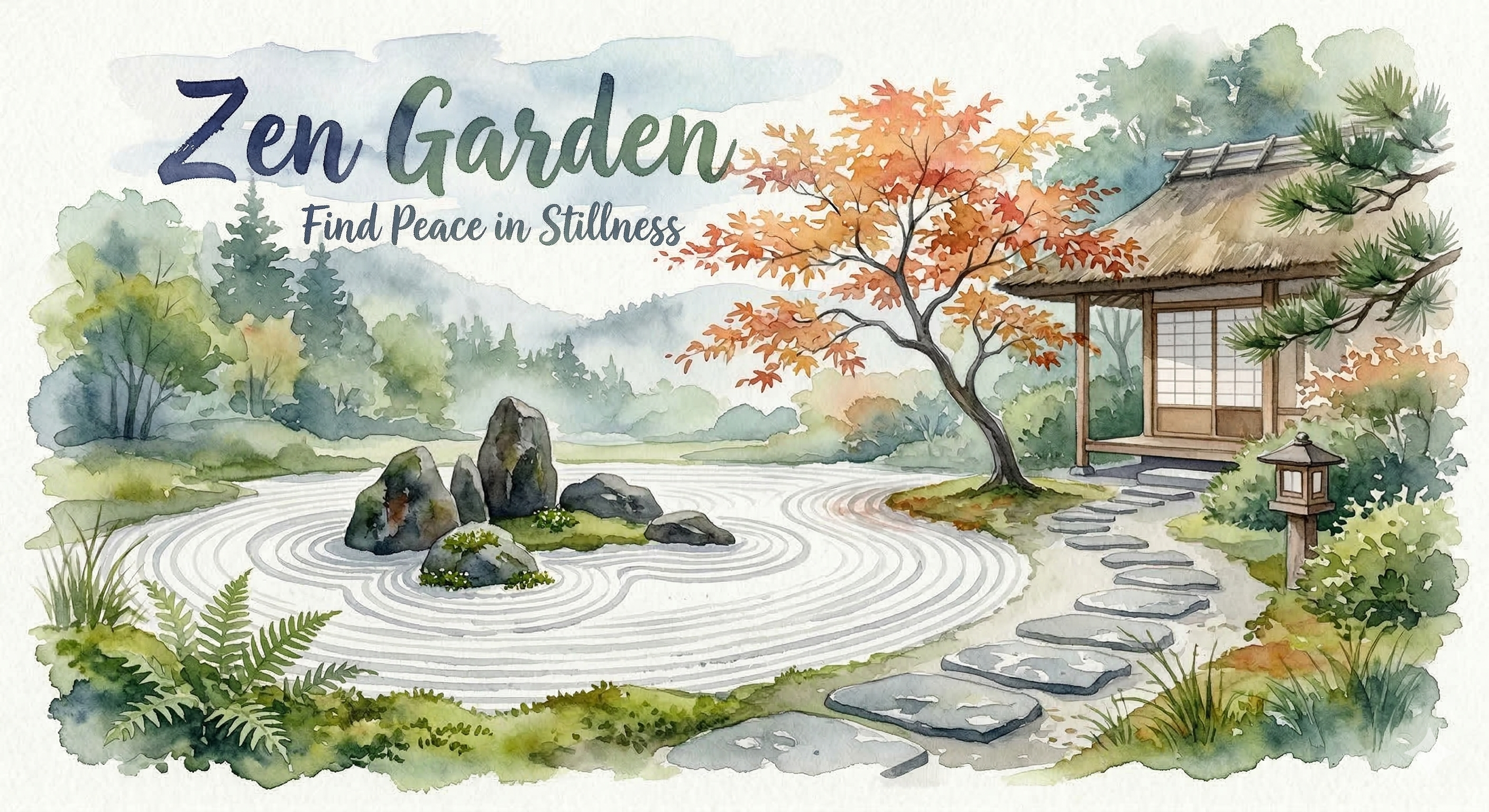
The word "Zen garden" in Western usage has come to describe almost any garden with Asian visual influences — a bamboo fence here, a stone lantern there, some ornamental grasses. This is not what a Zen garden is. A genuine Zen garden begins with a philosophical question rather than an aesthetic one: What kind of space will help a person be present?
The Japanese dry garden tradition — karesansui — emerged from Zen Buddhist monastery culture in the 12th through 16th centuries, when monks designed outdoor spaces not for pleasure or food production but for contemplation. The famous gardens of Ryoanji and Daisen-in in Kyoto are not decorative; they are environments designed to quiet the mind, dissolve distraction, and support the conditions of insight. Every element is chosen and placed to serve that purpose. What is not needed is removed. What remains is arranged with complete attention.
This guide takes that purpose seriously while making it fully accessible to American gardeners of any background, in any climate, with any amount of space. A genuine Zen garden does not require Japanese plants or Japanese ornaments. It requires a particular quality of attention in its design and a particular quality of presence in its use. The principles here will show you how to create that — whether in an acre of formal garden or a ten-foot courtyard or a balcony arrangement of gravel and stone.
This guide is organized to move from philosophy into practice in a sequence that mirrors good garden design: understanding what you are trying to create before deciding how to create it. The philosophical foundations in Section 1 are not preamble — they are the most important section in the guide, because every material decision that follows is an expression of them.
The Seven Principles at a Glance
Principle
Japanese Concept
In the Garden
Design Application
Asymmetry
Fukinsei
Nature is not symmetrical. Even the most carefully composed Zen garden avoids mirror symmetry, even numbers, and paired placement.
Use odd numbers of stones (3, 5, 7). Place focal elements off-center. Let paths curve rather than run straight to the midpoint.
Simplicity
Kanso
The garden contains only what is necessary. Every element present earns its presence. What can be removed, is removed.
Edit relentlessly. If you are uncertain whether an element belongs, remove it and observe the garden without it for a week. The garden that needs nothing added is finished.
Austere Elegance
Koko
Beauty in restraint, age, and the quality of things that have been worn smooth by time and weather. Not ornate, not new.
Choose materials that age beautifully: natural stone, weathered wood, aged ceramic. Avoid plastic, bright colors, synthetic materials. Welcome moss and lichen as the garden matures.
Naturalness
Shizen
The garden suggests nature without imitating it directly. Stones are placed as mountains, gravel raked as water — not to reproduce these things but to evoke them.
Avoid the obviously artificial. No precisely geometric shapes. No perfectly smooth or polished surfaces. Let natural material speak in its own character.
Subtle Mystery
Yugen
The quality of depth and incompleteness. A garden that reveals itself all at once is fully understood in a moment and forgotten. A garden that suggests what it does not show is inexhaustible.
Create a path that disappears around a planting. Place a stone partially buried so its full extent is unknown. Frame a view through a gate that shows only part of what is beyond.
Freedom from Convention
Datsuzoku
Within the ordered whole, a quality of the unexpected. A single stone of unusual character in a field of gravel. One asymmetric element that the eye catches and returns to.
Allow one element to break the visual expectation — not many, not randomly, but one deliberate, composed surprise.
Stillness
Seijaku
The experience the garden is designed to produce: active, alive stillness. Not emptiness, but the quality of silence that is full rather than absent.
Every design decision serves this quality. The sound of water over stone; the shadow of a branch on gravel; the mossed surface of an old rock. These are not decorations. They are the garden's purpose.
A genuine Zen garden begins with a question — what kind of space will help a person be present — not with an aesthetic checklist.
Philosophy, Mindfulness & the Garden as Practice
A Zen garden is not something you look at. It is something you practice. The distinction matters because it shapes every design decision: a garden designed to be seen from the driveway as you pull in has different requirements from a garden designed to be sat with for twenty minutes in the early morning. The first is an aesthetic object; the second is a tool for a specific kind of human experience.
The Garden as Contemplative Space
Contemplative spaces — spaces specifically designed to support inward attention, presence, and the quieting of discursive thought — are among the oldest human creations. They appear in every culture: the labyrinth, the desert hermitage, the sacred grove, the cloister garden. The Japanese Zen garden is one of the most refined and most studied of these traditions, and its principles translate across cultures and climates precisely because they are not cultural conventions but observations about how space affects human consciousness.
The research supports what tradition has long known: exposure to natural settings, particularly simple, ordered ones with natural materials, measurably reduces cortisol levels (a marker of physiological stress), lowers heart rate and blood pressure, improves attention span, and supports what attention researchers call 'soft fascination' — the effortless, restorative quality of attention that natural environments engage rather than demand. A well-designed Zen garden works on the nervous system in these documented ways. It is not a luxury. It is a technology for wellbeing.
Using the Garden as a Meditation Practice
The Zen garden supports two distinct but related practices: sitting meditation within or before the garden, and the meditative practice of tending it. Both are valuable; both are different from the experience of glancing at the garden in passing. If you design a garden purely as a visual object without creating conditions for either practice, you will have created something beautiful but not something transformative.
Sitting Practice
Designate a specific seating point in the garden — a bench, a flat stone, a low chair — from which the garden is experienced rather than observed. This is the primary viewpoint for which the garden is composed. Sit here for ten to twenty minutes with no specific agenda beyond noticing what the garden presents: the quality of light, the sound of wind in bamboo or water over stone, the pattern of shadows on gravel, the temperature of the air. The garden is the object of attention; the mind is the instrument.
Walking Meditation
If the garden includes a path, the path is an invitation to kinhin — walking meditation. Walk slowly, attending to each step, each stone underfoot, each shift in the garden's composition as the viewpoint changes. The garden designed for walking meditation reveals a sequence of compositions rather than a single view; the path is choreographed to unfold them in an intentional order.
Raking as Practice
The act of raking the gravel or sand of a karesansui garden is itself a meditation practice. The repetitive, precise movement — the rake drawn through the gravel in parallel lines, then in circles around each stone — requires complete present attention. It is not possible to rake well while also planning the afternoon or replaying a conversation. This is the practice: not the finished pattern, but the act of creating it with full presence. In Zen monastery contexts, raking was explicitly understood as a meditation practice equivalent to seated zazen.
Tending as Practice
Weeding, pruning, sweeping, placing and replacing stones — the ongoing maintenance of a Zen garden, done with deliberate attention, is a continuous practice rather than a chore. The gardener who approaches each maintenance session as a meditation session maintains the garden differently: more observantly, more patiently, with more care for each individual element.
Mono no Aware: The Beauty of Impermanence
Mono no aware — literally 'the pathos of things' or 'the beauty of transience' — is the Japanese aesthetic concept that most directly addresses the Zen garden's relationship to time. It is the bittersweet recognition that beauty is inseparable from impermanence: the cherry blossoms are beautiful because they fall; the autumn maple is beautiful because the color will not last; the bare winter branch is beautiful because it is what the maple has become, having given everything.
A Zen garden designed with mono no aware in mind is designed for all four seasons, not just the photogenic peak of spring and summer. The garden in winter, bare and simple and still, its stones dusted with snow, its gravel carrying the tracery of bare branches on the afternoon light — this is not the garden at its worst. It is the garden in one of its finest expressions. Design for this.
🪨
Wabi-sabi is the Japanese aesthetic of imperfection, impermanence, and incompleteness. It finds beauty in the worn, the irregular, the aged, and the unfinished. A cracked stone cup more beautiful for its crack. A lantern more beautiful for its moss. A maple more beautiful for the branch that broke in winter. Wabi-sabi is not an excuse for neglect — a weedy, untended garden is not wabi-sabi; it is simply untended. Wabi-sabi is a quality of intentional aging: the patina that is welcomed rather than fought, the imperfection that is composed rather than corrected, the incompleteness that is experienced as invitation rather than failure. For the American gardener, wabi-sabi offers something particularly valuable: permission to stop fighting impermanence. The garden that embraces the fallen leaf on the gravel, the darkening of old stone, the slow growth of moss between pavers, is a garden aligned with reality rather than opposed to it. That alignment is itself a form of mindfulness practice.
Space Design — Site Analysis & Garden Types
The first question of Zen garden design is not 'what do I want to put here?' but 'what is this space already?'. Site analysis — understanding what you have before deciding what to do with it — is not merely practical. It is itself an expression of the garden's philosophy: attention to what is actually present rather than imposition of a predetermined idea.
Reading Your Space
•Sun and shadow: Walk the site at three times of day: early morning, noon, and late afternoon. Note where the sun falls in each season if possible — a shadow map from midsummer looks very different from one in early spring when the sun angle is lower. The quality of light in a Zen garden — the way a raked gravel surface catches low afternoon light, the way dappled shade moves across a stone — is as important as the objects themselves.
•Sound environment: Sit in the space for twenty minutes with your eyes closed. What do you hear? Traffic, neighbors, wind, birds, existing water? The acoustic environment shapes the contemplative quality of the garden profoundly. A garden site with significant traffic noise may benefit from a water feature positioned to mask it; a site with natural bird activity may need no enhancement at all.
•Views and enclosure: What can be seen from the intended sitting position? Unwanted views — a neighbor's fence, a utility box, a busy street — can be screened by strategic planting or a simple bamboo panel. Borrowed views — a distant hillside, mature trees on adjacent properties, sky — can be incorporated into the garden's composition without belonging to it. The borrowed view technique (shakkei) is one of Zen garden design's most powerful tools.
•Existing elements: An existing mature tree, a large stone, an interesting grade change — these are the garden's starting gifts. Design around them rather than removing them. A mature tree is decades of growth that no new planting can immediately replace; a large stone in place has a quality of belonging that no newly placed stone achieves in the first years.
•Scale and proportion: A Zen garden of any size — from a two-square-foot balcony tray garden to an acre of walking garden — follows the same proportional principles. The scale of every element should relate to every other element and to the human body. A stone that looks impressive at the garden center often looks diminished in a large open space; a lantern that looks elegant in a large space can overwhelm a small courtyard.
Zen Garden Types: Choosing the Right Form
Garden Type
Japanese Term
Defining Feature
Minimum Space
Best American Application
Dry Landscape Garden
Karesansui
Water represented by raked gravel or sand; stones as islands, mountains, or simply themselves; minimal or no planting; designed primarily for viewing from a fixed point
As small as 6–10 square feet
The most widely adaptable and most philosophical form. Perfectly suited to side yards, enclosed courtyards, and small urban gardens. Low maintenance. Transformative even at very small scale.
Strolling Garden
Kaiyu-shiki-teien
Experienced by walking a path; sequential revelation of views; typically includes water feature, islands, bridges, multiple viewpoints
Minimum 1,000–2,000 sq ft for meaningful strolling experience
Adapted for larger suburban or rural properties. The key element is the sequential path; the water can be a small feature. Can be simplified significantly while retaining the essence.
Tea Garden Path
Roji
Path leading to a tea house or seating area; deliberately naturalistic; rough stepping stones; stone lantern; water basin for ritual washing; shade plants and moss
As small as a 6–10-foot path
One of the most achievable and most beautiful Japanese garden forms for American homes. The path, lantern, water basin, and destination are the essential elements. Perfect for a path from the back door to a garden seating area.
Courtyard Garden
Tsubo-niwa
Tiny enclosed garden designed to be seen from inside through a window or glass door; often a single composition of stone, moss, bamboo, or a small maple
As small as 6–15 square feet
Ideal for urban homes, side yards, and indoor-outdoor spaces. A single, resolved composition between two windows or outside a glass door. One of the most achievable and most impactful Zen garden forms.
Meditation Corner
Contemporary adaptation
A designated outdoor seating and contemplation space surrounded by simplified Zen garden elements: gravel, stone, perhaps a single specimen plant or lantern
6–10 feet of depth from the seating point
The most flexible and most accessible form for American gardeners. Works within an existing garden, on a patio, or as a defined area within a larger yard.
Indoor Tray Garden
Bonseki / adapted
A shallow tray containing raked sand or fine gravel, miniature stones, and possibly small plants; a complete Zen garden environment in table-top scale
A tray or container 12–36 inches wide
Perfect for apartments, offices, and spaces with no outdoor access. A genuine contemplative tool despite its small scale. Can be raked daily as a meditation practice.
The Design Process: From Observation to Plan
Good Zen garden design is not planned from a drawing and then built. It is developed in dialogue with the site through a process of observation, proposal, and revision. The following process is adapted from traditional Japanese garden design practice for the American home gardener.
•Observe first: Spend time in the space across different conditions — different times of day, different weather, different seasons if possible — before placing anything. Take photographs. Sit in the space and attend to it. Note what the space already has that is worth keeping, and what conditions it presents that will shape the design.
•Define the primary viewpoint: Every Zen garden has a primary viewpoint — the position from which it is most often experienced. This might be a window, a doorway, a designated bench location. The garden is composed for this viewpoint first and foremost. Every element's placement should be evaluated from this position.
•Place the major stones first: Before any gravel, planting, or structure, place the major stones. Stones are the structural and spiritual skeleton of the garden; everything else is arranged in relation to them. Use actual stones in the actual space rather than planning stone placement on paper — the quality and character of an individual stone determines how it is placed.
•Then gravel, then planting: Once the stones are placed satisfactorily, add the gravel or ground material. Then add any planting. Then any structures (lantern, water basin, fence). This sequence ensures that the most important elements are placed first and that subsequent elements serve them rather than competing with them.
•Edit: Step back and apply the kanso principle. What can be removed? What is competing for attention with the primary composition? The Zen garden that needs nothing added is finished. The Zen garden that could lose an element without losing its character should lose it.
Stone — The Essential Element
Stone is to the Zen garden what the skeleton is to the body: the structure on which everything else depends, and which remains present and meaningful even when everything else has been stripped away. In winter, when no leaf is on the maple and no flower on the moss, the stone composition remains. It is, in a sense, the garden's most permanent expression of itself.
How to Choose Stones
The Japanese tradition of suiseki — the appreciation of naturally formed stones — is the philosophical foundation of stone selection. A stone is chosen for its character: the quality of its form, the texture and color of its surface, the way it holds shadow, the way light moves across it at different times of day, and what it suggests to the imagination. A stone that suggests a mountain is placed as a mountain; a stone whose flat surface suggests water is placed near or instead of water.
•Stone character above all: Seek stones with inherent visual interest. Unusual shapes, surface texture that catches light, evidence of geological history in veins or inclusions, a crack or hollow where moisture gathers — these qualities make a stone compositionally valuable in ways that a smooth, featureless specimen is not. The stone with a story, visible in its surface, is more powerful than the perfect stone.
•Source locally: The most important principle in stone selection. Japanese garden design has always used stone native to the local landscape, and this is as true for an American Zen garden as for one in Kyoto. Granite in New England; limestone in the Midwest; sandstone and red rock in the Southwest; basalt in the Pacific Northwest. Local stone belongs to the landscape in a way that imported stone cannot. It also ages and acquires moss and lichen in patterns appropriate to the local climate, which imported stone may not.
•Scale to the space: The most common error in stone placement is choosing stones too small. A stone that looks impressive at the garden center or stone yard is often diminished once placed in a garden context among other elements and ground material. If in doubt, choose the larger stone. Err toward too large rather than too small — a stone that is too large commands the space; a stone that is too small disappears into it.
•Odd numbers: Place stones in groups of three, five, or seven — never two or four. The classic three-stone composition is the fundamental unit of Zen stone design: one tall vertical stone (the primary), one lower diagonal stone (the secondary), and one horizontal flat stone (the tertiary). These three represent heaven, humanity, and earth in the Zen garden's symbolic vocabulary.
Placement Principles
•Bury at least one-third: A stone whose entire form is visible above grade looks placed. A stone whose lower third is buried looks as if it has always been there and belongs to the earth beneath it. This is the single most important principle of stone placement.
•Lean slightly into the earth: Stones that lean slightly — not perfectly vertical or perfectly horizontal — look natural and settled. Perfect perpendiculars feel engineered and artificial.
•Find the stone's strongest face: Every stone has a face — the side with the most interesting texture, the most revealing profile, the most compelling character. Find it before placing and orient it toward the primary viewpoint.
•Consider shadow: How will this stone look at different times of day as light and shadow move across it? A stone that appears unremarkable at midday may have extraordinary texture at early morning or late afternoon light. Place it to take advantage of its finest light.
•Allow the stone to speak: Once a stone is placed well, do not move it casually or repeatedly. The stone's position becomes part of the garden's character, and the relationship between placed stones creates the garden's compositional energy.
Stone Types and Their Roles
Stone Feature
Japanese Term
Function
Placement Notes
Specimen Stone
Ishi
A single stone of character placed as a focal point, anchor to a composition, or primary element in a stone group.
Place partially buried. Face toward the primary viewpoint. Always in company of at least two supporting stones.
Stepping Stones
Tobi-ishi
The path through the garden; flat-topped stones placed for walking that simultaneously compose the rhythm and experience of the garden journey.
Space irregularly (not evenly) at a natural walking stride. Vary stone sizes. Set flush with or slightly above grade. Set in moss, gravel, or low planting.
Stone Lantern
Ishidoro
A carved stone lantern; originally functional, now primarily a compositional and atmospheric element. A focal point and seasonal object.
Never center in a composition. Always offset to a side, near water or a path. A lantern half-concealed by a plant or stone is more compelling than one in full open view.
Water Basin
Tsukubai
A low stone basin for water; in the tea garden tradition, for ritual handwashing; in the contemporary garden, a water feature, bird bath, and compositional anchor simultaneously.
Position low (the name means 'to crouch'). Near a path or entry. The surrounding stones — the yakuishi — are as compositionally important as the basin itself.
Bridge Stone
Ishi-bashi
A single large flat stone laid across a dry stream, path depression, or water feature to suggest a bridge.
Must span the gap fully with both ends resting on stable ground. Choose a stone with natural horizontal character. One of the most elegant minimal garden elements.
Dry Waterfall
Kare-taki
Stones arranged to suggest a waterfall without water — the central feature of a dry stream garden.
Three primary stones: a tall central stone (the fall), flanking stones suggesting the water's spread, and flat stones at the base suggesting a pool.
The yakuishi — the stones surrounding a water basin — carry as much compositional weight as the basin itself.
Gravel, Sand & the Dry Garden (Karesansui)
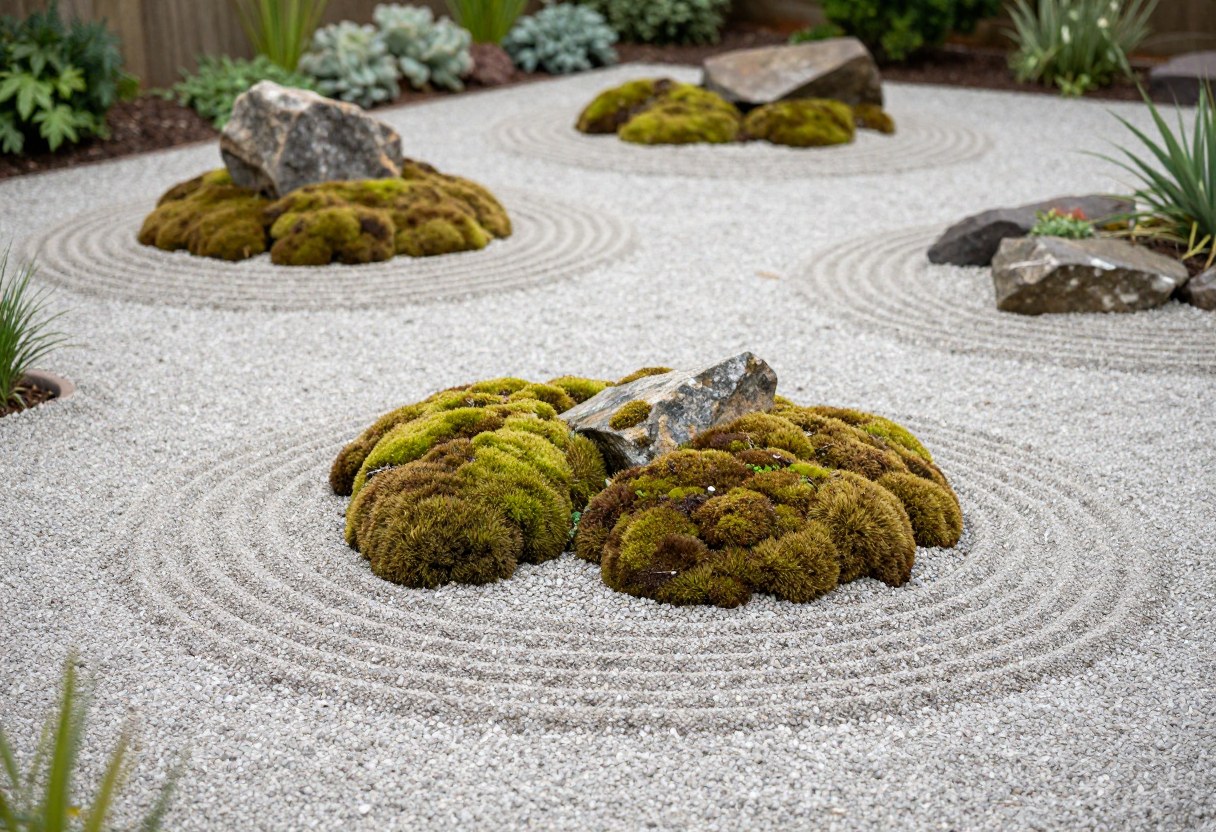
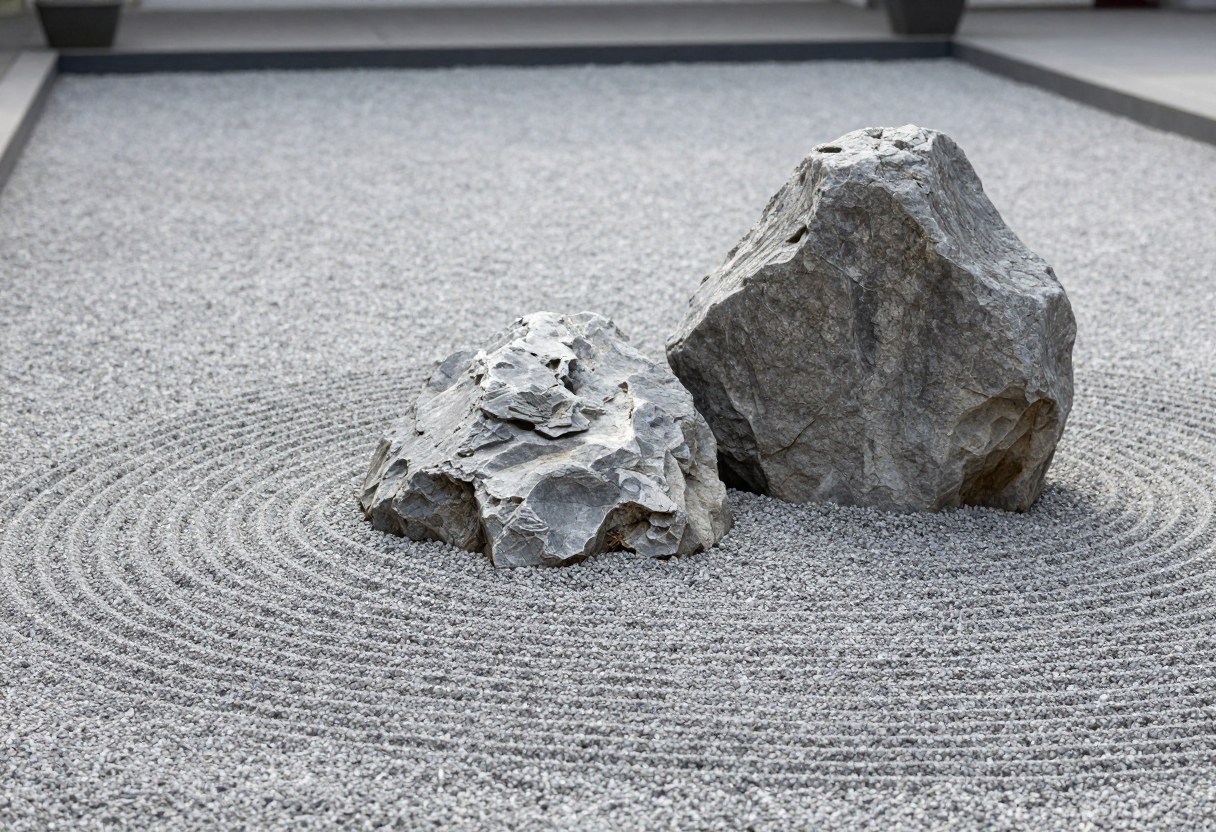
The karesansui — dry landscape garden — uses raked gravel or sand to represent water in its various moods: the stillness of a lake, the movement of a stream, the turbulence of ocean waves. The raked surface is one of the most distinctive and most misunderstood elements of the Zen garden tradition. It is not decoration. It is a philosophical statement about the nature of perception, impermanence, and practice.
The most famous karesansui gardens — Ryoanji with its fifteen stones in raked gravel visible only as fourteen from any single viewpoint; Daisen-in with its narrative dry waterfall and river — are among the most visited and most studied gardens on earth. Their power comes entirely from stone, gravel, and empty space. No plant, no structure, no ornament contributes what the composition of those materials achieves.
Choosing the Raking Medium
•Decomposed granite: The standard material for dry gardens in many American climates. Angular particles hold raking patterns well and compact slightly over time to a stable surface. Available in various colors from pale gray to tan to rust-red. Choose the color that contrasts well with your stones and reads as a water surface at the scale you are working with.
•Crushed granite: Similar to decomposed granite but more uniform particle size. Holds patterns crisply. Excellent for detailed raking work. More expensive than decomposed granite but produces cleaner results.
•Pea gravel: Rounded particles that do not hold raking patterns as crisply as angular materials. The rounded form is more reminiscent of river gravel; the overall effect is softer and more naturalistic. Better for contexts where a precise raked pattern is not the primary aesthetic.
•White marble chips: The material used in many historical Japanese gardens that have been adapted for Western contexts. Very high visual contrast. Holds patterns well. Can create significant glare in full-sun American climates. Most appropriate in shaded courtyard settings.
•Sand: Requires a completely weed-free base and a stable boundary or edging to prevent migration. Holds the finest and most precise raking patterns. Requires the most frequent maintenance (resetting after rain). Most appropriate for contained indoor or very protected outdoor contexts.
•Depth: 2 to 3 inches of raking material over a firm base. Less than 2 inches looks thin and does not hold patterns adequately. More than 3 inches wastes material and can make raking physically laborious.
Base Preparation
•Excavate 4–6 inches: Remove existing vegetation, roots, and soil to the required depth. The base must be firm and level; the quality of your raking surface depends entirely on the quality of what is beneath it.
•Compacted gravel base: Install 2–3 inches of compacted crushed gravel (not the raking surface material) as a base. This provides drainage and prevents the raking surface from sinking or shifting unevenly over time.
•Landscape fabric: Install long-term landscape fabric rated for perennial use (not the thin paper-like varieties that degrade quickly). This is one of the most important steps: without a weed barrier, weeds will grow through the raking surface, destroying the patterns and requiring constant intervention that undermines the contemplative quality of the garden.
•Edge containment: Install a clean, firm edge around the perimeter before adding the raking surface. Traditional edging materials include flat stones, pressure-treated lumber, composite decking boards, or metal edging. The edge must be high enough to contain the raking material and low enough not to interrupt the garden's visual plane.
•Add the raking surface: Spread to 2–3 inches depth. Rake level before placing stones or adding final composition.
Raking Patterns and Their Meanings
Pattern
Visual Effect
Meaning or Evocation
How to Rake
Straight parallel lines
Open water; a lake surface in calm; the sea undisturbed
Stillness; equanimity; the mind at rest
Draw the rake in parallel lines from one edge to the other in a single direction. The spacing between lines is determined by the rake's tine width.
Concentric circles around a stone
Water rippling outward from a point of contact; the ring a stone makes when dropped in still water
Cause and effect; the way one action spreads through everything
Work outward from the stone in expanding ovals or circles. The most meditative raking pattern: begin at the stone and move outward, then return and begin again.
Diagonal crossing lines
Turbulent water; ocean waves in motion; energy
Impermanence; the nature of change; dynamic force
Rake from one corner at 45 degrees, then cross at the opposite 45 degrees. Used sparingly — a small area of turbulence reads as an accent, not as the primary field.
Curved parallel lines
A flowing river; water moving through a channel or valley
Movement; passage; the river that is never the same water twice
Bend the parallel lines to suggest flow direction around stone 'islands.' The curve should be natural, not mechanical.
Whirlpool / spiral around a single stone
Water turning around a fixed point; concentrated energy
The still point within movement; the fixed within the changing
Begin at the stone and work outward in a tightening spiral. Very powerful but use at only one point in a garden. Can overwhelm if applied broadly.
🪨
In Zen Buddhist temple gardens, the daily raking of the karesansui was understood as a form of meditation practice equivalent to seated zazen. The act of raking — repetitive, precise, demanding complete present attention to the body's movement and the gravel's response — requires the same quality of non-discursive attention that seated meditation cultivates. Approach the raking with this understanding. Begin at the edge and work inward or outward with full attention to the physical sensations of the rake, the resistance of the gravel, the emerging pattern. If the mind wanders to planning or memory or fantasy, notice that and return to the physical act without judgment. The garden does not need a perfect pattern. It needs your complete attention while you make it. After heavy rain or wind, the pattern is gone. This is not a problem; it is the practice. Impermanence is not the obstacle to the garden's beauty. It is the point.
The raking is not decoration for the stones — in temple practice it was itself the meditation, equal in weight to seated zazen.
Plants — Restraint, Structure & Seasonal Meaning
Plant selection in the Zen garden is governed by the same principle that governs everything else: restraint. A Zen garden typically uses far fewer species than a conventional garden of equivalent size — perhaps 6 to 12 species where a cottage garden might use 40. This is not poverty of imagination. It is compositional discipline. Each species is chosen to perform a specific role — structural anchor, seasonal accent, ground texture, screening, borrowed scenery — and given enough space to perform that role fully.
What makes a plant appropriate for a Zen garden is not its geographic origin but its character. A native American serviceberry with its spring cloud of white flowers, its summer berries, its excellent fall color, and its winter silhouette of fine branching performs every role that a Japanese cherry performs in a traditional garden. A native sedge growing in a shaded area fills exactly the role of Japanese forest grass. The Zen garden principles apply to any plant with the appropriate character — structural clarity, seasonal interest, the ability to age gracefully, and the capacity to be still.
Trees: The Primary Structure
Tree
Hardiness Zones
Role in Garden
Key Qualities
Native/Regional Notes
Japanese Maple (Acer palmatum)
5–9
The signature Zen garden tree; specimen, focal point, seasonal drama; multiple forms and foliage colors
Native to Japan but adapted widely. Weeping varieties for water's edge and containers. Choose variety for mature size and sun exposure.
Serviceberry (Amelanchier spp.)
3–9 (varies)
Excellent native substitute for flowering cherry; spring flower, summer berry, fall color
White spring flowers; blue-black berries that feed birds; outstanding fall color in red-orange; multi-season interest
Native across North America. A. canadensis (eastern US); A. alnifolia (western US). Fully appropriate substitute for Japanese cherry in any Zen design.
Redbud (Cercis canadensis or C. occidentalis)
4–9
Spring flowering accent; the eastern American equivalent of Japanese cherry bloom
Spectacular magenta-pink spring bloom on bare branches; heart-shaped summer foliage; good fall color
Eastern redbud (Z4–9) native to eastern US; Western redbud (Z6–10) native to California. Both are Zen-appropriate in their respective regions.
Japanese Black Pine (Pinus thunbergii)
5–8
Structural evergreen; trained in the niwaki cloud-pruning tradition
Native across eastern North America. Responds well to niwaki training. A powerful Zen garden tree using North American material.
Pacific Coast Natives (coastal redwood, coast live oak)
7–10 (Pacific Coast)
Regional structural anchors of extraordinary presence
Ancient character; massive scale at maturity; irreplaceable borrowed-scenery value
Where these trees exist on or adjacent to the property, design the garden in relationship to them rather than adding trees at all.
Shrubs: The Middle Layer
•Azalea (Rhododendron spp.): The most traditional Japanese garden shrub for cloud-pruned form and spring color. In Zones 4–9 depending on variety. Clip azaleas into rounded or cloud-pruned forms. Acid soil essential. Satsuki and Kurume types are most traditional; many American native azaleas (R. periclymenoides, R. viscosum) are equally appropriate with fragrant flowers.
•Japanese Pieris (Pieris japonica): Zones 4–8. Year-round evergreen interest; cascading white spring flowers; attractive red new growth. One of the finest four-season shrubs for Zen garden use. Tolerates shade. Acid soil.
•Muhly Grass (Muhlenbergia capillaris): Zones 5–10. Native American ornamental grass with extraordinary pink-mauve fall flower plumes. Provides the movement and seasonal drama that grasses contribute in traditional Japanese gardens, with entirely North American provenance.
•Boxwood (Buxus spp.): Zones 4–9 (varies). The most widely available cloud-pruning subject in America. Responds beautifully to niwaki training. Evergreen year-round structure.
•Sweetbox (Sarcococca spp.): Zones 5–8. Evergreen shrub with intensely fragrant small white winter flowers — fragrance of late winter before any other plant in the garden. The fragrance of an unseen flower (yugen) is one of the finest Zen garden experiences.
•Heavenly Bamboo (Nandina domestica): Zones 6–9. Seasonal foliage color through the year; winter berries. Note: invasive in the Southeast — check your state's invasive species list. Where invasive, substitute native alternatives such as Itea virginica or Aronia arbutifolia, which offer similar multi-season interest.
Ground Layer: Moss, Ferns & Low Planting
The ground layer of a Zen garden is where the aesthetic difference from Western design is most immediately visible. Where a conventional garden might use mulch or a uniform ground cover, the Zen garden uses moss, ferns, and carefully chosen low plants that vary in texture and seasonal behavior, creating a ground plane as compositionally considered as everything above it.
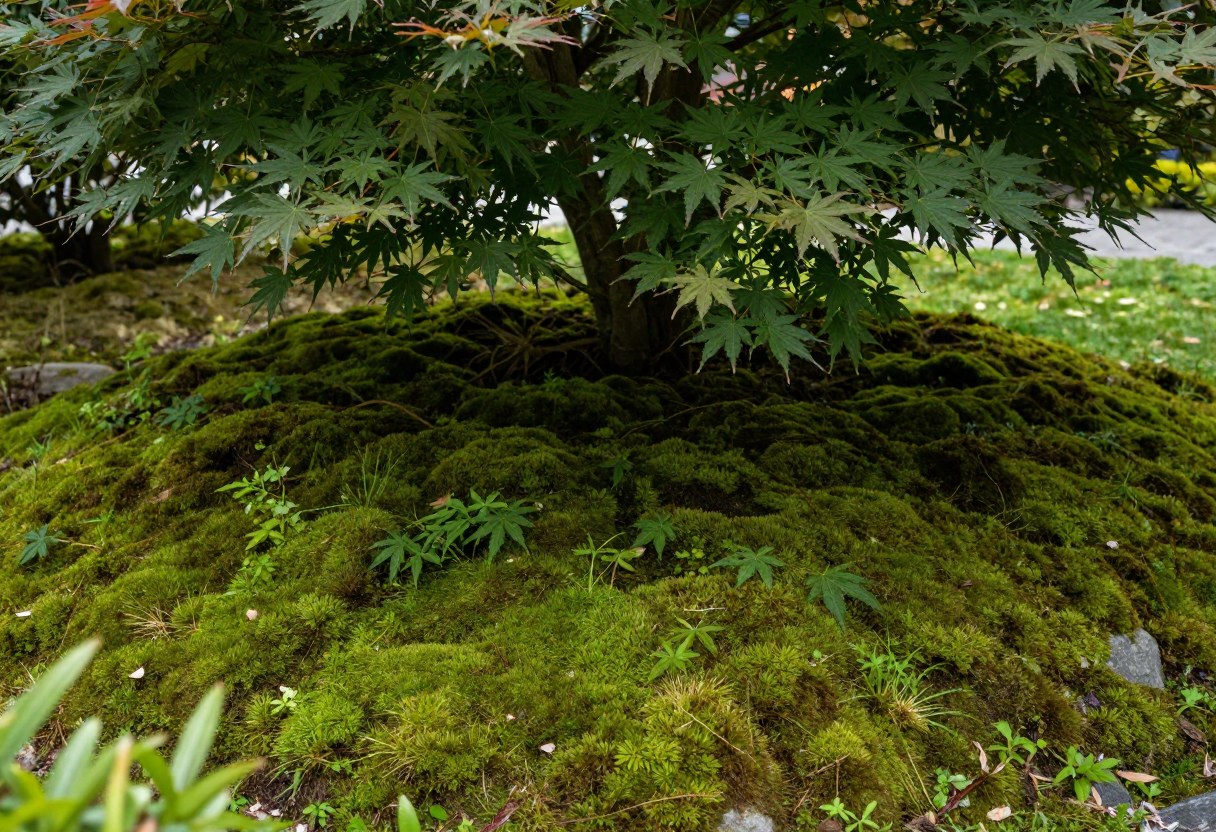
•Moss: The most quintessential Japanese garden ground cover. Communicates age, moisture, shade, and the quality of a place that has been attended to over years. Difficult to establish quickly but extraordinarily beautiful when healthy. Full guidance in Section 8.
•Japanese painted fern (Athyrium niponicum 'Pictum'): Zones 3–8. Silver-painted fronds of extraordinary beauty. One of the finest ferns for the Zen garden ground layer. Tolerates considerable shade.
•Christmas fern (Polystichum acrostichoides): Zones 3–9. Native American evergreen fern. Excellent in shade; holds its form through winter when most ferns have died back. A powerful Zen garden plant using entirely native material.
•Pennsylvania sedge (Carex pensylvanica): Zones 3–8. Native fine-textured sedge that grows in shade and requires no mowing, no irrigation after establishment, and no fertilizing. One of the finest no-maintenance native ground covers for shaded Zen garden areas.
•Mondo grass (Ophiopogon japonicus): Zones 6–10. Fine-textured, grass-like plant forming a dense low mat. Black mondo grass (O. planiscapus 'Nigrescens') is extraordinary in composition with pale gravel or light stone. Hardy to Zone 6.
•Epimedium: Zones 4–8. Delicate heart-shaped leaves; small spring flowers; tolerates dry shade (rare in any ground cover). One of the finest Zen garden ground covers for challenging shaded dry spots.
Bamboo: Use with Caution and Intention
Bamboo is perhaps the most immediately recognizable Japanese garden plant in the American imagination, and one of the most frequently misused. Running bamboo (Phyllostachys, Pleioblastus) spreads aggressively by underground rhizomes and has become invasive in many states. Clumping bamboo (Fargesia) does not spread by running rhizomes and is the responsible choice for most American gardens.
•Running bamboo in containers: If you want the tall, dramatic effect of running bamboo (P. nigra — black bamboo — is among the most beautiful), grow it in a large container sunk into the ground or in an above-ground container. This contains spread while providing the architectural form that makes bamboo so valuable as a sound screen and focal plant.
•Clumping bamboo: Fargesia rufa, F. murielae, and F. nitida are the most widely available clumping bamboos in the US. Hardy to Zones 4–6 depending on species. Shade-tolerant. Non-invasive. The fountain-like arching canes are graceful and unmistakably bamboo. Excellent for corner accents, screening, and container specimens.
Moss and clumping bamboo do the quiet work of a Zen garden's ground layer — no mowing, no fertilizing, just patience.
Structures, Paths, Water & Sound
Structures in the Zen garden — gates, fences, bridges, pavilions, and paths — are as carefully considered as the planting and stone. They do not merely serve functional purposes; they define the garden's spatial sequence, establish its character, and create the moments of pause and arrival that are central to the contemplative experience.
Paths: The Garden's Choreography
The path in a Zen garden is not a route from A to B. It is the choreographer of the garden experience. The path determines the sequence of views, the pace of movement, the moments of pause, and the orientation of the walker's attention. A straight path says: move quickly, there is nothing to linger over. A curving path that disappears around a planting says: slow down, there is something ahead you cannot yet see.
•Rhythm and pace: Stepping stones placed close together encourage quick movement; stones placed slightly further apart require attention and naturally slow the walker. A single larger stone in the path — a 'stop stone' — creates a natural pause point from which a view is intended to be contemplated.
•Irregular spacing: Stepping stones in a Zen garden are placed at irregular intervals and in irregular arrangements — not in a straight line, not at perfectly equal spacing. The irregularity mirrors natural stone placement and requires the walker to look at the path rather than moving on autopilot.
•Materials: The finest path material for a Zen garden is flat natural stone — flagstone, slate, local granite, or sandstone of appropriate scale. Avoid concrete stepping stones, which look manufactured. Between stones: moss (the finest option; requires shade and moisture), fine gravel (practical and Japanese in character), low ground covers (Mazus, Pratia, Corsican mint, creeping thyme), or bare earth in the most naturalistic sections.
•Never perfectly straight: A path that reveals the destination immediately misses the opportunity to control the garden experience. A path that curves right, then left, then reveals the destination is a path that earns its length.
Water: Stillness, Movement & Suggestion
Water in the Zen garden is never merely decorative. Still water represents the mind in meditation: reflective, calm, containing the sky. Moving water represents the continuous change of nature. Even in the dry garden, gravel is raked to suggest water — because the absence of water, thoughtfully composed, can evoke water more powerfully than water itself.
•Still water (pond): An asymmetric, naturalistic water body whose edges blend into planting and stone. Flat stones partially into the water at the waterline. Planting — iris, rush, sedge — at the shallow margins. Even a very small still water feature (a stock tank sunk into the ground, a stone bowl, a half-buried container) creates an entirely different quality of contemplative space: the sky is now in the garden.
•Moving water (stream or spout): The sound of water over stone is a primary sensory element in the Zen garden. A small recirculating pump connecting a water source to a bamboo spout that empties into a stone basin costs $40–80 and transforms the acoustic environment of a garden. The sound masks ambient noise, anchors attention in the present, and creates the quality of aliveness that makes a Zen garden a space in which something is always happening.
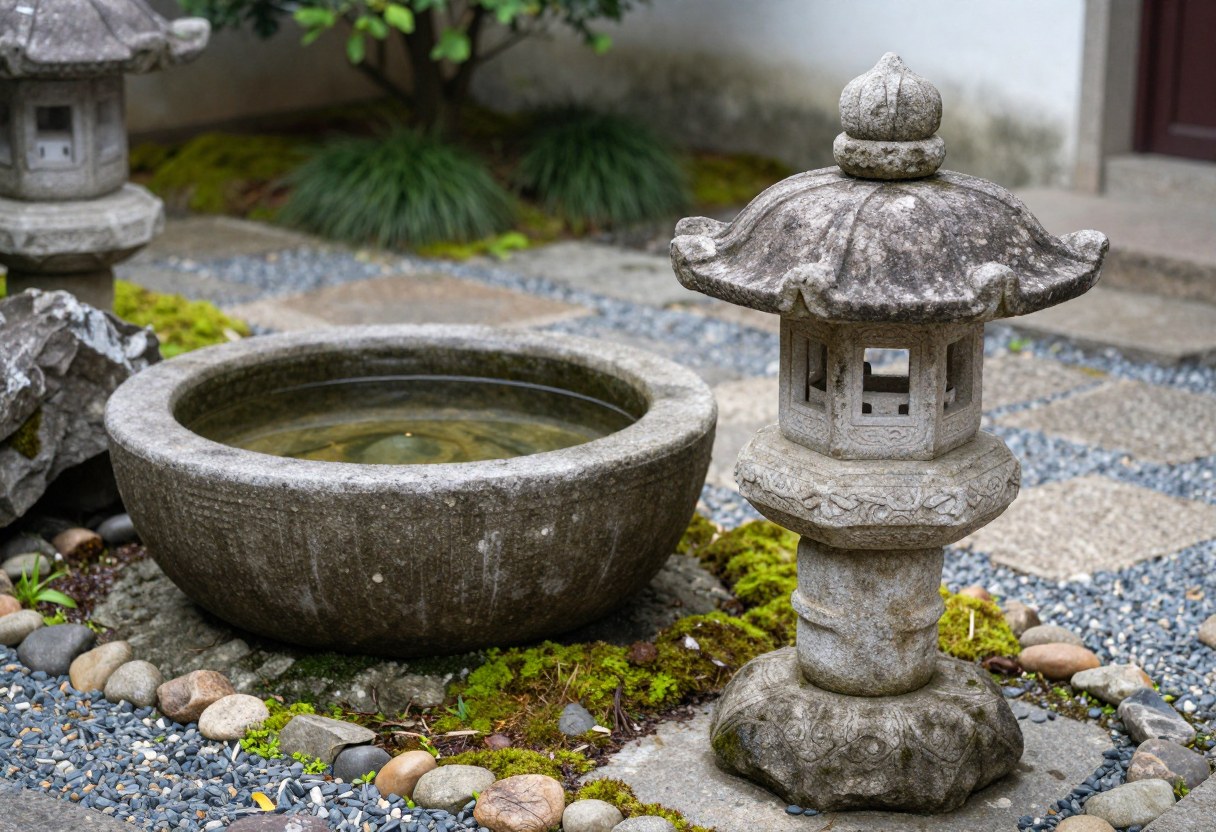
•The water basin (tsukubai): A low stone basin, traditionally used for ritual handwashing before the tea ceremony, is one of the most achievable and beautiful Zen garden elements. A natural boulder with a depression drilled by a mason is the finest option; cast stone basins are widely available. The surrounding stones and a bamboo spout complete the composition. The act of approaching and pausing at the water basin is itself a transition from ordinary mind to garden mind.
•Dry water: A dry stream — a naturalistic channel of rounded river stones — is one of the most effective and beautiful Zen garden techniques, particularly in drought-prone climates. It serves as a drainage channel during rain events and as a year-round compositional element. A flat bridge stone spanning the dry stream creates a garden moment of surprising power.
Gates, Fences & Enclosure
The gate is the threshold between the ordinary world and the garden world. Even a modest gate — two posts and a simple overhead member — creates a psychological transition that changes the experience of entering the garden. The garden that can be entered but cannot be simply walked into from any angle is a garden with a more intense interior quality.
•Materials: Natural wood (cedar, redwood, teak) that weathers to gray; bamboo lashed with natural twine; stone posts with a simple timber lintel. Avoid decorative ironwork, vinyl, or treated lumber with a green cast.
•The view through the gate: The most important design decision for any garden gate is what the visitor sees through it. Frame the view deliberately: a stone lantern, a specimen maple, a glimpse of water, a bend in a path. The gate creates the expectation; the garden beyond fulfills or deepens it.
•Bamboo fence types: Yotsume-gaki (four-eyed fence: open-weave bamboo defining space without blocking it); Teppo-gaki (gun barrel fence: vertical bamboo poles of alternating heights, providing more privacy); Kinkakuji-gaki (dense brushwood panels framed in bamboo). Each provides a different balance of enclosure and openness.
Stone Lanterns: Placement and Character
The stone lantern (ishidoro) is the element most frequently imported into Western garden contexts, often placed with more enthusiasm than understanding. A lantern placed well is a powerful compositional anchor; placed poorly, it looks like a garden center impulse purchase.
•Material: Natural granite that has begun to weather and acquire moss is ideal. Cast concrete lanterns can look cheap and lightweight. If budget requires concrete, choose a dense, well-cast version and allow several years to weather before evaluating.
•Placement: Never in the center of the garden. Always offset — beside a path, at the edge of water, partially obscured by a plant. A lantern half-hidden behind a maple branch is more interesting than one standing in open view. Site where it will eventually acquire moss — north-facing and near water are ideal.
•Number: One lantern per garden in most contexts. Two lanterns positioned symmetrically flanking an entry is a formal arrangement; elsewhere, a single lantern is always more powerful.
Niwaki — The Art of Cloud Pruning
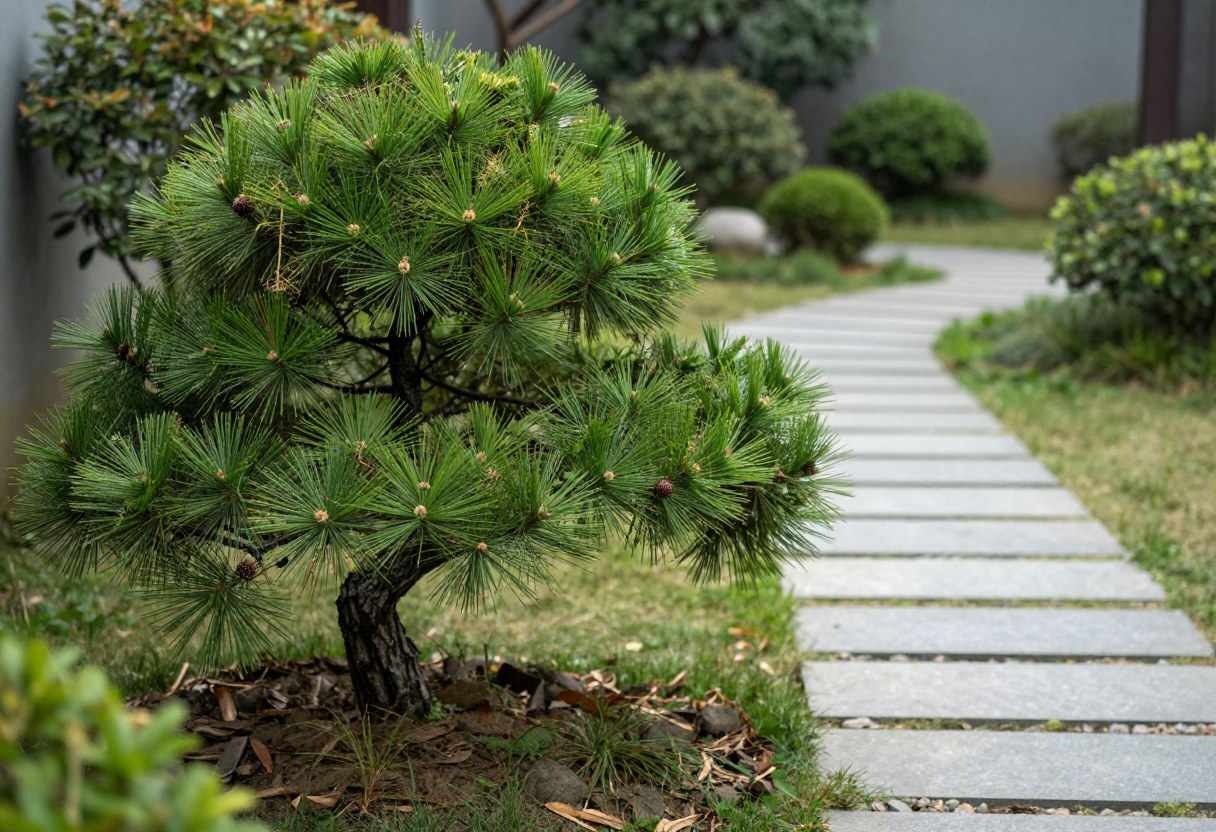
Niwaki — literally 'garden tree' — refers to the Japanese practice of pruning trees and shrubs into deliberately artistic forms that suggest natural, wind-shaped trees while revealing and celebrating the underlying branch structure. The most recognized form is the cloud-pruned tree: foliage gathered into distinct, rounded pads or 'clouds' on carefully exposed branches, with negative space between each cloud that reveals the branch and trunk structure beneath.
Niwaki is one of the most powerful ways to introduce Zen garden aesthetics into an existing American garden without redesigning the entire space. A boxwood, Japanese holly, yew, or juniper that has been cloud-pruned is unmistakably Zen in character, requires no additional garden redesign, and becomes more interesting with each year of careful development.
Plants Suitable for Niwaki Training
Plant
Zones
Form Achievable
Training Difficulty
Notes
Japanese Black Pine (Pinus thunbergii)
5–8
The most authentic niwaki form — layered cloud pads on dramatically exposed trunk and branches
High — requires annual candle pruning and multi-year development
The definitive niwaki plant. Begin training from a young age. Annual candle pruning in early summer is the key technique.
Medium — responds well to hard pruning and cloud-shaping
The most widely available cloud-pruning subject. B. sempervirens is vigorous; smaller-leaved varieties have finer cloud texture.
Japanese Holly (Ilex crenata)
5–7
Cloud forms similar to boxwood; small glossy leaves create fine texture
Medium
Excellent boxwood substitute where boxwood blight is a concern.
Yew (Taxus spp.)
3–7
Layered cloud forms; dense texture; very dark green
Medium — tolerates hard pruning; responds well to shaping
Extremely durable and shade-tolerant. T. × media is most widely available for niwaki development.
Juniper (Juniperus spp.)
Varies
Natural windswept forms; informal cloud-pruned shapes; the most immediately Zen-looking result
Medium — remove unwanted branches rather than shear; develop over years
J. chinensis, J. scopulorum, and J. sabina all respond to niwaki-style shaping.
American Holly (Ilex opaca)
5–9
Large-scale cloud forms; architectural winter presence with red berries
Medium
Native alternative to Japanese holly at larger scale. Provides birds with winter food while serving as a niwaki specimen.
The Basic Niwaki Technique
•Identify the primary trunk line: Before pruning, study the tree and identify its most interesting trunk and branch structure. Niwaki reveals this structure. The first step is always to remove branches that obscure the trunk or clutter the primary branch lines.
•Remove branches working bottom to top: Remove crossing branches, dead wood, and any branches growing straight up or straight down from a horizontal branch. Work slowly, removing one branch at a time and stepping back to evaluate the effect after each removal.
•Identify the future cloud positions: Look at the remaining foliage masses and determine which should become cloud pads. Typically three to five clouds on a small tree. Each cloud should be on a different horizontal plane so the layering creates depth.
•Shape each cloud: Clip each foliage mass into a rounded, slightly flattened cushion form. The underside should be relatively flat; the top slightly convex. This is done with hand pruners for the outline and by pinching or fine shearing within the pad for texture.
•Create negative space: The space between cloud pads — where the branch is exposed and empty — is as important as the pads themselves. Do not be afraid of the empty spaces. They are the 'ma' of the tree: the meaningful emptiness that makes the pads visible as pads.
•Maintain annually: Return to each tree once or twice per year to refine the cloud shapes, remove unwanted new growth, and continue developing the branch structure. A niwaki tree becomes more beautiful with each year of careful attention.
Moss, Water Features & Garden Lighting
Growing Moss: The Quintessential Zen Garden Skill
Moss is so central to the Zen garden aesthetic that an entire gardening tradition — koke-niwa, the moss garden — is devoted to it. Establishing moss requires patience and specific conditions, but once established, a healthy moss lawn is one of the most beautiful and low-maintenance surfaces a garden can support.
•Where moss thrives: Shade or dappled light; consistent moisture; slightly acidic soil (pH 5.0–6.0); good atmospheric humidity. Moss is most easily established in the Pacific Northwest, New England, the upper Midwest, and the humid Southeast. In hot, dry climates (Southwest, Great Plains), moss is difficult without creating an artificially moist microclimate through irrigation and shading. In these climates, fine-textured decomposed granite, pea gravel, or low ground covers (Mazus, Pratia) may substitute for the visual role that moss plays.
•Establishment by transplant: Collect or purchase living moss from a nursery or from areas of your property where it naturally grows. Remove existing ground cover. Lower soil pH to 5.5–6.0 if needed (test first). Press moss firmly onto moist soil with good contact. Water gently twice daily for 4–6 weeks. Do not allow to dry out during establishment. Avoid foot traffic for the first full season.
•Establishment by slurry: Blend moss, buttermilk, and water into a slurry. Paint onto prepared surfaces — stone, bare soil, a clay pot, a concrete wall. Keep moist. Moss establishes within weeks in humid, shaded conditions.
•Maintenance: Remove leaves by hand or with a soft broom (never a leaf blower, which destroys moss). Do not fertilize (moss does not need nutrients; fertilizer feeds the weeds that compete with it). Keep shaded and moist. Replenish patches that die back by transplanting from healthy areas.
Moss Type
Best For
Light
Moisture
Climate Notes
Sheet Moss (Hypnum spp.)
Ground cover in large areas; stepping stone surrounds; the most widely available
Part shade to full shade
Consistently moist
Adaptable across most of the US in shade. The standard moss for Zen garden establishment.
Cushion Moss (Leucobryum glaucum)
Stone compositions; the mounded cushion form is particularly beautiful with stone
Part shade to full shade
Moist; tolerates brief drying better than sheet moss
Eastern and Pacific Northwest US. The distinctive mounded form creates beautiful variation in the moss layer.
Haircap Moss (Polytrichum spp.)
Taller, more textured moss for transitional zones between gravel and planting
Part shade
Moist to average
Very widely adaptable; tolerates more sun than other mosses.
Fern Moss (Thuidium spp.)
The finest texture; feathery appearance; excellent in detailed stone compositions
Full shade to part shade
Consistently moist
Best in humid climates: Pacific Northwest, Southeast, New England.
Water Features: Installation and Maintenance
•Recirculating pump systems: A submersible pump placed in the water basin or pond, connected to a bamboo spout or stone channel, recirculates collected water continuously. Solar-powered submersible pumps (12V DC) are ideal for Zen garden water features: they operate when the sun shines, are silent, and require no electrical connection. A pump rated at 50–100 gallons per hour is adequate for a tsukubai basin; larger features need proportionally larger pumps.
•Water quality in small features: Standing water in a small stone basin in summer heat becomes stagnant within days. A recirculating pump that keeps the water moving dramatically slows this process. For basins not served by a pump, change water every 3–5 days in summer. A Bti mosquito dunk (Bacillus thuringiensis israelensis) in any standing water feature prevents mosquito breeding.
•Freeze protection: In Zones 6 and colder, any aboveground water feature must be drained before the first hard freeze. A stone basin cracked by freezing water cannot be repaired. Remove the pump and store indoors; drain all water and leave the basin tipped or covered to prevent it from refilling with rain.
•Sound design: A bamboo spout dropping water 6 to 12 inches into a stone basin creates a quiet, continuous sound. The higher the drop, the more sound is produced. The surface of the basin — stone versus water-covered gravel versus open water — also affects the quality of sound. Experiment with height and surface before finalizing the installation.
Lighting for Evening and Night
A Zen garden at night can be as powerful as — and often more powerful than — the same garden in daylight. The simplification that darkness creates — reducing the garden to a composition of light, shadow, and silhouette — eliminates visual complexity and produces the quality of stillness that the Zen garden is designed to cultivate. Lighting is not enhancement; it is a design tool for a different garden.
•Traditional stone lanterns: A stone lantern with a candle or small LED placed inside the lantern chamber casts a warm, low, indirect light that illuminates the area around the lantern without directing bright light anywhere. The silhouette of the lantern itself becomes a night composition.
•Low-voltage LED path lighting: Small, low-profile fixtures at ground level along the path create the experience of a garden that can be walked through safely at night without eliminating the darkness that gives the evening garden its character. The goal is to see the path, not to illuminate the garden as if it were daytime.
•Uplighting specimen plants: A single low-wattage uplight directed at a cloud-pruned pine or a specimen Japanese maple at night creates a dramatically different garden than the daytime version. The branch structure becomes the primary visual element; the gravel and ground material recede into shadow.
•What to avoid: Bright flood lighting, colored lights, and multiple conflicting light sources all undermine the garden's quality of stillness. A garden with too many lights becomes a light show; a garden with one or two well-placed, low-intensity sources becomes a different kind of garden.
Small-Space Zen Gardens & Regional Adaptation
Some of the most powerful Zen garden compositions in history have been created in extremely limited spaces. The tsubo-niwa — courtyard garden visible from inside a building — was traditionally as small as 36 square feet. The principle of mitate — using one thing to suggest another — is the key tool for the small Zen garden: a single stone suggests a mountain; a small moss mound suggests a forested island; a bamboo spout emptying into a stone basin suggests a river.
Small-Space Compositions
Composition
Space Required
Key Elements
Notes
Tsubo-niwa (courtyard garden)
As small as 36 sq ft
One specimen plant, one stone group, moss or fine gravel ground, one water basin or lantern
Designed to be viewed from inside the building. Design for the view from the window first. Evening lighting essential.
Entryway dry garden
20–50 sq ft
Raked gravel or decomposed granite, 3–5 stones, one specimen plant, optional stepping stone path
The transition from street to entrance. Even a narrow strip between a path and a wall supports a simplified karesansui.
Water basin composition
10–25 sq ft
Tsukubai basin, bamboo spout and pump, 3–5 surrounding stones, moss or fern planting, small lantern
One of the most achievable compositions. The sound of water is the primary gift of this design.
Stepping stone path
Any length from 10 ft
5–10 stepping stones, ground cover between (moss, gravel, or low plants), minimal planting alongside
A path of stepping stones through a shaded area, surrounded by moss and ferns, transforms a utilitarian side yard.
Container Zen garden (balcony / patio)
10–20 sq ft of container grouping
Japanese maple in large container, clipped boxwood or holly, small bamboo, water basin, gravel tray beneath
A complete Zen garden experience without any in-ground planting. Achievable on any balcony or terrace.
Indoor tray garden
A tray 12–36 inches wide
Fine sand or decomposed granite, 3–5 small stones, a miniature rake, perhaps one small plant or moss
A genuine contemplative tool. Rake daily as a meditation practice. Works in any space including offices.
Regional Adaptation: American Climates
Region
Climate Challenge
Plant Adaptations
Design Adaptations
Regional Opportunity
Northeast & New England (Zones 4–6)
Cold winters limit tender plants; late spring; intense fall color
Japanese maple (choose hardy varieties), pine for niwaki, clumping bamboo (Fargesia), hardy azaleas, Christmas fern, ostrich fern
Design for fall as the primary display season. Pond depth below frost line if koi are intended. Moss establishes readily in this climate.
The finest moss-growing climate in America outside the Pacific Northwest. Extraordinary fall color. Witch hazel and snowdrops provide late-winter interest when the garden is most austere.
Mid-Atlantic (Zones 6–7)
Hot humid summers; cold winters; wide seasonal range
Full Japanese maple palette; camellias (Zone 7); azaleas; sweetbox; nandina (check invasive status)
Four-season garden design is fully achievable here. The finest climate for the complete Zen garden plant palette.
Cherry and redbud bloom in early spring; azaleas follow; summer is lush; fall is brilliant; winter reveals the bones.
Southeast & Gulf Coast (Zones 7–9)
Intense summer heat and humidity; mild winters; camellias are foundational
Southern azaleas and camellias; loropetalum; gardenias; Japanese maple with afternoon shade; mondo grass; liriope
The garden lives outdoors year-round. Design for garden use from October through May. Summer shade is essential.
Camellias flower through winter and define the Southern Zen garden. Native ferns are extraordinary in damp shade compositions.
Midwest & Great Plains (Zones 4–6)
Cold winters, hot summers, wind; clay soils; variable rainfall
Hardy Japanese maples, cold-hardy azaleas, serviceberry (cherry substitute), native ferns and sedges, mugo pine
Karesansui gardens are particularly well-suited — they require no water and minimal irrigation. Wind management through fence and planting screens is essential.
Prairie sedges and native grasses can be incorporated into Zen garden compositions with elegant effect.
Karesansui gardens are the most sustainable and climate-appropriate choice. Use locally sourced stone (sandstone, granite, basalt). Replace moss with fine gravel or drought-adapted sedums.
The dry landscape is itself profoundly compatible with karesansui aesthetics. Native Southwest stone is among the most beautiful in America for garden use.
California & Coastal West (Zones 8–10)
Mediterranean climate; wet winters, dry summers; coastal fog; fire risk in some areas
Western redbud, coast live oak, manzanita, ceanothus, native grasses, drought-tolerant bamboo
The dry garden and karesansui form are both aesthetically and environmentally appropriate. Borrowed scenery from California hills or coastal views is a significant opportunity.
The gnarled oak and silver-leaved manzanita have a wabi-sabi quality that integrates naturally with Zen principles. Native California gardens can be deeply Zen in character without a single Japanese plant.
The Garden Through the Seasons & Ongoing Practice
A Zen garden designed for a single season misses the philosophy that animates it. The concept of mono no aware — the bittersweet beauty of impermanence — requires experiencing the garden across time: the cherry bloom that is beautiful because it falls; the bare branch that is beautiful because it is what the tree has become. Design for all four seasons. Use each season.
Season
Garden Experience
Care Tasks
Contemplative Focus
Late Winter / Early Spring
The garden at its most austere: bare branch structure against sky; first moss brightening with moisture; snow on stone. One of the finest Zen garden moments is a dusting of snow on raked gravel — the impermanence of the pattern made visible in the most literal way.
Prune pines (if not done in fall) before candle emergence. Re-rake the karesansui with fresh attention after winter. Clean and restart water features. Inspect moss for winter damage.
The austerity principle: what remains when everything is stripped away? The stone remains. The branch structure remains. The garden is most itself in winter.
Spring
Cherry, redbud, or serviceberry bloom. Azaleas follow. Moss at its most vivid green. New maple foliage emerges. The garden's most celebrated season, and the briefest — which is exactly the point.
Plant new additions. Divide ferns and sedges. Top-dress moss areas. Check and clean pond filtration. Begin regular raking. Add a fresh layer of decomposed granite if the raking surface has compacted.
Mono no aware: the cherry blossoms are beautiful because they fall. Experience the bloom season fully aware of its brevity. This awareness is the practice.
Summer
The green garden: full canopy, moss at its lushest, pond plants established, bamboo at its most vertical and dense. The garden is most private and enclosed in summer.
Rake karesansui regularly — this is the primary active season for raking practice. Clip niwaki plants (if second pruning is needed). Water moss areas in drought. Maintain pond and water features. Deadhead nothing — let the garden be.
The full-presence practice: the garden in summer heat, with the sound of water and the quality of green light through a maple canopy, is the Zen garden at full depth. Sit here without an agenda.
Fall
The most celebrated season: Japanese maple color from yellow through orange to crimson. Fallen leaves on moss and gravel. The raked pattern interrupted by a fallen leaf is a composition in itself — one that changes daily.
Rake fallen leaves from moss (by hand or soft broom; never a leaf blower). Begin winter preparation: protect marginally hardy plants. Divide and replant perennials. Do not cut back ornamental grasses — their winter form is part of the garden.
The leaf on the raked gravel. The moment between the wind and the stillness. These are not interruptions to the garden's beauty; they are expressions of it. Practice noticing this.
Winter
The purest Zen garden season: structure without distraction. Stone and gravel in full clarity. The lantern in snow. The garden is most austere and most philosophical in winter. The Western impulse to see winter as the garden's decline misses the point entirely.
Final cleanup before hard freeze: drain all water features; mulch marginally hardy plants; check rodent guards on young trees; nothing else — the winter garden does not need tending. It needs to be experienced.
Seijaku — active stillness. Sit in the winter garden as you sit in summer, but without the softness of green. What is the garden without its softness? What are you without yours?
Troubleshooting the Zen Garden
Challenge
Likely Cause
Resolution
Gravel surface becoming weedy
Landscape fabric degraded; seeds germinating on the gravel surface from wind and bird activity
Remove weeds by hand as soon as they appear — before they set seed. Replace landscape fabric if it has deteriorated. A thin layer of fine granite grit on top of larger gravel inhibits weed germination. Avoid organic mulch adjacent to the karesansui.
Moss dying or browning in patches
Insufficient shade; soil drying out; foot traffic; pH too alkaline; fallen leaves left too long
Increase shading. Irrigate with a gentle mist during dry periods. Install stepping stones to redirect foot traffic. Test and amend soil pH to 5.5–6.0. Remove leaves promptly with a soft broom.
Japanese maple scorching in summer
Too much afternoon sun; insufficient water in heat; reflected heat from hard surfaces
Japanese maples, particularly red-leaved varieties, prefer afternoon shade in Zone 7+. Move containerized specimens or add shade from a structure. Water deeply and mulch the root zone.
Stone lantern looks out of place
Scale mismatch; wrong material; placement too central; insufficient aging
A lantern that looks prominent and new needs two things: time and partial concealment. Paint with diluted buttermilk in a shaded, moist location to encourage moss. Plant a low shrub or fern partially in front. Relocate from the center to an edge.
Garden feels busy, not restful
Too many elements; too many plant species; too much color variety; insufficient negative space
Edit ruthlessly. Remove any element that does not clearly earn its presence. Reduce the number of plant species. Increase the proportion of empty space — gravel, moss, or bare stone — relative to planted area. Apply kanso: a garden that feels too full almost always needs subtraction, not addition.
Raking pattern doesn't hold shape
Gravel particles too round (pea gravel); gravel layer too thin; gravel is wet
Switch to angular decomposed granite, which holds patterns better than rounded pea gravel. Increase depth to 2–3 inches. Rake when the gravel is dry.
Pond water turning green
Algae bloom from too much sun, excess nutrients, or inadequate filtration
Add floating plants (waterlilies, water hyacinth where non-invasive) that shade the water and compete with algae for nutrients. Increase filtration. Add a UV clarifier to the pump circuit. Reduce direct sun by planting screening shrubs on the south side.
The Garden as Teacher
There is an important distinction in Japanese culture between a garden that is finished and a garden that is practiced. Western garden design tends toward completion: the plan is executed, the plants are established, the garden is done. Zen garden design tends toward practice: the garden is a living relationship that deepens over years and decades, requiring regular attention, seasonal adjustment, and continuous refinement.
The niwaki tree that will be magnificent in twenty years is beginning now. The moss that will cover the stepping stones completely in five years is establishing today. The stone that looks slightly awkward in its first year will look as if it has always been there in its seventh. The karesansui that you rake every week in different weather and light and mood becomes, over time, a meditation practice as much as a garden feature.
A niwaki tree shaped today will not reach its intended form for twenty years — the garden asks for patience as much as design.
Begin anywhere. One stone placed with intention. One path of stepping stones through a corner of the yard. A water basin and a lantern and a clump of moss. The principles of Zen garden design do not require a large garden, a large budget, or a complete renovation. They require a different quality of attention — and once that attention is brought to a space, it transforms the space in ways that no amount of planting or purchasing can replicate.
🪨
The garden is already here. The practice is to see it. — after a 12th-century garden diary, Sakuteiki
🌿 Get Seasonal Gardening Tips
New guides, planting reminders, and growing tips — straight to your inbox.
No spam. Unsubscribe anytime.
About the Author
David Rodgers is the Founder & Head Gardener of Planting Atlas. With over 40 years of hands-on gardening experience in Oklahoma's Zone 7 climate, he researches, writes, and personally tests every guide on the site.
David draws from real backyard trials, soil testing, and trusted sources like Oklahoma State University Extension and USDA data to deliver practical, zone-specific advice that actually works.