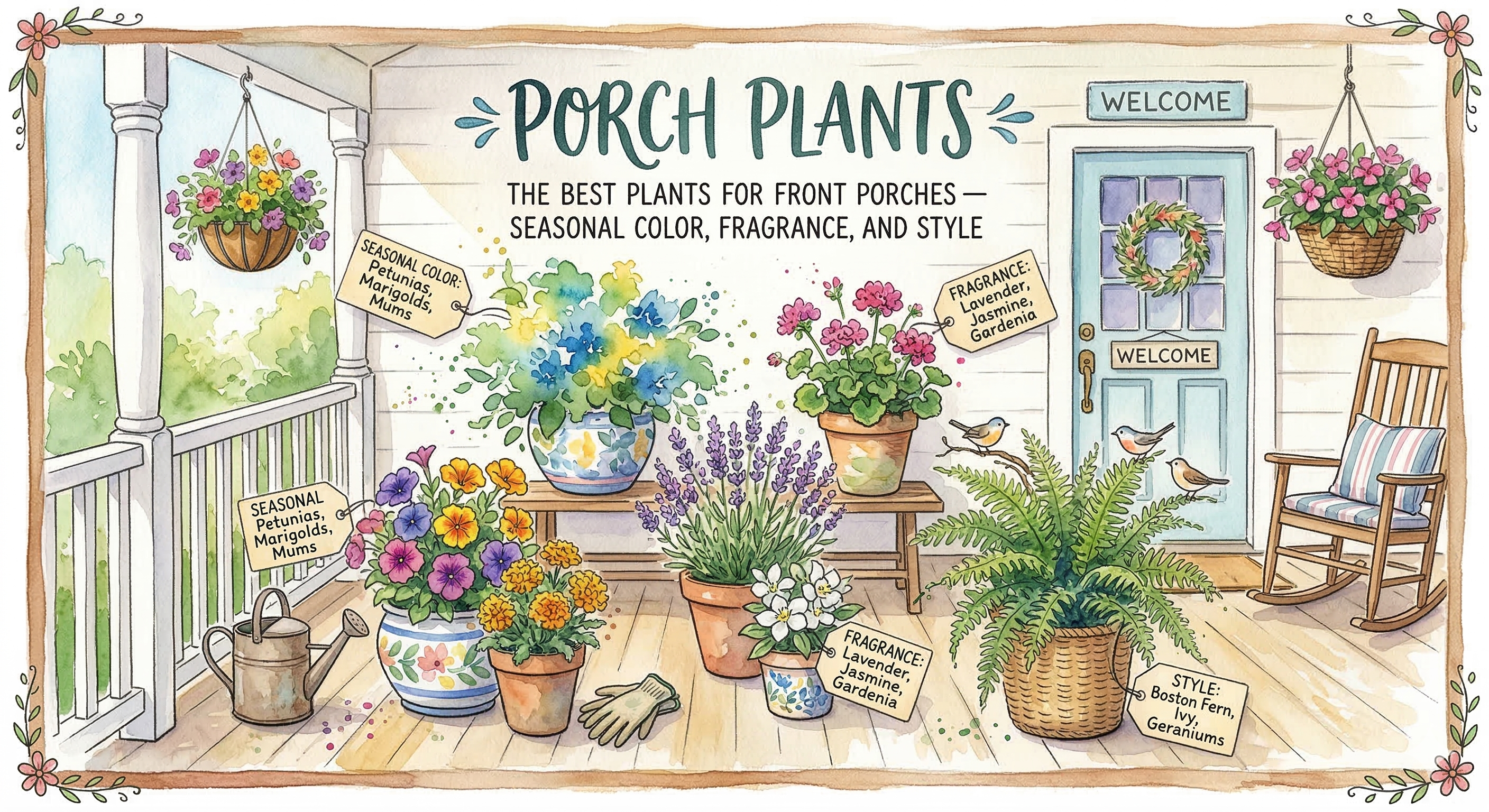
The Best Plants for Front Porches — Seasonal Color, Fragrance, and Style
A porch is a threshold — neither fully inside nor fully outside — and the plants that inhabit it set the tone for everything beyond. A front porch planted well communicates welcome, personality, and care. A back porch planted lushly becomes an outdoor room, a place to linger rather than pass through. Whether you're working with a sun-drenched south-facing stoop, a deep shady wraparound, or a small apartment balcony that qualifies as a porch by generosity of spirit, this guide will help you choose and care for plants that thrive in porch conditions and make your outdoor space extraordinary.
Assessing Your Porch — Sun, Shade, and Microclimate
Porch microclimates are unique and often hostile to plants. A covered porch reduces rainfall reaching containers by 80–100%, meaning manual watering is essential. Overhangs create dense shade even on south-facing porches. Reflected heat from siding and concrete can raise temperatures dramatically above ambient. Understanding your specific conditions before buying any plant will save you money and frustration.
Measuring Your Porch Light
Observe your porch at three times — 10 AM, 1 PM, and 4 PM — noting whether it receives direct sunlight. This tells you your light category:
Light Category
What It Looks Like
What It Means for Plants
Full Sun (6+ hours direct)
No overhang shadow during midday; open southern or western exposure
Can grow almost any annual, most vegetables, herbs, most flowering perennials. Watering is the critical challenge.
Partial Sun / Partial Shade (3–6 hours direct)
Morning sun only (east-facing porch); filtered light through tree canopy; shadow from overhang moves during the day
Excellent for impatiens, caladium, begonias, ferns, coleus. Many perennials. Cannot reliably grow full-sun vegetables.
Full Shade (under 3 hours direct)
North-facing porch; deep overhang; blocked by trees all day
Shade lovers only: ferns, hostas, caladiums, impatiens, coleus. Many tropical foliage plants. No flowering annuals that need sun.
Bright Indirect
Near a south or west window but no direct rays; open sky visible but no direct beam
Good for many foliage tropicals, begonias, streptocarpus, some ferns. Better than true shade.
Other Porch Conditions to Note
•Roof overhang: A roof directly above blocks most rainfall — any plant under an overhang requires manual watering regardless of outdoor precipitation. This is the most common reason porch plants die.
•Wind: Corner porches, elevated porches, and porches facing the prevailing wind experience much higher evaporation rates and can physically damage tender plants. Choose compact, stocky plants for windy conditions rather than tall or rangy types.
•Reflected heat: Concrete floors, white siding, and south-facing brick walls can add 10–20°F above ambient temperature. Choose heat-tolerant plants (lantana, portulaca, vinca, sweet potato vine) for very hot exposures.
•Weight restrictions: Elevated decks and balconies have weight limits. Use lightweight plastic or fiberglass containers instead of terracotta or ceramic on upper floors. Large whiskey barrels look great but are extremely heavy when planted and watered.
•Drainage: Water must have somewhere to go. Ensure every container has drainage holes and that runoff won't stain the porch floor or damage below-grade structures. Saucers help contain drips but should be emptied regularly to prevent mosquito breeding and root rot.
💧
A porch plant on a covered porch during a week of rain will receive zero water unless you water manually. Even in rainy climates, porch plants under overhangs typically need watering every 1–2 days in summer. The most reliable solution is a drip irrigation system on a timer — they are inexpensive, easy to install, and completely eliminate the most common cause of porch plant death: forgetting to water during a busy week.
A full-sun porch like this offers the widest plant selection — but also the most demanding watering schedule.
Best Plants for a Sunny Porch
A sun-drenched porch offers the widest plant selection but the most demanding watering schedule. In full sun and reflected heat, containers may need daily watering in summer. Choose plants adapted to heat and drought, and use the largest containers you can manage — bigger pots hold more water and stay moist longer.
Annuals for Sunny Porches
Plant
Bloom Color
Heat Tolerance
Watering
Notes
Lantana
Orange, yellow, pink, purple — mixed clusters
Extreme
Low–moderate once established
The #1 heat-tolerant porch plant; blooms from planting to frost; attracts butterflies; deer-resistant; drought-tolerant
Vinca (Catharanthus roseus)
Pink, red, white, lavender
Extreme
Moderate
Thrives in conditions that kill other annuals; excellent disease resistance; long-blooming; loves heat
Portulaca / Moss Rose
Brilliant jewel tones: red, pink, orange, yellow
Extreme
Very low
Succulent annual; closes flowers on cloudy days; perfect for small sunny containers and window boxes
Petunias (wave / spreading types)
Full color range
Moderate-high
Moderate-high
Spectacular in hanging baskets and window boxes; Wave types are most heat-tolerant; deadhead or fertilize for best bloom
Calibrachoa / Million Bells
All colors; tiny petunia-like flowers
Moderate-high
Moderate
Self-cleaning (no deadheading); excellent trailing habit for container edges; pairs beautifully with upright plants
Looks like a snapdragon, thrives in summer heat unlike true snapdragons; self-cleaning; excellent vertical accent
Pentas
Red, pink, white, lavender
Extreme
Moderate
Outstanding butterfly and hummingbird plant; heat-tolerant; long-blooming; ideal for Zones 8–11 porches
Zonal Geranium (ivy-leaved)
Pink, red, white, lavender
Moderate
Moderate
Trailing habit ideal for hanging baskets; clean-looking; more heat-tolerant than upright geraniums
Foliage Plants for Sunny Porches
Plant
Foliage Character
Zones (perennial)
Notes
Sweet Potato Vine (Ipomoea batatas)
Chartreuse, bronze, purple, or variegated; vigorous trailing
Annual / Zone 9–11
The ultimate trailing foliage plant; incredibly fast; fills container edges and spills to 3–4 ft; excellent heat and drought tolerance
Elephant Ear (Alocasia / Colocasia)
Giant tropical leaves; green, black, or variegated
Annual / Zone 9–11
Dramatic vertical focal point; needs regular water and fertilizer; spectacular in large containers
Dusty Miller (Senecio cineraria)
Silver-white; lacy or smooth depending on variety
Annual / Zone 8–10
Excellent contrast to colorful flowers; heat-tolerant; very low water once established
Agave
Blue-gray architectural rosettes; extremely bold
Zone 8–11
Virtually no water once established; excellent in terra cotta or modern geometric containers; full sun essential
The Classic Thriller-Filler-Spiller Combination
The most reliably beautiful sunny porch container uses three types of plants in combination — a thriller (tall vertical focal point), a filler (mounding blooming plant), and a spiller (trailing plant that cascades over the container edge):
•Thriller: Spike / Dracaena, tall salvia, ornamental grass, elephant ear, or a standard (tree-form) lantana
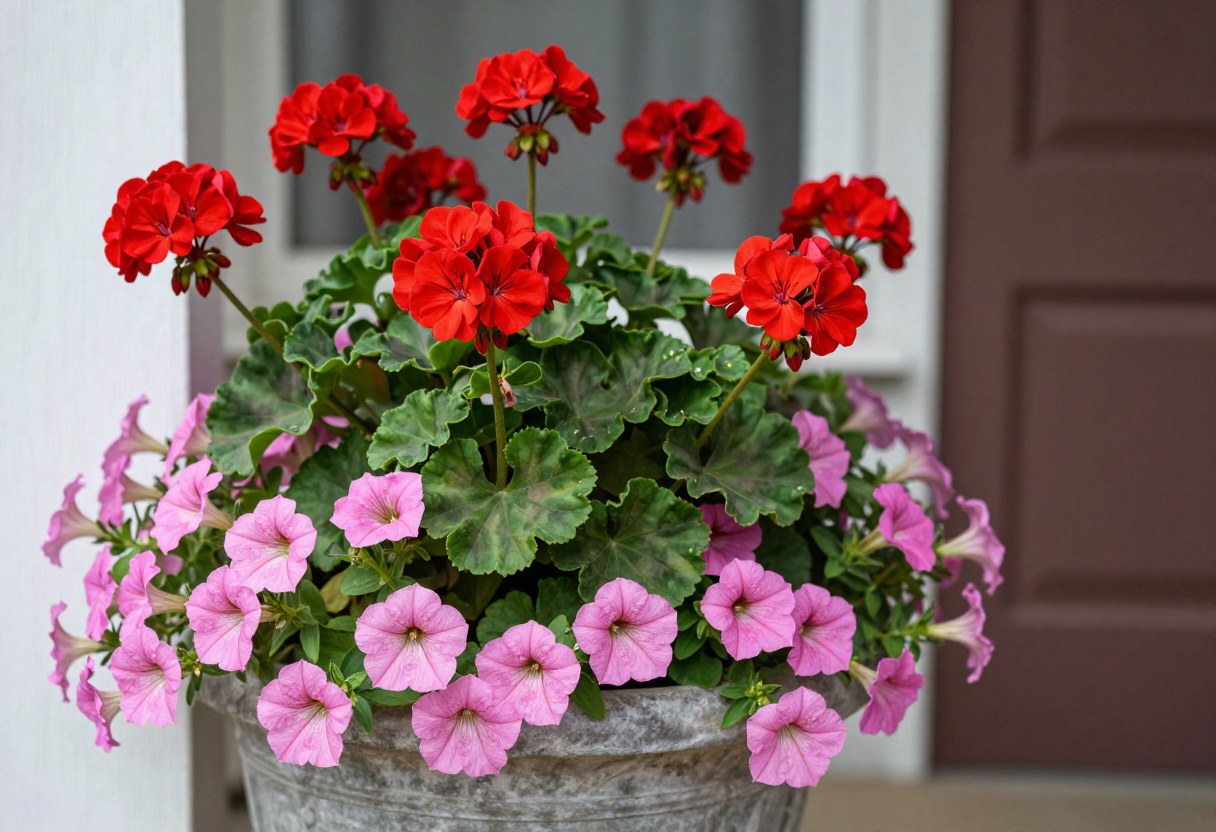
•Filler: Geranium, petunia, vinca, angelonia, or calibrachoa in a color that complements your home's exterior
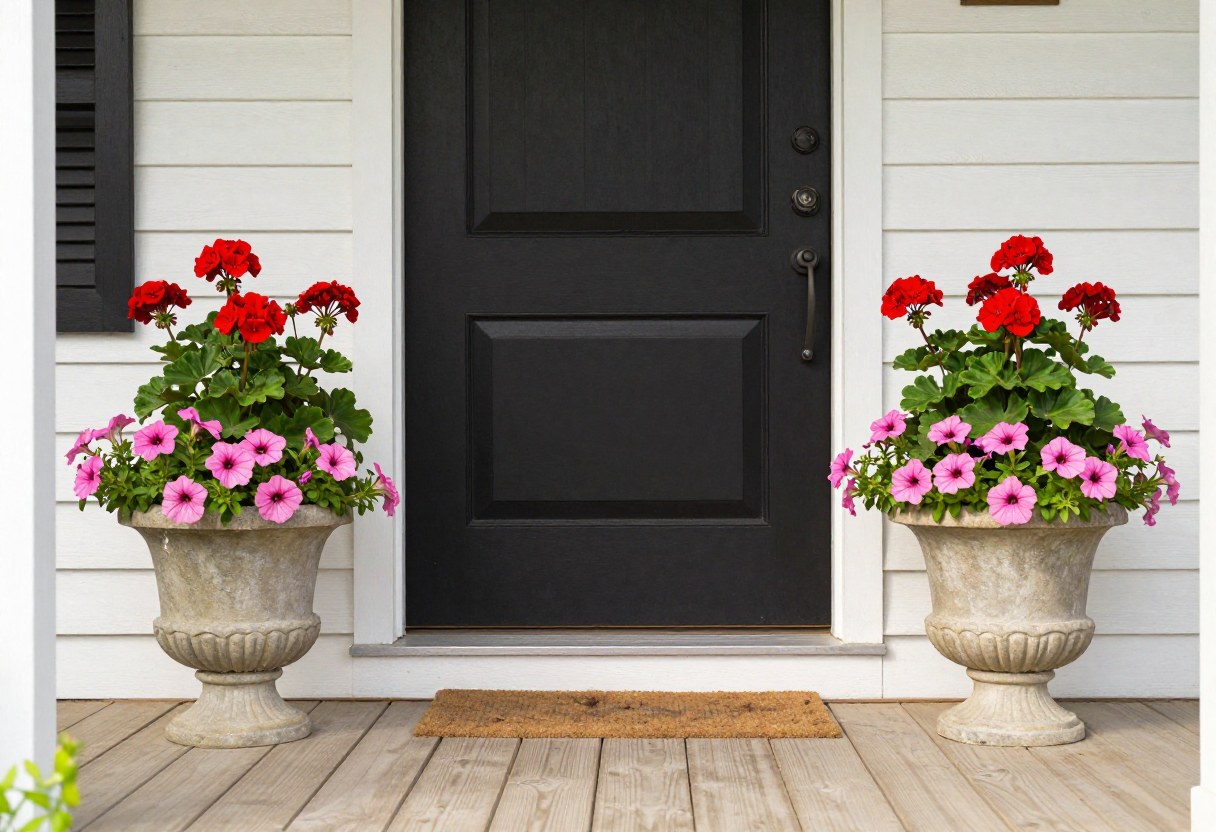
Use a single dominant color with one or two companions rather than mixing every available color in one container. Example: all white petunias + silver dusty miller + trailing white calibrachoa makes a sophisticated, polished statement. All-red combinations (geranium + red salvia + trailing red verbena) are bold and classic. Mixed "party" containers look exciting in the nursery but often become chaotic against a complex home exterior.
A committed single-color combination like this reads as intentional in a way a mixed "party" pot rarely does.
Best Plants for a Shady Porch
A shady porch presents a different but equally exciting planting palette. While you'll sacrifice many flowering annuals, shade opens the door to spectacular foliage plants — the caladiums, ferns, hostas, and coleus that create lush, layered tropical effects that are simply impossible in full sun. A well-planted shady porch can be even more dramatic than a sunny one.
Top Flowering Plants for Shady Porches
Plant
Bloom Color
Shade Tolerance
Notes
Impatiens (New Guinea types)
Full color range; large flowers
Partial shade — needs some light
New Guinea impatiens tolerate more sun than standard types; choose these over standard impatiens to avoid downy mildew
One of the most spectacular shade plants; double flowers in glowing colors; needs rich mix and regular fertilizer
Wax Begonia
Red, pink, white; waxy foliage in green or bronze
Full shade to partial sun
The most reliable and easiest begonia; heat-tolerant for a shade plant; blooms continuously without deadheading
Fuchsia
Red-purple bicolor pendulous flowers
Partial to full shade
The classic hanging basket plant for cool, shady conditions; hummingbirds love it; struggles in heat above 90°F — better for cool-summer climates (Zones 5–7)
Torenia / Wishbone Flower
Purple, pink, white, yellow bicolors
Partial to full shade
Underused annual for shade; flowers resemble tiny snapdragons; heat-tolerant for shade; blooms continuously
Browallia
Blue-purple or white
Partial to full shade
One of the few true blue-flowered shade annuals; compact; good in containers; less common but worth seeking out
Foliage Stars for Shady Porches
Plant
Foliage Effect
Notes
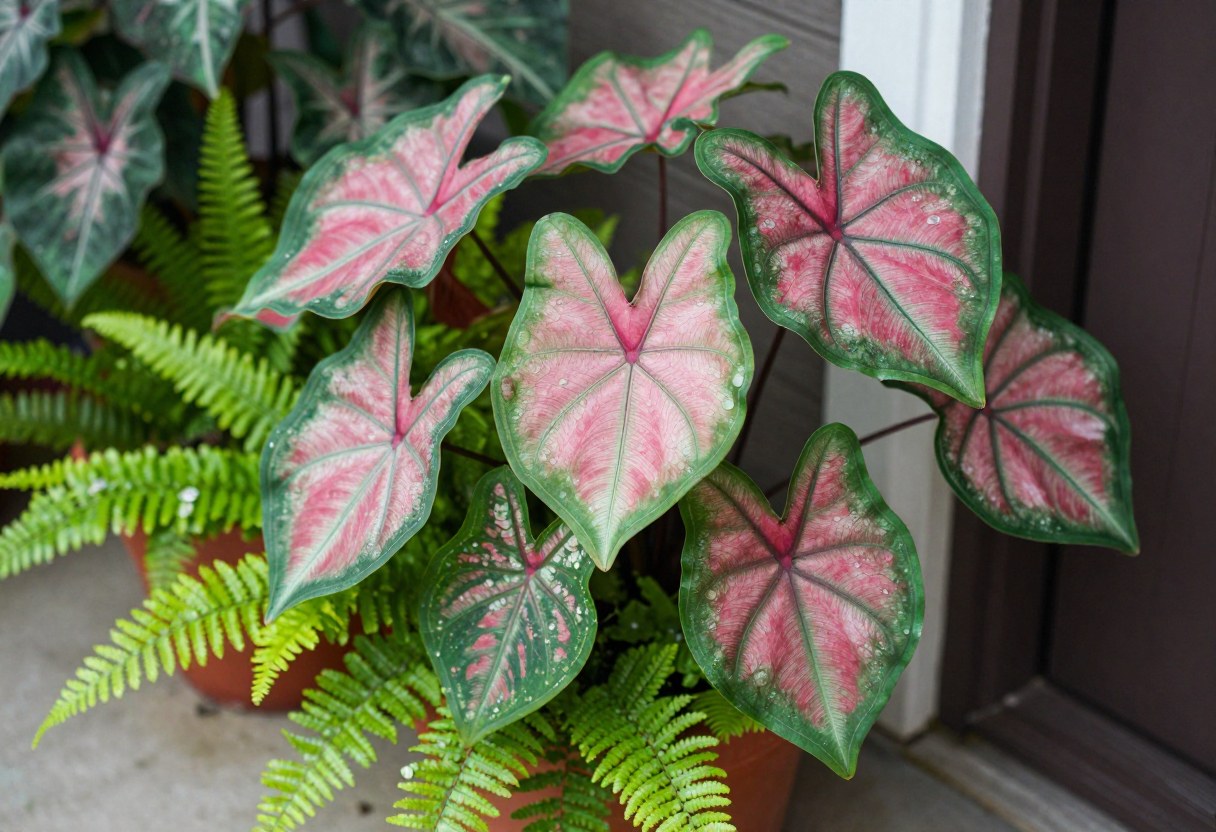
Caladium
Tropical heart-shaped leaves in red, pink, white, green combinations — intensely colorful
The queen of shade foliage; thrives in heat and humidity; dozens of varieties; plant in well-draining mix; spectacular in mass plantings or mixed containers
Modern coleus varieties are far more heat-tolerant than old types; pinch flowers to maintain foliage; grow as annuals everywhere or overwinter cuttings indoors
Hosta (compact varieties)
Blue, green, or gold — often variegated; bold texture
'Miniature Cadet', 'Blue Mouse Ears', or 'Halcyon' for containers; hostas are excellent in shaded porch pots but need winter dormancy — move to garage in Zones 3–6
Ferns (Boston, Kimberly Queen, Autumn fern)
Feathery, arching fronds; lush green texture
Boston fern is the classic porch fern but demands high humidity; Kimberly Queen is more upright and tolerates lower humidity; Autumn fern has copper-red new growth
Persian Shield (Strobilanthes)
Metallic silver-purple iridescence — unlike any other plant
Stunning in shade containers; moderate heat tolerance; overwinters easily as a houseplant; needs some humidity
Rex Begonia
Swirling patterns of silver, burgundy, pink, green — the most ornate foliage of any common plant
Tender houseplant brought outdoors for summer shaded porches; no direct sun ever; loves humidity; spectacular in its own container or mixed with ferns
Elephant Ear (shade types — Colocasia)
Giant green, black, or colorful tropical leaves
Some Colocasia varieties prefer part shade; 'Black Magic' and 'Mojito' thrive in partly shaded conditions; dramatic vertical focal point
🌿
Combine caladiums in contrasting color variations within a single large pot for a spectacular shade container: 'White Queen' (white with green edges) + 'Red Flash' (red with pink and green) + 'Miss Muffet' (lime with maroon spots) creates a living tapestry that intensifies through summer as leaves overlap and layer against each other. Add a trailing coleus at the edges to soften the container rim.
Shade doesn't mean fewer options — it means trading flower color for the kind of layered foliage drama full sun can't match.
Container Selection, Soil, and Feeding
The container and growing medium matter as much as plant selection. The best plant in a poor container with inadequate soil will underperform; the right combination turns a porch into something extraordinary.
Choosing the Right Container
Material
Pros
Cons
Best For
Terra Cotta / Clay
Beautiful; breathable (good for roots in high-humidity areas); traditional
Heavy; breaks in freezing temperatures; dries out very fast in sun and wind; must be brought indoors or emptied in winter
Mediterranean-style plants (lavender, herbs); covered porches where weight isn't a concern; seasonal use in freeze-prone zones
Glazed Ceramic
Beautiful; retains moisture longer than unglazed; heavy enough to resist wind
Very heavy; breaks if water freezes inside; expensive; ensure adequate drainage holes
Shaded porches; specimen focal-point plants; moderate climates (Zones 7+) or seasonal use
Lightweight Fiberglass / Resin (looks like stone/terra cotta)
Looks like ceramic or stone; very light; frost-resistant; durable; keeps moisture well
Less breathable than terra cotta; higher-quality pieces needed for realistic look; some fade in intense UV over years
Upper-floor porches with weight restrictions; large statement containers that need to be moved; cold climates where containers must be brought inside
Self-Watering Containers
Built-in water reservoir reduces watering frequency by 50–70%; excellent for vacation management
More expensive; requires specific watering technique (filling reservoir rather than top-watering); not all plants thrive in constantly moist conditions
Busy households; covered porches where rain doesn't reach; moisture-loving plants like ferns and coleus
Hanging Baskets
Vertical dimension; maximum drainage; allows trailing plants to perform at their best
Dry out very fast — may need daily watering in summer; heavy when planted; requires strong bracket and support
Garden soil becomes compacted, waterlogged, and airless in containers — it is not suitable for any container planting. Use a quality all-purpose potting mix (not potting 'soil') for most porch plants, modified as follows:
•Standard potting mix: suitable for most annuals, perennials, and tropical foliage plants
•Add 20–25% perlite to standard mix for succulents, sedums, and Mediterranean herbs (lavender, rosemary) that need extra drainage
•Add moisture-retaining crystals (water crystals / hydrogel) at label rate for ferns, coleus, and moisture-lovers in hot or sunny exposures — reduces watering frequency significantly
•Cactus / succulent mix: use straight from the bag for succulents, agave, portulaca, and drought-adapted plants
•Orchid bark or chunky mix blended 50/50 with potting mix: ideal for elephant ears and tropical aroids that prefer excellent aeration around roots
Feeding Porch Containers
Container plants exhaust their potting mix nutrients within 4–6 weeks of planting. Without regular fertilization, plants yellow, stop flowering, and decline. This is the most common reason porch containers fade from spectacular to shabby by midsummer.
•Slow-release fertilizer (Osmocote or similar): incorporate at planting time; provides baseline nutrition for 3–4 months; supplement with liquid feeding for heavy bloomers
•Liquid balanced fertilizer (20-20-20 or similar): apply every 10–14 days through the growing season; fastest way to correct a yellowing or underperforming plant
•Bloom-booster fertilizer (high phosphorus, e.g. 15-30-15): switch to this once plants are established (6–8 weeks after planting) to maximize flower production
•Fish emulsion or organic liquid: excellent for leafy foliage plants (coleus, ferns); slower but improves long-term soil biology; not ideal for heavy-blooming annuals
Recommended Product
Osmocote Plus Smart-Release Plant Food — Outdoor & Indoor
The gold standard slow-release fertilizer for container plants. One application at planting lasts all season, providing consistent nutrition so porch containers stay vibrant from May through October.
✓Feeds for up to 6 months with a single application
✓Releases nutrients in response to temperature — fastest when plants need most
✓Contains 11 essential nutrients including micronutrients
✓Works in all containers: pots, hanging baskets, window boxes
Affiliate link — we may earn a small commission at no extra cost to you.
Fragrant Porch Plants — Adding Scent to Your Outdoor Room
A porch is the perfect place for fragrant plants — the enclosed, sheltered space concentrates scent rather than dispersing it into open air. Walking through a porch door flanked by fragrant plants, or sitting in a porch chair surrounded by evening-blooming aromatics, is one of the great simple pleasures of summer.
Plant
Fragrance
Light Need
Notes
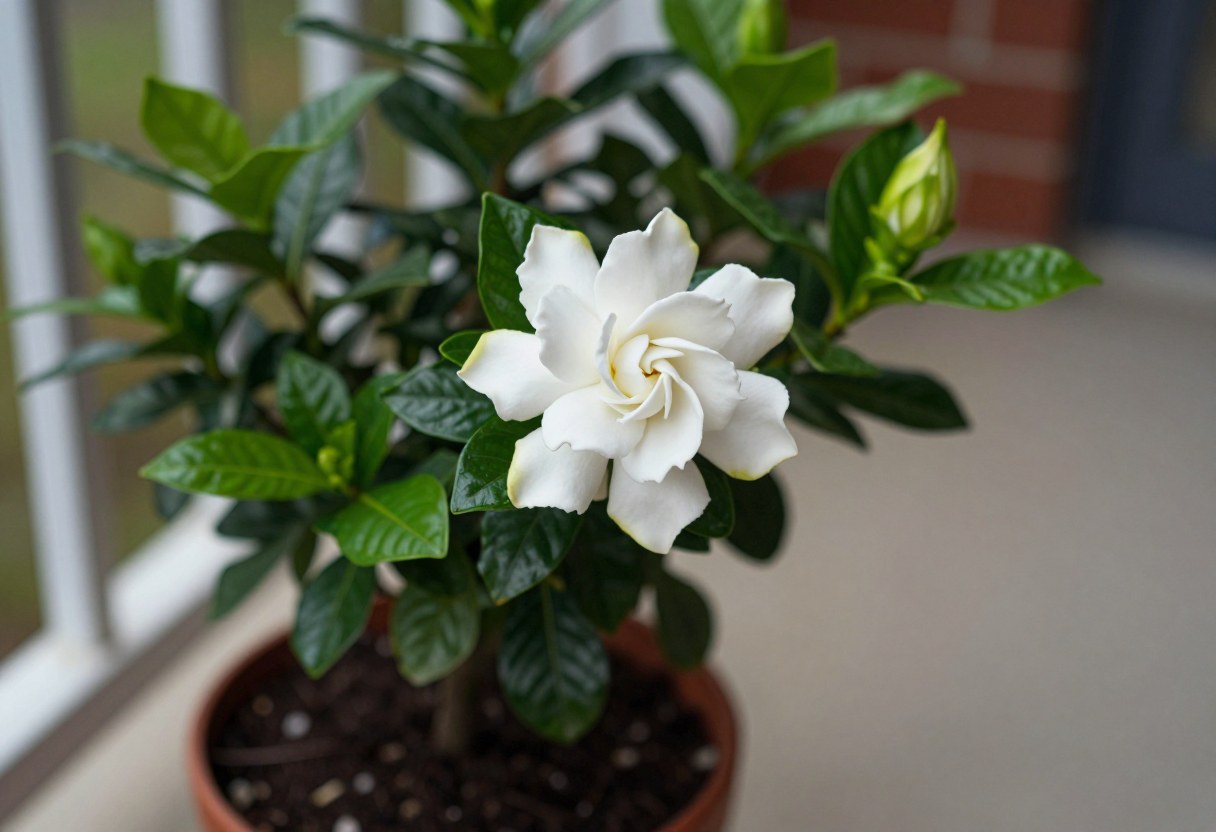
Gardenia (container)
Heavy, tropical, unmistakable — the most powerful porch fragrance possible
Bright indirect to partial sun
Plant in acidic potting mix; keep evenly moist; bring inside before frost; a single plant in bloom scents the entire porch
Jasmine (Jasminum sambac / Star jasmine)
Sweet, classic floral jasmine
Full to partial sun
'Maid of Orleans' (J. sambac) blooms repeatedly with intense scent; Star jasmine (Trachelospermum) is hardier to Zone 7 and excellent on porch posts
Scented Geranium (Pelargonium)
Rose, lemon, nutmeg, mint, or ginger — from the foliage
Full to partial sun
Rub a leaf for instant aromatherapy; not the flower but the foliage that's fragrant; overwinter easily as a houseplant
Heliotrope
Cherry vanilla — intensely sweet and distinctive
Full sun
Plant near a sitting area; one of the most distinctive fragrant annuals; bring inside for winter
Sweet Alyssum
Honey — light, delicate, persistent
Full sun to partial shade
Cascades beautifully over container edges; self-seeds; best in spring and fall when temperatures are cool
Lavender (pots)
Herbal-floral, calming — classic
Full sun essential
Use a terra cotta pot with very fast-draining mix; 'Hidcote' stays compact; move to protected spot in winter (Zones 5–6)
Nicotiana (N. sylvestris)
Jasmine-tobacco — intensely fragrant at night
Full to partial sun
Tall (4 ft); place at the back of a large porch container or in a pot near evening seating; fragrance peaks after dark
Four O'Clocks
Lemony-sweet — strongest at dusk
Full to partial sun
Opens in the late afternoon; excellent for porches used primarily in the evening; deer-resistant; can be grown in large containers
Hyacinth (spring)
Sweet, heavy, classic — outstanding in spring pots
Partial to full sun
Plant bulbs in fall for spectacular spring porch display; after bloom, plant out in the garden; replace with summer annuals
🌙
For an evening porch with all-day use, plant moonflower (Ipomoea alba) on a small trellis in a large container. It blooms only after dark, opening its large white trumpet flowers at sunset and filling the porch with a sweet floral scent through the evening. By morning the flowers are spent and closed — but a new set opens each evening. Train it up a porch post for a stunning vertical element.
The enclosed, sheltered space of a porch concentrates fragrance rather than dispersing it — a single gardenia in bloom can scent an entire seating area.
Seasonal Porch Planting Calendar
Porch containers can be replanted seasonally to maintain impact year-round. This calendar uses Zone 7 as a reference. Shift 2–3 weeks later per zone colder, 2–3 weeks earlier per zone warmer.
Season
Timing (Zone 7)
Plant Choices
Tips
Late Winter / Early Spring
February–March
Pansies, violas, snapdragons, dusty miller, ornamental kale
Pansies tolerate light frost; plant early for instant color when winters end; replace when heat arrives in May–June
Spring
March–May
Add bulbs (tulips, hyacinth, daffodil) in fall for spring display; transition pansy containers to summer annuals as weather warms
Plant a dedicated "spring container" of forced hyacinth bulbs by the front door for fragrance; dismantle after bloom
Early Summer
May–June
Plant main summer containers after last frost: geraniums, petunias, impatiens, caladiums, elephant ears, coleus
This is the main planting event of the year; invest in quality plants and the largest containers you can manage
Midsummer Refresh
July–August
Remove spent plants; add fresh plants where gaps appear; topdress with slow-release fertilizer
Shear back any overgrown petunias or calibrachoa by 50% — they'll flush with new growth and flowers within 2–3 weeks
Early Fall
September–October
Transition to fall: add chrysanthemums, ornamental kale, asters, and late-season color plants; remove tender tropicals before first frost
Kale and mums are fall workhorses; ornamental peppers add unique color; pansies can return for fall in Zones 6–8
Late Fall / Winter
November–February
Evergreen boughs, berry branches, dried seed heads; forced paperwhites or amaryllis on covered porch
Use containers to hold arranged greens, berries, and branches for winter display — no living plants needed but still beautiful
The Porch Mum — The Easiest Fall Transition
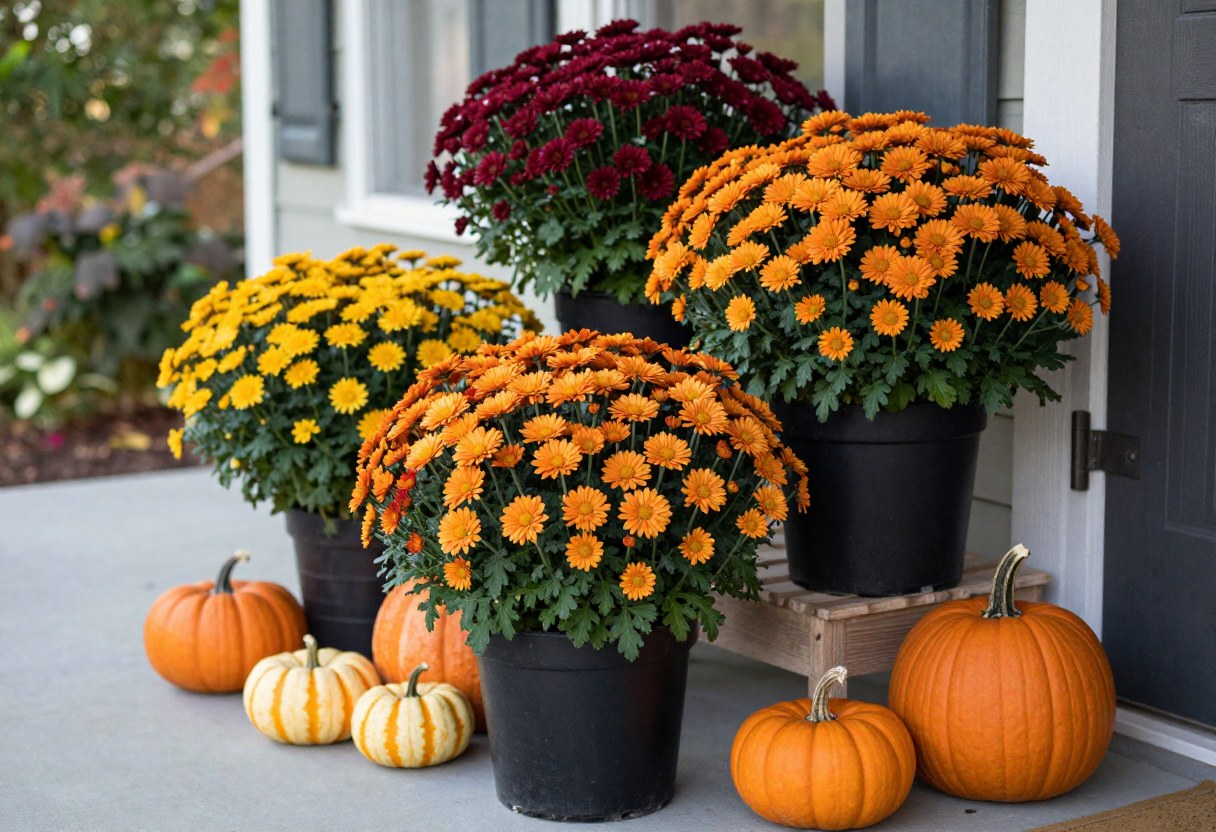
Chrysanthemums (garden mums) are the fastest, most impactful way to transition summer containers to fall. They are sold in full bloom from August through October in every home improvement store and garden center, typically for $8–12 per pot. Placed directly into existing containers between summer plants, or displayed in their own decorative cache pots, they provide 6–8 weeks of bold fall color. Combine with ornamental kale, small pumpkins, and gourds for a complete fall porch display.
🍂
Prolong the life of fall mums by purchasing them in bud rather than full bloom. A plant with mostly closed buds will bloom 3–4 weeks longer than one already at peak. Keep the root ball consistently moist — mums in full bloom dry out very quickly. A mum allowed to wilt severely even once will never fully recover its bloom quality.
Garden mums dropped directly into existing containers are the fastest, cheapest way to carry a porch from summer into fall.
Porch Plant Care — Watering, Deadheading, and Troubleshooting
Porch containers require more consistent care than in-ground plants — but the tasks are simple and quick when performed regularly. The best porch gardeners spend 10–15 minutes every 2–3 days rather than trying to rescue neglected plants with heroic interventions.
The Essential Porch Plant Care Routine
Task
Frequency
Why It Matters
Watering
Daily in hot summer for covered porch; every 2–3 days in moderate weather
The most critical task; containers on covered porches receive no rainfall; check by inserting a finger 1–2 inches into soil — if dry, water thoroughly until it runs from drainage holes
Deadheading
Every 3–5 days for roses, petunias, geraniums; weekly for others
Removing spent flowers signals the plant to produce more rather than setting seed; most important for petunias, geraniums, calibrachoa, and marigolds
Fertilizing
Every 10–14 days with liquid feed; or slow-release at planting
Container nutrients deplete quickly; without feeding, plants yellow and stop blooming by midsummer
Grooming
Weekly
Remove yellow or brown leaves; cut out any dead stems; this is mainly aesthetic but prevents disease from spreading
Pinching
As needed through summer
Pinch growing tips of coleus, basil, and other foliage plants to prevent flowering and maintain bushy habit; pinch back overly long sweet potato vine shoots
Pest inspection
Weekly
Check undersides of leaves for aphids, whitefly, spider mites; catch problems early when they're easy to control with a jet of water or insecticidal soap
Troubleshooting Common Porch Plant Problems
•Yellowing lower leaves on annuals: almost always nitrogen deficiency — apply liquid fertilizer immediately; results visible within 1 week
•Leggy, sparse growth in full-shade plants: not enough light for those plants — move to brighter location or switch to true shade plants
•Wilting despite recent watering: check for root rot (soggy soil, dark mushy roots) caused by poor drainage or overwatering; or check for very tight rootbound pot that can't absorb water normally
•Powdery white coating on leaves (powdery mildew): poor air circulation or overhead watering; apply neem oil or potassium bicarbonate spray; improve airflow around affected plants
•Brown leaf tips on ferns and tropical plants: low humidity; mist foliage daily or place container on a pebble tray with water below the drainage holes
•Petunias sparse in midsummer with few flowers: shear back by one-third; apply liquid fertilizer; they will flush with new growth and re-bloom within 2–3 weeks
•White crusty deposits on terra cotta pots: mineral salts from water and fertilizer; scrub with a stiff brush and dilute white vinegar; not harmful to plants but aesthetically undesirable
Overwintering Porch Plants — Saving Your Favorites
Many of the best porch plants are tender perennials — tropical or subtropical plants that will die at frost but can be saved and reused for many years if brought indoors before cold arrives. This extends the investment of premium plants and allows you to develop mature specimens that are far more dramatic than nursery starts.
Plant
How to Overwinter
Where to Store
Bring Back Out
Geranium (Pelargonium)
Cut back by half; pot up if in ground; keep barely moist
Cool but frost-free: 45–55°F; garage, basement, or cool sunroom
March–April; gradually reintroduce to outdoor light
Gardenia
Bring inside before nights below 50°F; reduce watering
Bright window; 60–65°F; high humidity (pebble tray); no cold drafts
After last frost; re-acclimate to outdoor conditions gradually over 2 weeks
Heliotrope
Take cuttings in September; root in water or potting mix
Bright windowsill; standard indoor temperatures
After last frost; grow on as a houseplant all winter
Coleus
Take 4-inch stem cuttings before frost; root easily in water
Any bright windowsill; excellent houseplant
After last frost; can grow as a year-round houseplant
Elephant Ear (Colocasia / Alocasia)
Dig tubers after frost kills tops; allow to dry 24 hours
Paper bag or mesh bag; 55–65°F; dry; do not freeze
Start tubers indoors 4–6 weeks before last frost; plant outdoors after danger of frost
Caladium
Dig tubers before frost; dry thoroughly in shade
Dry storage in peat moss or vermiculite; 65–70°F minimum — caladiums rot if too cold
Start tubers indoors 6–8 weeks before last frost in warm soil
Jasmine (tender types)
Bring inside as houseplant; reduce watering and fertilizing
Bright window; cooler temperatures (55–65°F) encourage rest; resume watering in spring
After last frost; prune back lightly to encourage new growth before returning outside
Scented Geranium
Cut back; bring inside as houseplant
Bright window; standard temperatures; water sparingly
After last frost; hardier than zonal geraniums; often survives light frost
🐛
Inspect every plant carefully before bringing it indoors for winter — especially the undersides of leaves and the surface of the potting mix. Common hitchhikers include fungus gnats (in damp soil), mealybugs (white cottony clusters at leaf joints), and scale insects (brown waxy bumps on stems). Treat with insecticidal soap before moving indoors to prevent spreading pests to houseplants.
✂️
Even if you decide not to overwinter a plant as a whole, take 3–4 stem cuttings from your best performers in late summer and root them in a glass of water on a sunny windowsill. Coleus, impatiens, geraniums, and sweet potato vine all root readily this way. By spring, you'll have free, vigorous young plants ready to go back onto the porch — plants that are genetically identical to last year's best performers.
🌿 Get Seasonal Gardening Tips
New guides, planting reminders, and growing tips — straight to your inbox.
No spam. Unsubscribe anytime.
About the Author
David Rodgers is the Founder & Head Gardener of Planting Atlas. With over 40 years of hands-on gardening experience in Oklahoma's Zone 7 climate, he researches, writes, and personally tests every guide on the site.
David draws from real backyard trials, soil testing, and trusted sources like Oklahoma State University Extension and USDA data to deliver practical, zone-specific advice that actually works.