Year-Round Color and Structure with Conifers and Broadleaf Evergreens
Every well-designed landscape has a skeleton — a permanent framework of structure, mass, and greenery that holds the composition together through every season. Evergreen trees are that skeleton. They are the reason a garden looks purposeful and alive in January, not just in May. They create the backdrop against which flowering trees bloom, deciduous foliage turns orange and gold, and perennials make their seasonal appearance. Without them, most residential landscapes would look bare, flat, and lifeless for four to five months of the year.
Why Evergreens Are the Backbone of Every Landscape
Every well-designed landscape has a skeleton — a permanent framework of structure, mass, and greenery that holds the composition together through every season. Evergreen trees are that skeleton. They are the reason a garden looks purposeful and alive in January, not just in May. They create the backdrop against which flowering trees bloom, deciduous foliage turns orange and gold, and perennials make their seasonal appearance. Without them, most residential landscapes would look bare, flat, and lifeless for four to five months of the year.
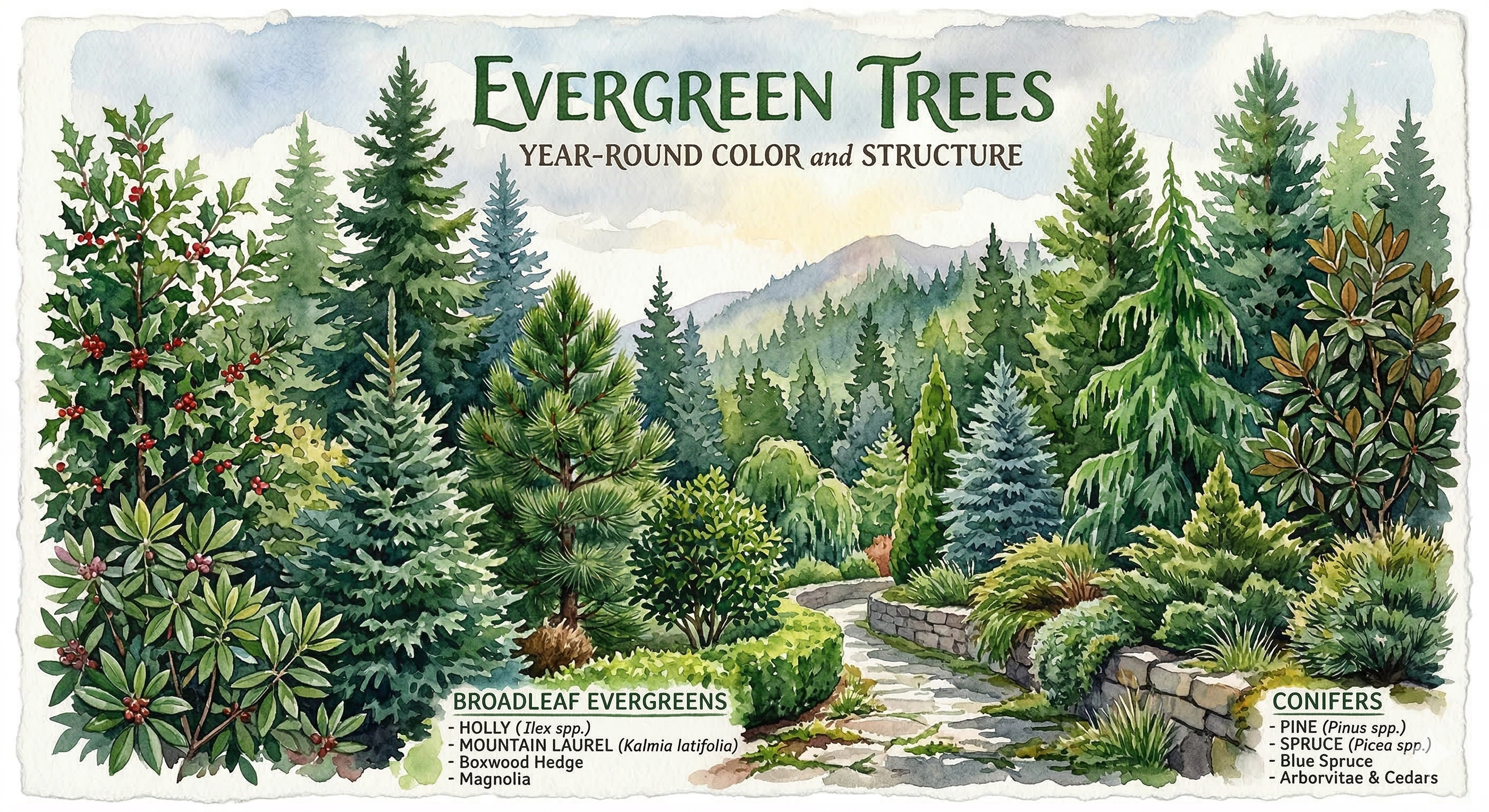
Evergreen trees come in two fundamentally different forms. Conifers — the pines, spruces, firs, junipers, arborvitaes, hemlocks, yews, and cedars — carry needle or scale-like foliage and are typically (though not always) cold-hardy to remarkable extremes. Broadleaf evergreens — hollies, Southern magnolias, live oaks, camellias, cherry laurel, wax myrtles — carry traditional flat leaves that persist year-round and tend to perform best in warmer climates. Understanding the difference between these two groups, and knowing which representatives of each group serve specific landscape functions best, is the foundation of successful evergreen selection and use.
🌲
A Note on the Word 'Evergreen': Evergreen does not mean indestructible or static. All evergreen trees shed and replace their foliage — just not all at once, and not in autumn. Pines typically hold their needles 2–5 years; spruces and firs 5–7 years; arborvitaes and junipers 3–4 years. Inner needles turn brown and drop naturally each fall — a process that alarms many homeowners but is completely normal. Broadleaf evergreens also shed leaves periodically, usually replacing them in spring as new growth emerges. This is not a problem; it's how the tree works.
What Evergreens Contribute to the Landscape
•Year-round structure: Unlike deciduous trees, evergreens maintain their volume, mass, and visual presence in every season. A well-placed evergreen defines space, blocks wind, and creates visual enclosure even in February.
•Privacy and screening: No fence can match a mature row of evergreen trees for effectiveness, beauty, or the way it improves with age. Evergreens are the most functional privacy solution available to homeowners.
•Windbreaks: A properly designed evergreen windbreak on the north and west sides of a property can reduce winter heating costs significantly by intercepting prevailing cold winds. The protection extends downwind a distance of roughly 10x the height of the tallest trees.
•Wildlife habitat: Evergreens are critical winter habitat for birds — they provide shelter from wind, rain, and predators, nesting sites, and in many species, seeds and berries for winter food. A property with mature conifers will have dramatically more bird activity in winter than one without.
•Backdrop and contrast: The deep, steady green of conifers makes flowering trees, ornamental grasses, and deciduous fall color pop with far greater intensity. Every landscape needs a backdrop, and evergreens provide it.
•Sound and pollution buffering: Dense evergreen plantings reduce noise transmission and filter particulates from traffic and other sources — a meaningful benefit for properties near roads.
This is the skeleton doing its job — the same structure that reads as backdrop in June becomes the entire show in January.
Section 1: Understanding Evergreen Types — Conifers vs. Broadleaf
Before selecting any evergreen, it helps to understand what distinguishes the two major categories and what that means for your landscape.
Conifers — The Cold-Hardy Needle-Bearers
Conifers are defined by two characteristics: they bear their seeds in cones, and most carry needle or scale-like foliage. This foliage architecture is a brilliant adaptation to cold and dry conditions. Needles have a small surface area relative to their volume, are coated with a waxy cuticle that dramatically reduces moisture loss, and are highly resistant to freeze damage. This is why conifers dominate cold-climate forests from zone 2 through zone 7, and why they form the backbone of northern and mountain landscapes.
Within the conifer category, different genera have different needle types, growth habits, soil requirements, and landscape uses. The key genera are:
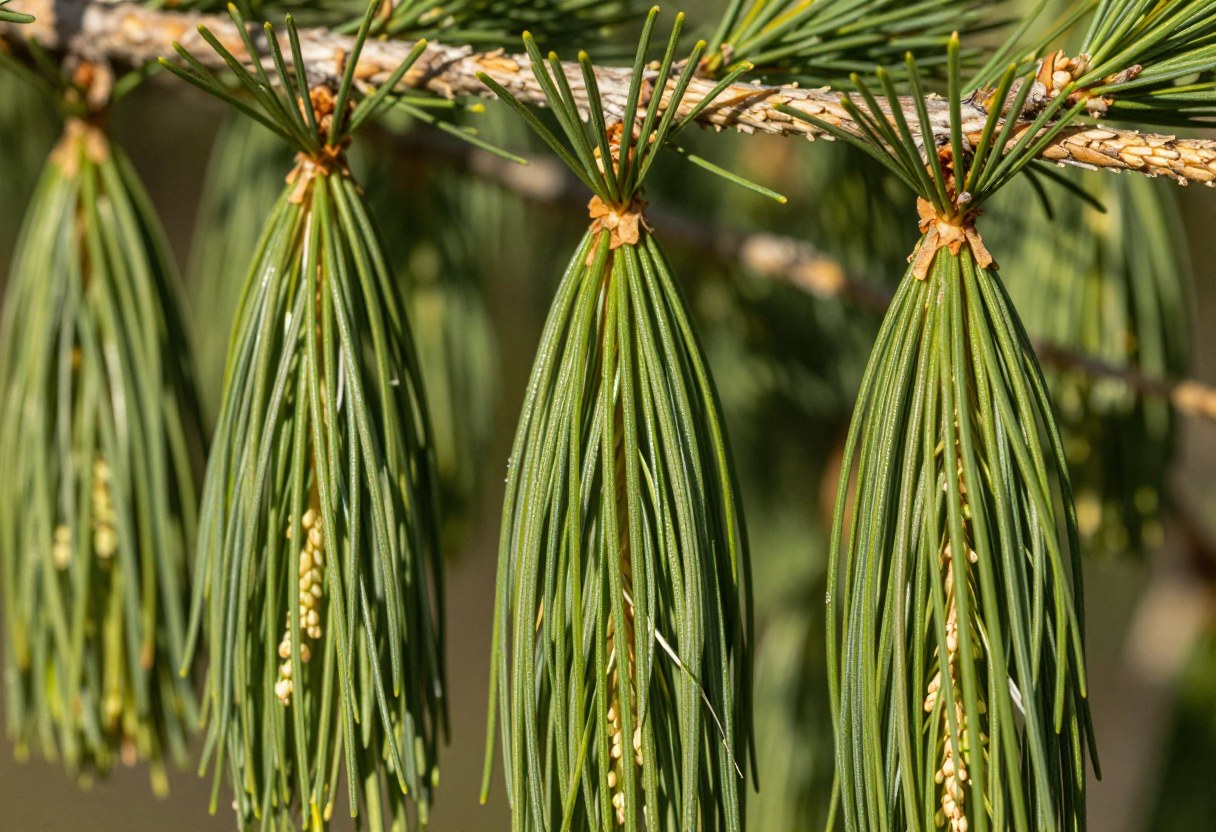
•Pines (Pinus): Needles in bundles of 2, 3, or 5 held together at the base by a papery sheath. Generally the most drought-tolerant and fastest-growing conifers. As they mature, most pines lose lower branches and develop an open, layered, high-canopied form that allows underplanting. Excellent for windbreaks and naturalistic landscapes.
•Spruces (Picea): Short, stiff, 4-sided needles that attach individually to the branch on small woody pegs. Hold needles for many years. Maintain dense lower branches well into maturity, making them excellent for screens and windbreaks. Needles are often sharp — wear gloves when working with them.
•Firs (Abies): Flat, soft needles with two white bands underneath. More tolerant of shade than pines or spruces. Many species have striking ornamental cones that stand upright on branches rather than hanging. Prefer cooler, moister conditions than pines.
•Junipers (Juniperus): Scale or awl-like foliage (or both, on the same tree). Extremely wide range of sizes and forms — from low groundcover junipers to 40-foot trees. Among the most drought-tolerant and adaptable of all conifers. Produce aromatic blue-gray berries (technically fleshy cones). Eastern red cedar (J. virginiana) is the most important native juniper in eastern North America.
•Arborvitaes / Thujas: Flat, scale-like foliage in fan-like sprays with a distinctive aromatic fragrance when crushed. Among the easiest and most reliable evergreens for privacy screening. Several species and many cultivars; Green Giant arborvitae is currently the most-planted privacy evergreen in the eastern US.
•Hemlocks (Tsuga): Soft, flat needles with two white bands underneath; drooping branch tips give a graceful, flowing character unlike any other conifer. Very shade-tolerant — one of the few conifers that thrives on the north side of buildings. The finest screening and hedging plant for partial shade. Requires consistent moisture.
•Yews (Taxus): Dark, flat needles; flexible red-fleshed berry-like seeds (not true berries; seeds are poisonous). Exceptional shade tolerance, tolerance of pruning, and longevity. The definitive formal hedging and topiary plant. Long-lived — yews centuries old exist in European landscapes.
•False Cypress / Chamaecyparis: Scale-like foliage in flat fan sprays. Wide range of garden cultivars in many sizes, forms, and foliage colors including gold, blue-green, and deep green. From small specimens to medium-sized trees.
•True Cedars (Cedrus): Needles in dense clusters on short spur shoots; large, barrel-shaped upright cones. Majestic specimen trees for larger landscapes. Three commonly planted species: Atlas cedar, Deodar cedar, and Lebanon cedar. Not cold-hardy into the upper Midwest or New England (typically zones 6–9).
•Cryptomeria (Japanese Cedar): Soft, awl-like needles; reddish-brown exfoliating bark; columnar to pyramidal form. Valuable ornamental tree for zones 5–9. Foliage often bronzes in cold winters, returning to green in spring.
Broadleaf Evergreens — Southern Charm and Lush Texture
Broadleaf evergreens carry flat, traditional-looking leaves that remain on the plant year-round. As a group, they are less cold-hardy than most conifers — most perform best in zones 6 through 10, though there are cold-hardy exceptions. They typically offer richer leaf texture, often flowering, and some produce ornamental fruit. They bring a lushness and subtropical quality to landscapes that conifers, for all their virtues, cannot replicate.
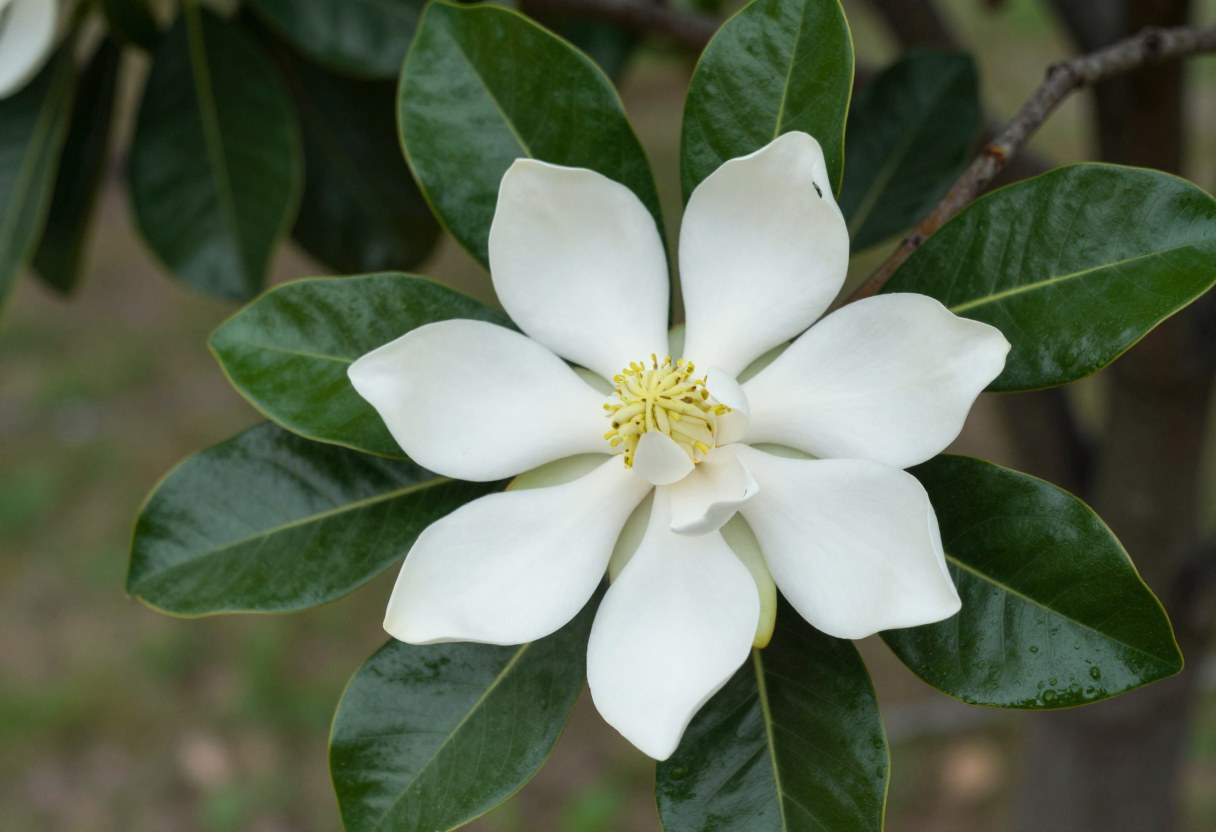
•Southern Magnolia (Magnolia grandiflora): The iconic broadleaf evergreen of the American South — enormous glossy leaves with rust-brown undersides, massive fragrant white flowers in early summer, and a dense pyramidal to oval form. Zones 7–9. Compact cultivars like 'Little Gem' (20–25 feet) and 'Bracken's Brown Beauty' bring this species within reach of more gardens.
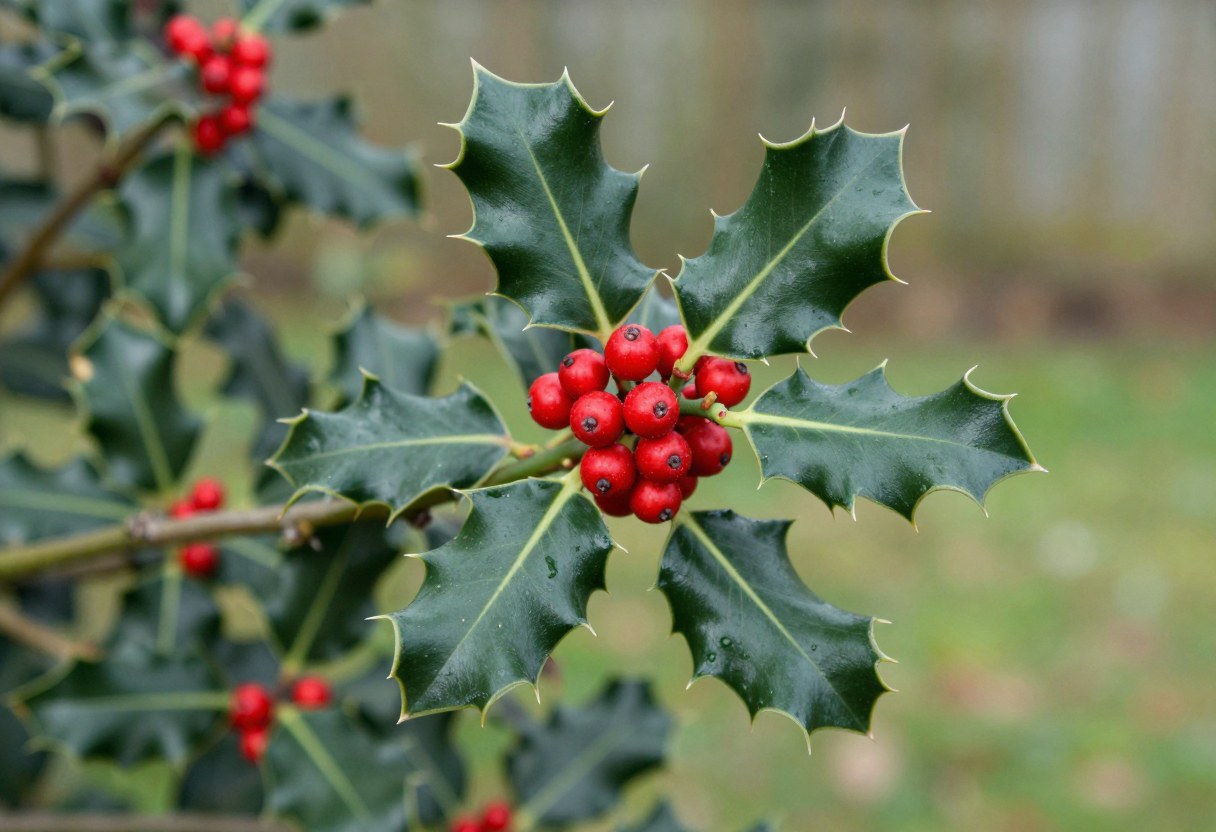
•American and Evergreen Hollies (Ilex): Perhaps the most versatile and landscape-important broadleaf evergreen genus. Glossy, often spiny leaves; red, orange, yellow, or black berries on female plants (male pollinators required for most). Hardy from zones 3 (inkberry) to 9 (Chinese holly). Nellie R. Stevens holly is the most-planted evergreen holly for screening in zones 6–9.
•Cherry Laurel / Skip Laurel (Prunus laurocerasus): Fast-growing broadleaf evergreen with large, glossy deep-green leaves. Excellent for fast privacy screens in zones 6–9. Fragrant white flower spikes in spring; dark berries in fall. Tolerates shade better than most privacy trees.
•Wax Myrtle (Morella cerifera): Fast-growing native broadleaf evergreen for zones 6–10. Aromatic olive-green foliage; waxy blue-gray berries attractive to birds. Excellent for informal screening, coastal planting, and rain gardens. Tolerates wet soils and salt spray.
•Camellia (Camellia japonica and C. sasanqua): Broadleaf evergreen shrubs and small trees prized for winter and early spring flowers in white, pink, and red. Glossy dark green leaves year-round. Zones 6–9. Excellent foundation and specimen plants for shaded or partial-shade locations in the South.
•Live Oak (Quercus virginiana): The great broadleaf evergreen tree of the Deep South — massive spreading canopy, incredibly long-lived (centuries), iconic landscape presence. Zones 7–10. Produces small acorns that are critical wildlife food.
•Sweetbay Magnolia (Magnolia virginiana): Semi-evergreen in the North, fully evergreen in the South. Attractive silver-green leaves; creamy, lemon-scented flowers in late spring and into summer. Excellent for wet or poorly drained sites — one of the most moisture-tolerant ornamental trees. Zones 5–10.
•Leyland Cypress (x Cuprocyparis leylandii): Fast-growing (3–4 feet per year) narrow conifer hybrid widely used for quick privacy screening in zones 6–10. Important caveat: Leyland cypress is prone to several serious diseases including Seiridium canker and Botryosphaeria canker in humid climates; not recommended as a long-term investment in the Southeast. Arborvitae or holly are more reliable alternatives.
Section 2: Choosing the Right Evergreen — A Systematic Approach
The single biggest mistake in evergreen selection is choosing based on appearance at the nursery rather than performance in the specific landscape situation. An arborvitae that looks perfect at the garden center can become a dead, brown monstrosity within three years if planted in heavy wet soil or deep shade. Start with conditions, not with plants.
Step 1 — Define the Function
Function
Key Requirements
Top Candidates
Privacy Screen / Visual Buffer
Dense foliage to groundline, year-round coverage
Green Giant arborvitae, Emerald Green arborvitae, Nellie Stevens holly, cherry laurel, Norway spruce, Skip laurel
Windbreak
Height, density, wind resistance; typically multi-row
Eastern white pine, Norway spruce, Colorado blue spruce, Eastern red cedar, Douglas fir
Specimen / Focal Point
Exceptional form, color, or texture as standalone accent
Colorado blue spruce, weeping Norway spruce, Blue Atlas cedar, Japanese cryptomeria, Deodar cedar
Foundation Planting
Moderate size, good form, appropriate scale to house
Dwarf Alberta spruce, Emerald Green arborvitae, yew, compact holly, Hinoki cypress
Shade Tree (Broadleaf)
Large canopy, year-round leaf retention
Southern magnolia, live oak, sweetbay magnolia
Wildlife Habitat
Shelter, nesting sites, berries or seeds as food
Eastern red cedar, American holly, Eastern hemlock, native hollies, white pine
Slope Erosion Control
Root system that anchors soil; tolerates harsh conditions
Juniper (many species), eastern red cedar, shore pine, rugosa rose + conifer combo
Accent Color
Blue, gold, or unusual foliage for year-round interest
Colorado blue spruce, Blue Atlas cedar, Gold mop false cypress, 'Rheingold' arborvitae
Step 2 — Know Your Site Conditions
Hardiness zone is just the beginning. These site factors are equally or more important:
•Soil drainage: The most commonly overlooked site factor. Most conifers absolutely require well-drained soil — planting arborvitae, spruce, or fir in a low-lying wet area almost guarantees failure. Exceptions: sweetbay magnolia, bald cypress, Atlantic white cedar, wax myrtle, and inkberry holly tolerate wet conditions. If in doubt, dig a 12-inch hole, fill with water, and check drainage: if water sits for more than an hour, drainage is poor.
•Soil pH: Most conifers prefer slightly acidic soil (pH 5.5–6.5). Broadleaf evergreens like hollies, rhododendrons, and camellias prefer acidic soil (pH 4.5–5.5). Plants in alkaline soil (pH 7.0+) often develop iron chlorosis — yellowing between the veins — despite adequate fertilizing. Test your soil before planting.
•Sunlight: Most conifers and broadleaf evergreens need full sun (6+ hours). Major shade-tolerant exceptions: hemlock, yew, cherry laurel, some hollies. Even 'shade-tolerant' evergreens will grow more slowly and less densely in shade than in sun.
•Wind exposure: South and west exposures are warmer but can cause winter desiccation. North and northeast exposures are coldest and may push some broadleaf evergreens beyond their hardiness limits. Windy, exposed hilltops need the toughest species (pines, junipers, spruce).
•Salt exposure: Properties near roads treated with deicing salt, or coastal properties with salt spray, need salt-tolerant species. Best salt-tolerant evergreens: Eastern red cedar, Colorado blue spruce, Austrian pine, inkberry holly, wax myrtle, shore pine.
•Mature space: Perhaps the most chronically underestimated factor. A Norway spruce planted 6 feet from a window will, in 20 years, have blocked the window entirely and begun damaging the foundation. Always plan for mature spread, not current size.
Step 3 — Match Growth Rate to Patience and Purpose
Growth Rate
Time to Effect
Examples
Best Use
Slow (under 1 ft/yr)
6–12+ years to substantial size
Dwarf Alberta spruce, Hinoki cypress, yew, Korean fir, false cypress dwarf cultivars
Foundation plantings, accents, rock gardens, small yards — permanent features
Moderate (1–2 ft/yr)
5–8 years to screening height
Eastern white pine, balsam fir, American holly, Emerald Green arborvitae, Eastern hemlock
Most residential landscape uses; good balance of patience and performance
Privacy screens where quick results are needed; windbreaks
Very fast (3–5 ft/yr)
1–2 years to screening height
Leyland cypress, Green Giant arborvitae (top end)
Immediate impact — but monitor for disease; not a long-term strategy in humid Southeast
⚠️
The Fast-Grower Trap: Fast-growing privacy trees are tempting, but speed always comes with trade-offs. Leyland cypress grows 4 feet per year but develops serious disease problems in humid conditions and has a lifespan often under 25 years. Overplanted monoculture screens of any single fast-growing species are vulnerable to pest and disease problems that can wipe out an entire screen in a few seasons. Mixing species is always better than monoculture, and a moderately fast grower like Green Giant arborvitae — disease-resistant, deer-resistant, adaptable — is almost always a better investment than Leyland cypress.
Section 3: The Star Conifers — Detailed Profiles
These are the most important and versatile conifers for residential landscaping across North America. For each genus, the most useful landscape species and cultivars are highlighted.
🌲 Eastern White Pine (Pinus strobus) — The Graceful Giant
Eastern white pine is arguably the finest large conifer for residential landscaping in zones 3–8. It grows to 80+ feet at maturity, but reaches usable screening height (15–20 feet) within 5–8 years. The 5-needled clusters are soft, blue-green, and non-prickly, making it pleasant to plant near areas where people walk. Its texture is softer and more graceful than most spruces or firs. Unlike many pines, it maintains reasonable lower branch density for decades, making it effective for privacy and windbreaks for a long time before eventual limbing-up occurs.
•Light: Full sun to part shade. More shade-tolerant than most pines.
•Soil: Prefers well-drained, sandy to loamy, slightly acidic soil. Intolerant of wet, compacted, or highly alkaline soils. Also sensitive to road salt.
•Wildlife value: Outstanding — provides critical habitat for 21+ bird species. Seeds eaten by many songbirds, squirrels, and small mammals. One of the most wildlife-valuable native trees in eastern North America.
•Key use: Windbreaks, wildlife plantings, naturalistic landscapes, privacy screens on larger properties. Too large for small suburban yards in the long term.
•Notable cultivars: 'Fastigiata' (narrow columnar to 40 feet, excellent for tight spaces), 'Pendula' (dramatic weeping specimen).
•Watch for: White pine blister rust (avoid planting near currant/gooseberry plants); white pine weevil (damages central leader — prune out and destroy affected tips in spring).
The bundled sheath at the base is the giveaway for pines — spruces and firs attach their needles individually, never in these papery-wrapped clusters.
🌲 Norway Spruce (Picea abies) — The Reliable Workhorse
Norway spruce is one of the most widely planted large conifers in the northern United States and is among the best options for windbreaks and privacy screens. It grows vigorously (2–3 feet per year when young), maintains dense, low branching well into maturity, and tolerates a wide range of conditions including some clay and moderately poor drainage. The drooping branchlets give it a graceful, layered appearance. It's one of few conifers reliably hardy to zone 2.
•Light / Soil: Full sun; adaptable to most well-drained soils; tolerates clay better than most conifers.
•Size: 60–100 feet tall, 25–30 feet wide at maturity. Allow generous spacing (20+ feet) in long-term plantings.
•Key use: Windbreaks, large-scale privacy screens, wildlife habitat, specimen tree. Too large for small properties.
•Watch for: Cytospora canker (dieback of lower branches — primarily affects stressed trees; maintain tree health), Rhizosphaera needle cast.
🌲 Colorado Blue Spruce (Picea pungens) — The Statement Specimen
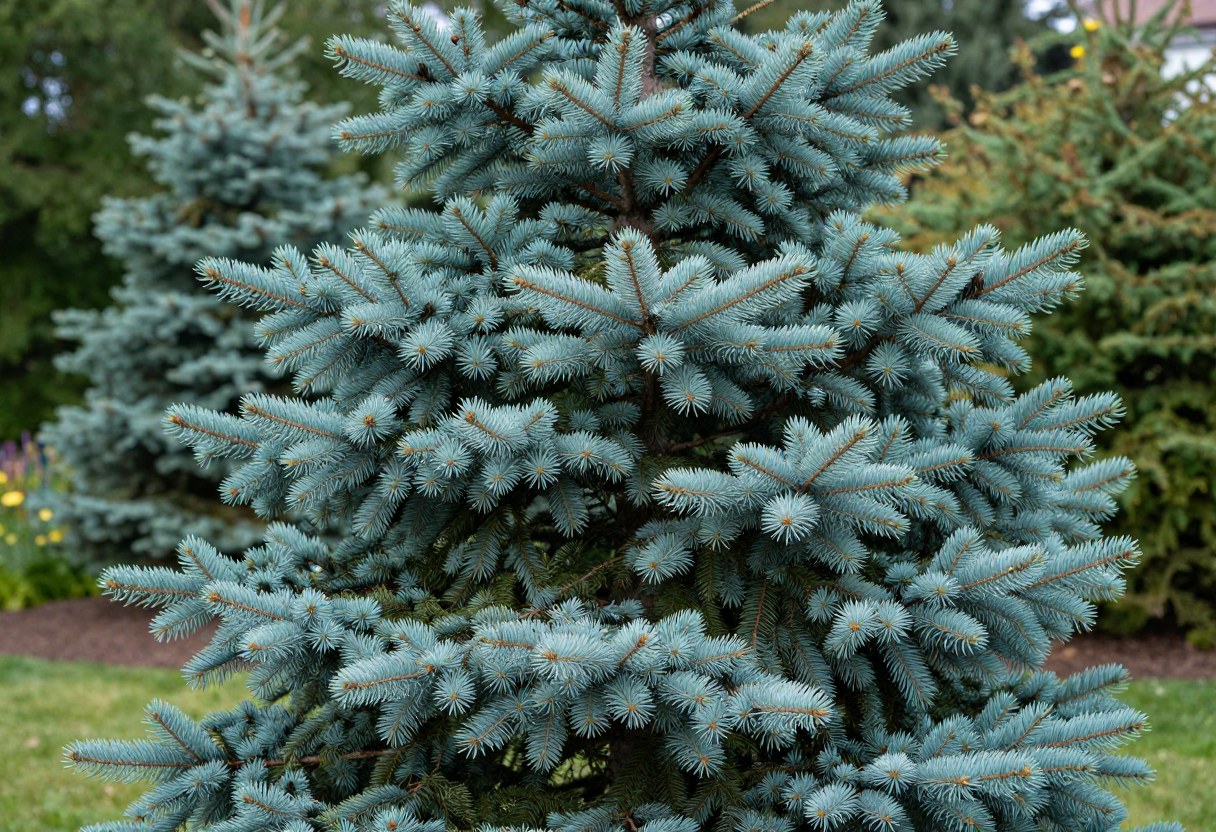
Colorado blue spruce is one of the most visually striking evergreens available — its steel-blue to silver-blue needles provide year-round color unlike any other common landscape tree. It grows as a dense, perfectly symmetrical pyramid for decades and tolerates cold to zone 2. These qualities have made it one of the most popular specimen conifers in American landscaping.
However, Colorado blue spruce has significant disease problems in the humid East and Southeast — Rhizosphaera needle cast and Stigmina needle cast cause progressive loss of interior needles starting from the bottom of the tree, eventually leaving a skeleton of bare lower branches. In the drier Rocky Mountain West and northern Great Plains where it is native, it is magnificent and nearly trouble-free. In humid climates east of the Mississippi, it should be used with caution and given excellent air circulation.
•Best zones / regions: Zones 2–7; best performance in the West and upper Midwest. Use with caution in humid Southeast.
•Soil: Adaptable; prefers well-drained, slightly acidic; surprisingly drought-tolerant once established.
•Disease management: Space at least 15 feet from other spruce; avoid overhead irrigation; apply preventive copper fungicide in spring if Rhizosphaera is common in your area.
Magnificent and nearly trouble-free in its native dry West — in the humid East, that same steel-blue density needs generous spacing and air circulation to avoid needle cast.
🌲 Green Giant Arborvitae (Thuja standishii x plicata 'Green Giant') — The Privacy Champion
Green Giant is currently the most widely planted privacy screen evergreen in the eastern United States, and for good reason. It grows 3–5 feet per year when young, reaching 20–30 feet at maturity with an 8–12 foot spread. It holds a dense, naturally pyramidal form without shearing. It is deer-resistant, highly disease-resistant, adaptable to a wide range of soil types, and maintains rich green color through winter without the bronzing that affects some arborvitaes. It's also resistant to most insect pests.
•Zones: 5–9.
•Light: Full sun to light shade. Performs best in full sun.
•Soil: Adaptable; prefers well-drained but tolerates clay if not waterlogged. Avoid standing water.
•Spacing for privacy screen: 5–6 feet apart center-to-center for a dense screen. 8 feet apart for a slightly more open but still effective screen that costs less initially. Staggered double row at 10–12 feet between rows and 8–10 feet within rows gives the densest result.
•Maintenance: Little to none once established. Can be lightly sheared to control height if desired. Never cut into old bare wood.
•Caution: Green Giant is an excellent tree in the right situation, but monoculture screens of any single species are vulnerable. Mix in American holly, Douglas fir, or eastern red cedar for diversity and resilience.
🌲 Emerald Green Arborvitae (Thuja occidentalis 'Smaragd') — The Compact Screener
Where Green Giant is the large-scale privacy solution, Emerald Green is the residential favorite. It grows to 10–15 feet tall and only 3–4 feet wide — a columnar-to-narrow-pyramidal form that fits between windows, along property lines, and in spaces where Green Giant would eventually overwhelm. Its bright green color holds well through winter without bronzing. Growth rate is 1–2 feet per year — slower than Green Giant but still reasonable for screening purposes.
•Zones: 2–8; the cold hardiness is exceptional.
•Spacing: 3–4 feet apart for a solid hedge; 5 feet for a slightly more natural screen.
•Soil: Adaptable; prefers moist, well-drained soil. Drought stress is the most common cause of browning — water during dry periods, especially in the first two years.
•Watch for: Bagworms (inspect in midsummer; hand-pick or apply Bt spray); spider mites in hot, dry conditions; deer browsing (apply deer repellent or use Green Giant if deer pressure is high).
🌲 Eastern Red Cedar (Juniperus virginiana) — The Toughest Native
Eastern red cedar is the most cold-hardy, drought-tolerant, and adaptable evergreen native to eastern North America. It grows on rocky outcrops, clay slopes, sandy barrens, and abandoned agricultural fields where almost nothing else survives. Its dense, dark blue-green to silvery-green foliage provides year-round screening; female plants produce abundant small blue-gray berries that are one of the most important winter food sources for birds — cedar waxwings in particular will flock to fruiting trees in remarkable numbers.
•Zones: 2–9.
•Size: Species typically 40–50 feet; many cultivars in various sizes and forms.
•Notable cultivars: 'Taylor' (extremely narrow columnar, 20 feet tall, 2–3 feet wide — the best cold-hardy columnar evergreen), 'Blue Arrow' (similar narrow columnar form), 'Brodie' (dense oval, excellent for screens).
•Watch for: Cedar-apple rust (orange gelatinous galls appear after rain in spring — unsightly but not life-threatening; separate from nearby apple trees if possible). Do not plant near apple orchards.
•Key use: Wildlife habitat, windbreaks, naturalistic landscapes, urban planting, challenging sites. Underused and undervalued in formal landscapes despite its exceptional toughness.
🌲 Eastern Hemlock (Tsuga canadensis) — The Shade-Tolerant Masterpiece
Eastern hemlock is the finest shade-tolerant evergreen for privacy screening and formal hedging in the eastern US. Its soft, flat needles with white undersides, gracefully drooping branch tips, and dense pyramidal form give it a distinctive elegance that no other conifer can match. It tolerates deep shade — one of the very few conifers that performs well on north-facing slopes and under the canopy of taller trees. It responds beautifully to shearing, making it the best evergreen for formal hedges.
•Zones: 3–7.
•Soil: Prefers cool, moist, well-drained, acidic soil. Intolerant of drought, compaction, and pollution. Not suitable for dry, exposed, or urban sites.
•Critical threat: Hemlock woolly adelgid (HWA) — a devastating invasive insect spreading from the South that kills hemlocks within 4–10 years of infestation. Check with your local cooperative extension for current HWA presence in your region. In affected areas, hemlocks require regular systemic insecticide treatment (imidacloprid soil drench) to survive.
•Spacing for hedges: 3–4 feet apart; shear in late spring after new growth flushes.
•Wildlife value: Outstanding — seeds are important winter food; dense branches provide critical shelter habitat.
🌲 Additional Notable Conifers
•Douglas Fir (Pseudotsuga menziesii): Pyramidal to 80+ feet; excellent windbreak tree for zones 4–6; soft, fragrant foliage; better than most spruces for windy exposed sites. Native to the West but adaptable across much of the country.
•Concolor Fir / White Fir (Abies concolor): Outstanding large specimen tree for zones 3–7 with distinctive blue-green to silver-blue flat needles — similar color to blue spruce but without the needle disease problems. More adaptable to heat and drought than most firs. Citrus-scented foliage. Zones 3–7.
•Korean Fir (Abies koreana): Compact (15–20 feet) with outstanding ornamental cones — upright purple-blue cylinders that appear even on young trees. 'Silberlocke' cultivar has needles that curl upward to reveal bright silver undersides, creating a glittering frosted appearance. Zones 4–7.
•Japanese Cryptomeria (Cryptomeria japonica): Graceful conifer with reddish-brown exfoliating bark and soft, awl-like foliage. Columnar to 40+ feet; 'Yoshino' is the most popular cultivar for privacy screening. Foliage bronzes in winter, returns to green. Zones 5–9.
•Deodar Cedar (Cedrus deodara): Majestic large specimen with gracefully drooping branch tips and soft blue-green to gray-green needles. A truly elegant tree reaching 40–70 feet. Zones 7–9. Not cold-hardy into the upper Midwest or New England.
•Blue Atlas Cedar (Cedrus atlantica 'Glauca'): Striking silvery-blue specimen tree with stiff horizontal branching and a dramatic irregular form as it matures. 40–60 feet tall. Zones 6–9. Weeping form 'Glauca Pendula' is a spectacular garden sculpture when trained to a specific form.
Section 4: The Star Broadleaf Evergreens — Detailed Profiles
Broadleaf evergreens bring a different kind of beauty than conifers — richer leaf texture, often spectacular flowers or berries, and a lush, almost tropical quality that transforms southern landscapes in particular. Most perform best in zones 6–10, with a few cold-hardy exceptions extending to zone 5.
🌿 Southern Magnolia (Magnolia grandiflora) — Icon of the South
The Southern magnolia is one of the most magnificent broadleaf evergreen trees in cultivation. Its enormous, glossy, deep-green leaves — often 8–10 inches long, with distinctive rust-brown felted undersides — create a dense, lush canopy that provides year-round visual interest. From late spring through early summer, the tree produces enormous (8–12 inch diameter) cup-shaped white flowers with a powerful, sweet lemon fragrance that carries extraordinary distances on warm evenings. In fall and winter, ornamental cone-like seed pods with bright red seeds add another layer of interest.
•Size: Species: 60–80 feet tall, 30–50 feet wide. For most residential landscapes, compact cultivars are essential.
•Zones: 7–9; some cultivars rated to zone 6b with protection.
•Key compact cultivars: 'Little Gem' (20–25 feet tall, 8–12 feet wide, reblooms over 6+ months, excellent for smaller yards), 'Bracken's Brown Beauty' (dense pyramidal, 30–40 feet, excellent cold hardiness to zone 6b), 'D.D. Blanchard' (formal pyramidal, 30–40 feet, dark glossy leaves with rich brown undersides), 'Kay Parris' (semi-dwarf, 20–25 feet, very reliable bloomer).
•Soil: Moist, well-drained, slightly acidic. Tolerates clay if not waterlogged. Established trees are surprisingly drought-tolerant.
•Key considerations: Shallow, wide root system — plant away from foundations and paving. Drops large leathery leaves throughout the year; avoid planting where leaf cleanup is difficult. Provide a generous mulch ring.
A single flower can span 8-12 inches — the lemon fragrance carries far enough on a warm evening that you'll smell the tree before you see it.
🌿 American Holly (Ilex opaca) — Native Winter Jewel
American holly is a stately native broadleaf evergreen tree with spiny, dull to glossy green leaves and brilliant red berries that persist through winter — providing critical food for cedar waxwings, robins, mockingbirds, and dozens of other bird species. It grows slowly to 15–30 feet in cultivation (larger in ideal conditions), developing a dense, pyramidal form. Female plants berry prolifically; one male per 5–6 females is sufficient for pollination. It's one of the most wildlife-valuable broadleaf evergreens in eastern North American landscapes.
•Zones: 5–9.
•Light: Full sun to part shade.
•Soil: Moist, well-drained, acidic (pH 4.5–6.0). Tolerates clay if not waterlogged.
•Pollination: Plant at least one male within 50–100 feet of female plants. Good male pollinators include 'Jersey Knight' and 'James Swan.' Female cultivars with exceptional berrying: 'Jersey Princess,' 'Satyr Hill,' 'Old Heavy Berry.'
•Key use: Specimen tree, wildlife habitat, informal screening, mixed native plantings. Slower to establish than some alternatives but ultimately more beautiful and wildlife-valuable.
🌿 Nellie R. Stevens Holly (Ilex x 'Nellie R. Stevens') — The Privacy Workhorse
Nellie R. Stevens holly has become one of the most widely planted broadleaf evergreens in the eastern US for good reason — it grows relatively quickly (2–3 feet per year), maintains dense foliage from ground to crown, produces abundant red berries without needing a separate male pollinator (self-fertile to a degree, though a male holly nearby increases production), and is remarkably adaptable. Its dark, glossy leaves are less spiny than American holly, making it easier to work around. Zones 6–9.
•Size: 15–25 feet tall, 8–12 feet wide — naturally pyramidal. Can be maintained at any desired height with pruning.
•Spacing for screens: 6–8 feet apart for a dense living fence. 10 feet for a more naturalistic screen.
•Pruning: Prune in late winter or early spring, or right after the first flush of new growth. Tolerates hard pruning and shearing.
•Also consider: 'Mary Nell' (similar to Nellie Stevens but more refined), 'Emily Bruner' (taller, more upright), 'Oakleaf' (slightly smaller, distinctive leaf shape).
Those berries only appear on female plants — and only if a male holly is blooming somewhere within 50-100 feet to pollinate them.
🌿 Cherry Laurel / Skip Laurel (Prunus laurocerasus) — Fast and Handsome
Cherry laurel is one of the fastest-growing and most reliable broadleaf evergreens for screening in zones 6–9. Its large (4–6 inch), glossy, deep-green leaves create an exceptionally dense visual barrier that filters wind and sound effectively. In spring, fragrant white flower spikes appear along the branches, followed by dark purple-black berries attractive to birds. It tolerates partial shade better than nearly any other fast-growing screening tree.
•Size: Species can reach 30+ feet; 'Skip Laurel' is the most popular compact cultivar at 10–18 feet tall and 5–7 feet wide, making it ideal for residential screening.
•Zones: 6–9 (some sources say zone 5b with protection).
•Soil: Adaptable — tolerates clay, sand, drought once established, and moderate shade. One of the most site-tolerant broadleaf evergreens.
•Spacing: 5–7 feet apart for Skip Laurel privacy screen; 8–12 feet for species.
•Watch for: Shot hole fungus in wet climates (brown spots with holes in leaves; treat with copper fungicide; improve air circulation through proper spacing); Prunus aphid.
🌿 Additional Broadleaf Evergreens Worth Knowing
•Wax Myrtle (Morella cerifera): Fast-growing native for zones 6–10. Aromatic olive-green foliage; excellent for wet sites, coastal locations, and wildlife gardens. Grows to 10–15 feet; responds well to pruning. Masses of waxy blue-gray berries in fall for birds.
•Sweetbay Magnolia (Magnolia virginiana): Graceful, semi-evergreen to fully evergreen depending on zone. Outstanding for wet or poorly drained sites — thrives where other trees fail. Creamy, lemon-scented flowers June into summer. Excellent native alternative to Southern magnolia for cooler zones (5–10).
•Portuguese Laurel (Prunus lusitanica): More cold-hardy than cherry laurel (zones 6–9, some sources say 5). Smaller, more refined dark green leaves; fragrant white flowers in long racemes in spring; small dark berries. Excellent formal hedge and screening plant.
•Live Oak (Quercus virginiana): The defining broadleaf evergreen tree of the Deep South — massive, spreading, incredibly long-lived. Zones 7–10. Not suited to northern landscapes but irreplaceable in its native range. Plant away from structures given its enormous eventual size.
•Osmanthus (Tea Olive, Osmanthus fragrans): Prized for its extraordinarily fragrant tiny white or apricot flowers in fall and winter. Dense, holly-like foliage. Zones 7–9. One of the most fragrant plants in cultivation — a single tree in bloom perfumes an entire yard.
•Camellia (Camellia japonica / sasanqua): Broadleaf evergreen with glossy dark leaves and spectacular winter to spring flowers. Sasanqua camellias bloom in fall and are slightly more cold-hardy (zones 6–9); japonica types bloom in winter/spring (zones 7–9). Both prefer partial shade and acidic, well-drained soil.
Section 5: Planting Evergreens for Long-Term Success
Evergreens are often slow to establish and expensive to replace if planting mistakes are made. Getting the fundamentals right at planting time pays dividends for decades.
When to Plant
•Early fall (September–October): The best planting window for most evergreens. Soil is still warm enough for root growth, temperatures are cooling so trees don't face summer heat stress, and rains are typically more reliable. Roots establish through fall and early winter even as tops go largely dormant.
•Early spring (before bud break): Second-best window. Soil is workable and cool; trees immediately push new growth to establish. Avoid planting in the heat of late spring when combined transplant shock and heat stress can be lethal.
•Avoid: Midsummer planting (heat stress on transpiring evergreens is severe); late fall after soil has frozen (no root establishment possible); late season planting in areas with harsh winters — new evergreens need at least 6 weeks to establish before hard freezes.
The Planting Hole
The most critical principle in tree planting: the hole should be wide but not deep. Plant at exactly the right depth — the root flare (where the trunk widens as it meets the soil) must be at or just above grade. Planting even 2 inches too deep causes girdling roots, trunk rot, and slow decline over years.
•Width: 2–3 times wider than the root ball. This loosens the surrounding soil so establishing roots can penetrate easily.
•Depth: Exactly as deep as the root ball — no deeper. Set the root ball in the hole and check that the root flare sits at or just above grade. Firm the base of the hole if needed to prevent settling.
•Backfill: Use the native soil you excavated. Research consistently shows that adding amendments to the backfill (compost, peat, topsoil) does not improve establishment and in some conditions creates a 'bathtub effect' where amended soil holds moisture against roots that prefer the surrounding soil. Amend the entire planting area, not just the hole.
•The NO gravel myth: Never add a layer of gravel at the bottom of the hole for 'drainage.' This creates a perched water table that keeps the root ball saturated. For drainage problems, raise the planting grade or choose a more moisture-tolerant species.
Mulching — Do This Right
A proper mulch ring is one of the most beneficial things you can do for a newly planted evergreen. It conserves moisture, moderates soil temperature, suppresses competing grass and weeds, and improves soil biology as it decomposes.
•Depth: 2–4 inches of coarse organic mulch (arborist chips, shredded bark, pine needles). Not finely shredded leaves or sawdust — these mat and can restrict air and water penetration.
•Extent: As wide as possible — ideally to the drip line (edge of the canopy). Minimum 3 feet radius.
•The volcano rule: Keep mulch away from the trunk — minimum 6 inches of clearance. Mulch piled against the trunk causes bark rot, fungal disease, and rodent damage. A flat donut shape, not a volcano.
🌱
First-Year Watering: Establishing evergreens need deep, thorough watering during their first growing season — especially conifers, which are less obvious about water stress than broadleaf trees. A wilting broadleaf tree is visibly distressed. A stressed conifer may look fine for weeks before interior needles begin turning brown. For all newly planted evergreens: water deeply every 7–10 days during the first growing season (more frequently in sandy soils or heat); reduce to every 14 days in year 2. Always water until the soil is wet to a depth of 8–10 inches. In fall, water until the ground freezes — this is the single most effective way to prevent winter burn.
Privacy Screen and Windbreak Planting Design
•Single row privacy screen: Space at 50–75% of mature spread. Green Giant arborvitae: 5–6 feet apart. Emerald Green arborvitae: 3–4 feet apart. Nellie Stevens holly: 6–8 feet apart. Skip laurel: 5–7 feet apart. This spacing creates initial gaps that close within 3–4 years.
•Double-row staggered screen: For maximum density and resilience, plant two rows with trees staggered like footprints — offset 5–10 feet between rows, staggered so each tree in the second row fills the gap of the first. This creates faster coverage and a more naturalistic appearance. More trees required, but substantially better long-term result.
•Species diversity: Never plant a screen of all one species. Mix 2–3 compatible species: Green Giant + Nellie Stevens holly + cryptomeria, for example. This creates visual variety, reduces disease risk, and provides resilience — if one species has problems, the screen doesn't fail entirely.
•Windbreak design: Multi-row windbreaks with varying heights provide better protection than single rows. Place taller trees in the center or back row, shorter dense species in front. Windbreak protection extends 10x the height of the tallest trees downwind; 20–30x under optimal conditions.
•Distance from structures: Plant at least half the mature spread away from property lines and structures. A 15-foot-wide mature arborvitae planted 2 feet from the fence will eventually damage it. Always check mature dimensions.
Section 6: Ongoing Care — Keeping Evergreens Healthy and Beautiful
Established evergreens are among the lowest-maintenance trees in the landscape. But they are not no-maintenance — several care practices make the difference between trees that decline slowly over decades and trees that thrive and improve with age.
Watering Established Evergreens
Established evergreens (3+ years in the ground) generally need supplemental water only during extended drought. The key signs of drought stress differ by type:
•Conifers: Needle tips and inner needles begin turning brown and dropping prematurely; needles look dull rather than waxy; in severe cases, branches die from the tips inward.
•Broadleaf evergreens: Leaf curling (especially in rhododendrons and hollies); marginal browning; early leaf drop; wilting on hot afternoons.
During drought, water deeply and infrequently rather than lightly and often. A deep soak every 10–14 days during dry periods is more beneficial than daily light watering, which encourages shallow roots. Water the entire root zone (extending to and beyond the drip line), not just the base of the trunk.
Fall watering before ground freeze is critical — perhaps the most important single watering event of the year. Evergreens going into winter with dry soil are far more vulnerable to winter burn. Continue watering until the ground is consistently frozen, which may mean watering into early December in many zones.
Fertilizing Evergreens
Most established evergreens in ordinary residential soils benefit from occasional fertilization, but excessive fertilization — especially with high-nitrogen fertilizers — promotes soft, lush growth that is more susceptible to winter injury, insects, and disease. A soil test is the most reliable guide to what your specific trees actually need.
•Timing: Apply fertilizer in early spring as growth begins, or in early fall (September) to support root development without pushing vulnerable late-season top growth. Never fertilize in summer or late fall.
•Product: A balanced, slow-release granular fertilizer appropriate for evergreens (look for acidifying fertilizers for acid-loving species like hollies, rhododendrons, and camellias). Avoid quick-release high-nitrogen products.
•Amount: Follow label recommendations based on trunk diameter or square footage — never apply more than recommended. Over-fertilized evergreens develop rapid, weak growth that winter-kills and invites disease.
•When not to fertilize: Newly planted trees (wait 1–2 years); trees that are drought-stressed; trees with root rot or other serious problems (correct the problem first); mature, healthy trees in good growing conditions (they may not need fertilizing at all).
Pruning Evergreens — Less Is Usually More
Tree Type
Best Timing
How to Prune
Pines
Spring (when candles are extending)
Minimal — remove dead or diseased branches anytime. To control size, cut candles (new spring shoots) by 1/2 to 2/3 before they harden. NEVER cut into old bare wood — pines will not regenerate from bare branches.
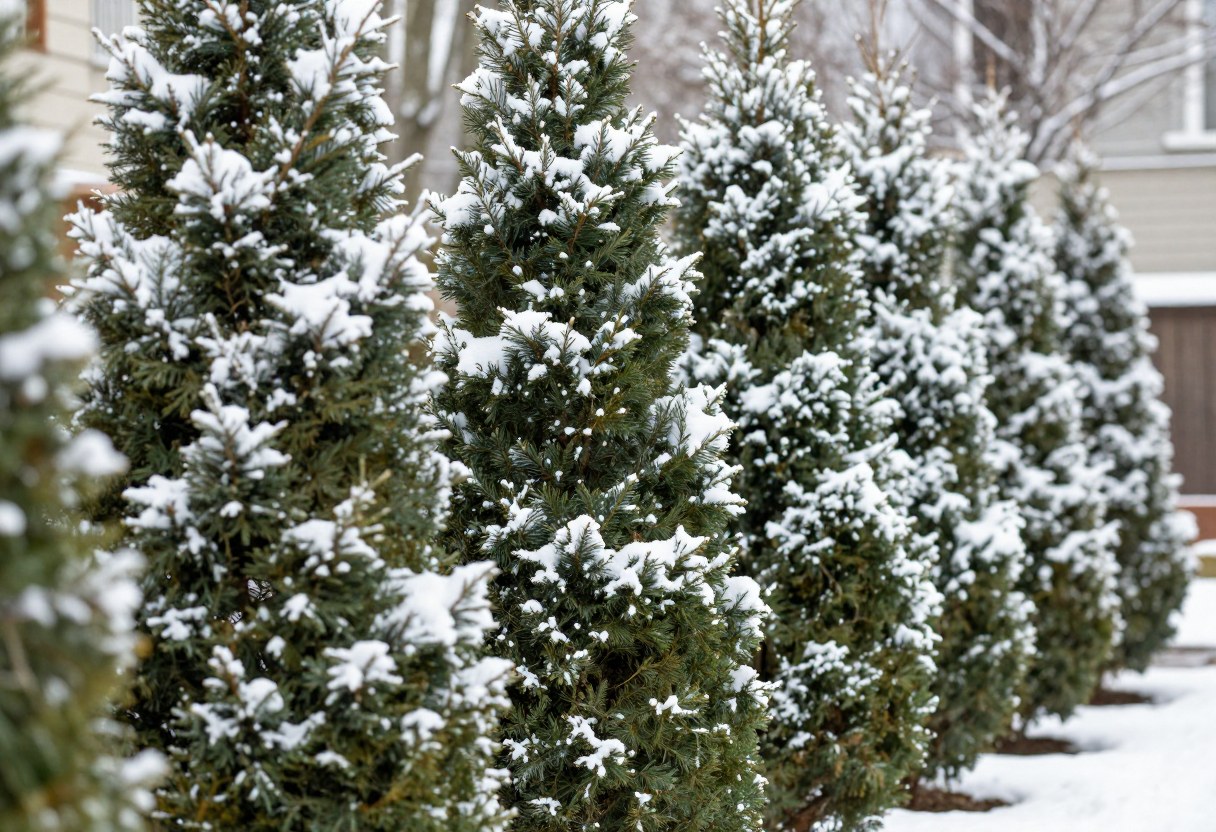
Spruces and Firs
Late spring after new growth extends
Minimal. Remove dead/diseased branches anytime. Light tip pruning after new growth hardens is acceptable for size control. Like pines, do not cut into old bare wood.
Arborvitae and Junipers
Late spring to midsummer (avoid late summer/fall)
Tolerates regular shearing for hedge form. Always leave green foliage on pruned branches — bare wood won't regenerate. Shape while young for best long-term results.
Yews
Late spring, or early spring before growth
Most tolerant of pruning of all conifers — can be cut back hard into old wood and will regenerate. Excellent formal hedging plant. Can be sheared anytime except late summer/fall.
Hemlocks
Late spring after new growth extends, or early spring
Excellent hedge plant — tolerates shearing well. Can be maintained at any height. Responds to renovation pruning if overgrown.
Southern Magnolia
Late spring after flowering
Minimal — remove dead/crossing branches. Young trees can be shaped. Mature trees require almost no pruning.
Hollies
Late winter to early spring (before new growth)
Tolerates heavy pruning. Prune to shape or control size. Avoid late summer/fall pruning — promotes tender growth that winter-kills.
Cherry Laurel
Late winter or right after flowering
Tolerates heavy pruning and renewal cutting. Can be cut back severely if overgrown and will regrow vigorously.
✂️
The Old-Wood Rule for Conifers: Most conifers (pines, spruces, firs) will not regenerate from bare, brown, needle-free wood. If you cut a branch back to bare wood, that branch dies — permanently. Always leave green foliage beyond your cut. Yews are the notable exception — they will regenerate even from bare old wood, which is why they are such exceptional hedging plants. When in doubt about any conifer, leave green foliage beyond every pruning cut.
Winter Care and Winter Burn Prevention
Winter burn is the most common winter damage to evergreens, and understanding it is essential for keeping them healthy. It is caused by desiccation — foliage loses moisture through transpiration faster than frozen roots can replace it. The result is browning, typically starting on the windward or sun-exposed side of the plant, usually becoming apparent in late winter or early spring as temperatures rise.
•Prevention — the fundamentals: Water deeply until the ground freezes (fall watering is the single most effective prevention). Apply 3–4 inch mulch ring to insulate roots and retain soil moisture. Avoid late-season fertilizing that pushes tender growth.
•Site selection: Plant winter-sensitive evergreens on protected sides of the property — north or east exposures, or sheltered by buildings, fences, or established windbreaks. Exposed south and west sites cause the worst winter burn.
•Burlap wrapping: For newly planted or marginally hardy evergreens, burlap screens on windward stakes (not wrapped tightly around the plant) can reduce moisture loss significantly. This is most important for the first 2–3 winters while the tree establishes. Avoid plastic wrapping — it traps heat and moisture and can cause rot.
•Anti-desiccant sprays: Products like Wilt-Pruf coat foliage with a thin waxy film that reduces moisture loss. Apply in late fall when temperatures are above 40°F. Most beneficial for broadleaf evergreens (hollies, rhododendrons) and arborvitaes in exposed, windy locations.
•Recovery: Wait until late spring before cutting back winter-burned branches — many will push new growth from apparently dead wood. Scratch the bark with your thumbnail; green tissue means the branch is alive. Cut dead branches back to live tissue only after new growth confirms what is living and what is not.
Common Problems and Solutions
Problem
Symptoms
Solution
Winter burn (desiccation)
Brown foliage on wind/sun-exposed side; typically appears late winter or early spring
See Winter Care section. Water until ground freeze; mulch; protect with burlap; choose hardy, well-adapted species for the site
Rhizosphaera needle cast (spruce)
Progressive loss of interior needles starting from bottom of tree; affected needles turn brown and drop each fall
Apply copper fungicide preventively in spring; space trees for air circulation; choose resistant species in humid climates
Cytospora canker (spruce, pine)
Dieback of individual lower branches; white resin bleeding from affected areas
No chemical cure; maintain tree health; remove severely affected trees; improve drainage and air circulation
Bagworms
Spindle-shaped bags (1.5-2 inches) of silk and plant material hanging from branches; defoliation
Hand-remove bags Oct–May (eggs inside); apply Bt or spinosad when caterpillars are small (late spring)
Hemlock woolly adelgid
White cottony masses at needle bases; rapid needle loss and decline
Apply imidacloprid soil drench annually; consult arborist for large trees; check local extension for regional situation
Spider mites
Stippled, gray-green needles; fine webbing; worst on dwarf Alberta spruce in hot, dry conditions
Strong water spray to dislodge; neem oil; insecticidal soap; keep plants well-watered
Root rot (Phytophthora)
General decline; foliage turns brown/gray; roots are dark, mushy, smell bad; common in poorly drained sites
Remove and destroy affected plants; improve drainage before replanting; choose tolerant species for wet sites
Natural inner-needle drop
Browning and drop of interior needles each fall, especially on pines and arborvitaes; outer foliage remains green
Normal process — no action needed. Only a problem if outer foliage browns or new growth is affected
Salt damage
Foliage browning on roadside-facing side; root damage in sodic soils; dieback
Redirect salty runoff; install physical barriers; choose salt-tolerant species near roads; flush soil with water in spring
Deer browsing
Foliage stripped from branches, especially in winter; arborvitae most commonly affected
Apply deer repellent regularly; install physical fencing for young trees; choose deer-resistant species (false cypress, spruce, pine, boxwood)
Section 7: Design with Evergreens — Creating the Living Framework
Evergreens should never be an afterthought in landscape design. They are the most important permanent structural elements in the landscape — the backdrop, the frame, the screen, and the anchor. Used thoughtfully, they make every other element of the landscape more effective.
Designing the Screen and Windbreak
The most functional use of evergreens is also their most common: the privacy screen and windbreak. A well-designed screen does more than block a view — it creates a sense of enclosure, reduces noise, filters wind, provides wildlife habitat, and adds year-round beauty. A poorly designed screen becomes an overgrown problem that blocks light, crowds structures, and eventually fails.
•Height-to-purpose matching: How tall does your screen need to be? Calculate the sightline from your outdoor living area to the view you want to block. A screen only needs to be tall enough to break the sightline — a 12-foot screen seen from a patio 30 feet away may fully screen a two-story neighbor's house. Taller is not always better.
•Curved over straight: Where the design allows, a curved screen line looks more natural and is more effective at redirecting wind than a straight wall. Slight S-curves in a screen planting line transform a utilitarian planting into an organic landscape feature.
•Mixed species over monoculture: A screen of all one species is an ecological liability. A screen mixing evergreen species creates more natural appearance, greater resilience to disease, and richer habitat value. Use arborvitae as the backbone, intersperse holly for winter berry interest, and add a cryptomeria or white pine at intervals for varied texture.
•The front row technique: For a screen with additional seasonal interest, plant the primary evergreen screen as the backdrop, then add lower-growing deciduous flowering shrubs (lilac, viburnum, native spirea) in front. The deciduous layer provides spring and summer color while the evergreen backdrop provides the permanent structure.
Evergreens as Specimen and Focal Point Trees
Not all evergreens need to function as screens. A single well-chosen specimen conifer can be the most dramatic and enduring element in a residential landscape — a weeping blue spruce trained to an elegant cascading form, a Blue Atlas cedar with its striking angular branching and silvery needles, a Japanese cryptomeria with exfoliating red-brown bark, or a Korean fir covered in ornamental purple-blue cones. These are trees that command attention in every season.
•Placement principles: Place specimens where they can be seen from the primary outdoor living area and from windows. Allow generous space — specimen trees need room to develop their full natural form. Use a backdrop of darker, simpler evergreens behind a light-colored specimen (blue spruce against dark green arborvitae, for example) to maximize visual impact.
•Night lighting: Uplighting a specimen evergreen from below transforms it into a dramatic night focal point. LED uplights placed 3–5 feet from the base and angled upward highlight the form, texture, and color that make specimen conifers special.
Foliage Color and Texture in Evergreen Design
Thoughtful use of foliage color — green, blue-green, silver-blue, and gold — creates visual depth and year-round interest in the evergreen framework. The principles of good design apply to evergreens just as to any other plant category.
Foliage Color
Design Role
Examples
Best Used As...
Deep, dark green
Backdrop, visual mass, framing
Norway spruce, Nellie Stevens holly, Hinoki cypress, yew
Use as the foundational mass behind lighter-colored or flowering plants
Blue-green / silver-blue
Accent, focal point, contrast element
Colorado blue spruce, Concolor fir, Blue Atlas cedar, blue juniper
Use sparingly as an accent — too much blue in one area becomes monotonous
Bright / lime green
Freshness, light-catching, seasonal contrast
Emerald Green arborvitae, Leyland cypress, Eastern hemlock new growth
Provides a bright, living quality; good near entrances where you want energy
Gold / chartreuse
Warmth, year-round color, winter brightness
Gold mop false cypress, Rheingold arborvitae, golden false cypress varieties
Exceptional for brightening winter landscapes; pair with dark green backdrop
Red-bronze winter toning
Seasonal interest, acknowledges winter naturally
Cryptomeria japonica, some arborvitaes, some false cypress
Adds warmth to winter compositions; returns to green in spring
🎨
The Design Principle for Color: In evergreen design, use the one-third rule — no more than one-third of your planting should be any single foliage color. A screen of all blue spruce reads as a monochromatic block. A screen of mostly deep green with blue spruce specimens at intervals reads as intentional, professional, and interesting. Variety creates depth; monotony creates static flatness.
Layering Evergreens with Deciduous Companions
The most effective landscapes combine evergreens with deciduous plants to create compositions that are alive in all four seasons. Evergreens provide the permanent structure; deciduous trees and shrubs provide seasonal drama. The combination creates a year-round narrative.
•The three-layer screen: Back row — tall conifer screen (Green Giant, Norway spruce, white pine). Middle row — medium shrubs (viburnum, native witch hazel, native spicebush). Front layer — low perennials and groundcovers. This creates habitat, seasonal interest, and visual depth that a single-species row never achieves.
•Contrast partners for conifers: The gold fall color of ginkgo or hickory against a dark conifer backdrop is spectacular. White spring-flowering dogwood or serviceberry in front of a deep green spruce wall creates a luminous spring effect. Red-stemmed dogwoods or orange-barked paperbark maple against a green spruce screen provides winter color without relying on evergreen foliage alone.
•Underplanting large conifers: As pines and spruces age and begin to limb up, the shaded area beneath becomes a design opportunity. Eastern hemlock, yew, native ferns, rhododendrons, mountain laurel, and shade-tolerant groundcovers can create a woodland understory beneath established conifers that is beautiful, ecologically rich, and essentially self-maintaining.
Section 8: Seasonal Care Calendar for Evergreens
Season
Key Tasks
Late Winter (Feb–Mar)
Inspect for winter burn damage — wait until late April/May to prune dead material (live tissue may still push new growth). Continue watering on days when temperature is above 40°F and soil isn't frozen. Apply dormant oil to susceptible trees before bud break. Order bare-root or balled-and-burlapped trees for spring planting.
Early Spring (Mar–Apr)
Plant balled-and-burlapped and container evergreens — excellent timing. Fertilize established evergreens with slow-release balanced fertilizer. Apply preventive copper fungicide spray to Colorado blue spruce prone to Rhizosphaera if wet spring predicted. Begin monitoring for bagworms on arborvitae and juniper — remove overwintered bags by hand.
Late Spring (May–Jun)
Prune after new growth extends — arborvitae, hemlock, yew. 'Candle' pines if size control is desired. Apply Bt or spinosad for bagworms when caterpillars are small. Establish consistent watering schedule for newly planted trees. Watch for deer browse damage as preferred food sources green up.
Summer (Jun–Aug)
Deep-water newly planted and established evergreens during drought — check moisture 3–4 inches below surface before watering. Monitor for spider mites on dwarf Alberta spruce in hot, dry periods. Watch for hemlock woolly adelgid if in affected range. Avoid fertilizing after midsummer.
Early Fall (Sep–Oct)
Best planting window — plant container and B&B evergreens now. Apply slow-release fertilizer if plants show nutrient deficiency. Deep-water all evergreens as temperatures cool. Apply anti-desiccant spray to vulnerable broadleaf evergreens and arborvitaes in exposed locations. Mulch new plantings before ground freeze.
Late Fall / Winter (Nov–Jan)
Water all evergreens until ground freezes — the most critical winter care step. Install burlap windscreens for vulnerable trees in exposed locations. Rodent guards around young trunk bases. Gently knock heavy snow off arborvitae and other breakable columnar evergreens after storms — use an upward motion from below, not downward sweeping. Protect marginally hardy species with appropriate mulch.
Quick Reference: Evergreen Trees at a Glance
Tree
Type
Zones
Mature Ht (ft)
Light
Soil
Growth
Best Use
Eastern White Pine
Conifer
3–8
80+
Sun–Part shade
Well-drained, acidic
Fast
Windbreak, privacy, wildlife
Norway Spruce
Conifer
2–7
60–100
Full sun
Well-drained, adaptable
Fast
Windbreak, privacy, specimen
Colorado Blue Spruce
Conifer
2–7
30–60
Full sun
Well-drained
Moderate
Specimen, accent color
Green Giant Arborvitae
Conifer
5–9
30–50
Full sun
Moist, well-drained
Fast
Privacy screen #1 choice
Emerald Green Arborvitae
Conifer
2–8
10–15
Full sun
Moist, well-drained
Moderate
Compact privacy, foundation
Eastern Red Cedar
Conifer
2–9
40–50
Full sun
Adaptable, drought tolerant
Moderate
Wildlife, windbreak, tough sites
Eastern Hemlock
Conifer
3–7
40–70
Shade to sun
Cool, moist, acidic
Moderate
Shade screen, formal hedge
Douglas Fir
Conifer
4–6
40–80+
Full sun
Well-drained
Moderate–Fast
Windbreak, specimen
Concolor Fir
Conifer
3–7
30–50
Full sun
Well-drained
Moderate
Blue specimen, adaptable
Japanese Cryptomeria
Conifer
5–9
30–50
Full sun–part shade
Moist, well-drained
Moderate–Fast
Specimen, privacy
Deodar Cedar
Conifer
7–9
40–70
Full sun
Well-drained
Moderate
Specimen, warm-climate accent
Blue Atlas Cedar
Conifer
6–9
40–60
Full sun
Well-drained
Moderate
Dramatic specimen, blue color
Southern Magnolia
Broadleaf
7–9
20–80*
Sun–Part shade
Moist, acidic
Moderate
Specimen, screen, shade tree
American Holly
Broadleaf
5–9
15–30
Sun–Part shade
Moist, acidic
Slow–Moderate
Wildlife, specimen, native screen
Nellie Stevens Holly
Broadleaf
6–9
15–25
Full sun–part shade
Adaptable
Moderate–Fast
Privacy screen, hedge
Cherry Laurel / Skip Laurel
Broadleaf
6–9
10–30*
Sun to part shade
Adaptable
Fast
Fast privacy, shade-tolerant screen
Sweetbay Magnolia
Broadleaf
5–10
10–35
Sun–Part shade
Wet to moist
Moderate
Wet sites, specimen, native
Wax Myrtle
Broadleaf
6–10
10–15
Full sun–part shade
Wet or dry, coastal
Fast
Coastal, wet sites, native screen
* Compact cultivars significantly smaller — see species profiles
Final Thoughts — The Permanent Gift of Evergreens
Every landscape is a work in progress, but the evergreen trees you plant today become more valuable every year. They grow into the skyline. They deepen in color. They develop bark character and branching structure that becomes more beautiful with age. The Eastern white pine you plant this fall will, in 20 years, be a 40-foot statement that your neighbors admire and your yard could not do without. The row of Green Giant arborvitaes you plant along the back fence will, in five years, transform an exposed, uncomfortable yard into an enclosed, private outdoor room.
Choose your evergreens the way you choose any permanent investment — deliberately, based on the long term, matched to the actual conditions of your site. A Colorado blue spruce planted in a humid, disease-prone climate will be a maintenance problem. The same tree planted in the Rocky Mountain West will be magnificent for a century. An Eastern hemlock planted in a windy, exposed southern exposure will struggle; the same tree in a sheltered, moist, north-facing slope will be gorgeous and trouble-free. Right plant, right place is not a cliché — for evergreens, it is the entire game.
🌲
The Evergreen Gardener's Principles: Choose for the site, not just the appearance. Buy local when possible — locally-grown trees are already acclimated to regional conditions. Plant at the right depth. Water until the ground freezes in fall. Never fertilize late in the season. Be patient — the best evergreens are slow, and slow trees last centuries.
Sources & Further Reading
University of Minnesota Extension (extension.umn.edu) • Oklahoma State University Cooperative Extension (extension.okstate.edu) • Pennsylvania State Extension (extension.psu.edu) • Missouri University Extension (extension.missouri.edu) • University of Wisconsin Horticulture (hort.extension.wisc.edu) • Arbor Day Foundation (arborday.org) • USDA Plant Hardiness Zone Map (planthardiness.ars.usda.gov) • American Conifer Society (conifersociety.org) • Garden Design (gardendesign.com) • Almanac.com Evergreen Guide
🌿 Get Seasonal Gardening Tips
New guides, planting reminders, and growing tips — straight to your inbox.
No spam. Unsubscribe anytime.
About the Author
David Rodgers is the Founder & Head Gardener of Planting Atlas. With over 40 years of hands-on gardening experience in Oklahoma's Zone 7 climate, he researches, writes, and personally tests every guide on the site.
David draws from real backyard trials, soil testing, and trusted sources like Oklahoma State University Extension and USDA data to deliver practical, zone-specific advice that actually works.