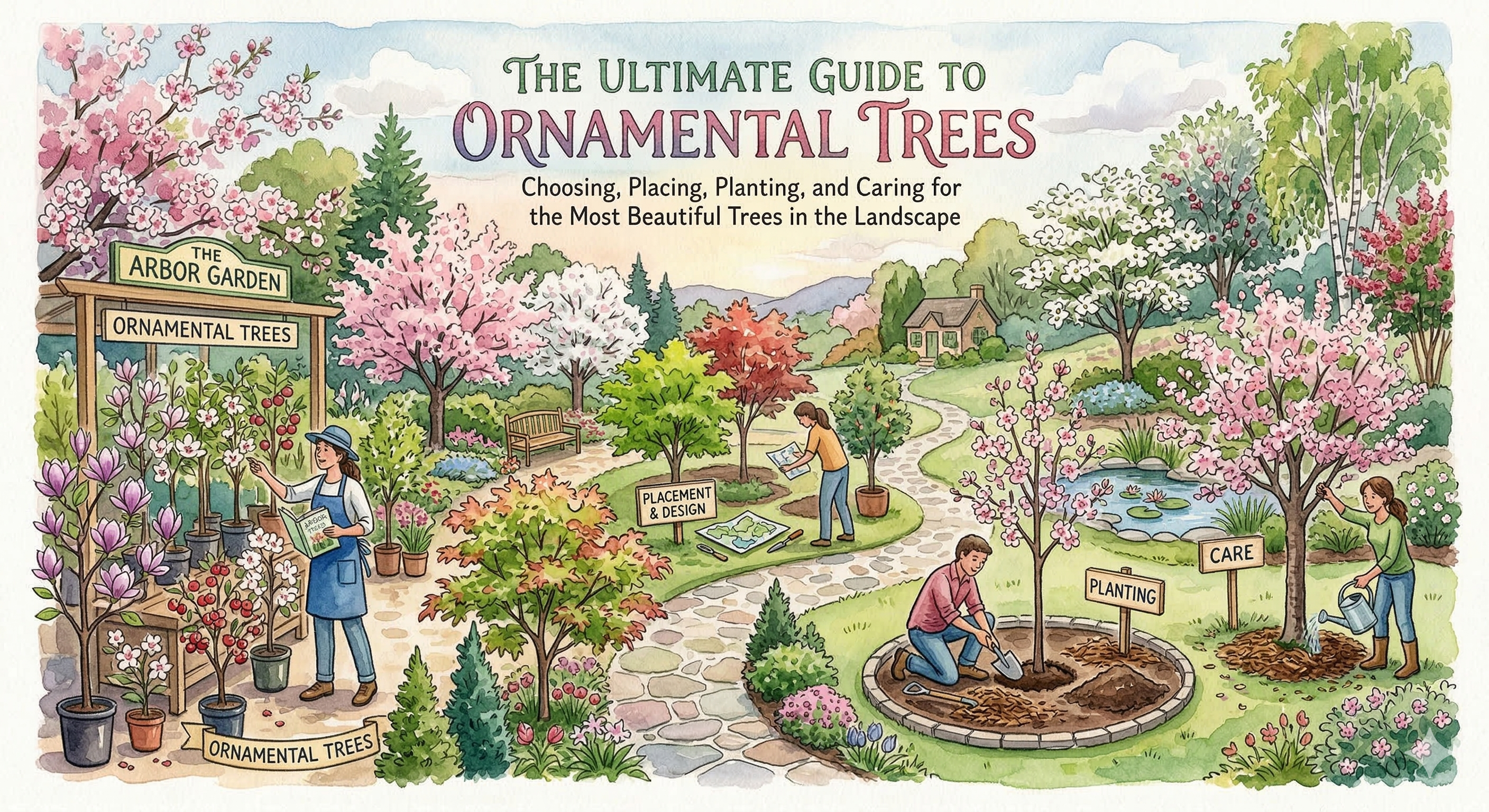
Choosing, Placing, Planting, and Caring for the Most Beautiful Trees in the Landscape
A garden without trees is just a collection of plants. Add even one well-chosen ornamental tree and suddenly you have a landscape — something with structure, scale, drama, and a sense of permanence. Ornamental trees are the anchors that give everything else meaning. The flowering dogwood that stops traffic every April. The Japanese maple whose crimson leaves glow like stained glass in October sun. The paperbark maple whose cinnamon-colored bark peels in curls during a gray January — reminding you the garden is still very much alive. Unlike shade trees or fruit trees, ornamental trees are grown for pure visual delight. Most are smaller than shade trees, fit in more spaces, work beautifully as focal points, and generally demand less maintenance.
More ornamental trees die from being the wrong tree in the wrong place than from any pest or disease. The single most important thing you can do is choose carefully before you buy.
Step 1: Define the Job First
Every tree in a landscape has a role. Before you shop, decide what role your tree needs to fill.
Role
What It Means
Top Candidates
Specimen / Focal Point
A tree that commands attention — planted alone in a lawn, at the end of a path, beside a front entrance. Should be exceptional in at least one season, ideally multiple.
Japanese maple, weeping cherry, saucer magnolia, paperbark maple
Accent / Companion
A tree that enhances nearby features — framing a doorway, backing a perennial border, complementing architecture.
•Hardiness Zone: Check yours at planthardiness.ars.usda.gov. The 2023 updated map shifted many areas half a zone warmer — verify even if you looked it up years ago.
•Sunlight: Most flowering ornamentals perform best in full sun (6+ hours daily). But several beloved ornamentals — dogwood, redbud, serviceberry, witch hazel, Japanese maple — actually prefer some afternoon shade, especially in hot climates.
•Soil: Most ornamental trees prefer well-drained, slightly acidic to neutral soil (pH 5.5–7.0). Heavy clay or poorly draining sites should be amended or avoided.
•Wet soil: River birch, sweetbay magnolia, and baldcypress tolerate consistently moist conditions.
•Dry/drought-prone soil: Redbud, hawthorn, crape myrtle, and smoke tree are notably drought-tolerant once established.
•Urban/compacted soil: Honeylocust, zelkova, ginkgo, and some crabapple varieties tolerate urban conditions, pollution, and road salt.
☀️
Sun Exception in Hot Climates: In zones 7 and warmer, afternoon shade is often beneficial for shade-tolerant ornamentals like dogwood and Japanese maple. A Japanese maple in full sun in Zone 7+ is a recipe for sunscald and stress. "Part shade" means different things in different climates.
Step 3: Match Mature Size to Available Space
Size Category
Example Trees
Best Use
Small (under 15 feet)
Japanese maple, dwarf crabapple, Star magnolia, witch hazel, weeping Higan cherry
Patios, foundation plantings, small yards, under power lines, container growing
Most residential yards, corner plantings, garden focal points
Medium (25–40 feet)
Saucer magnolia, hawthorn, smoke tree, golden rain tree, Japanese tree lilac, sweetbay magnolia
Larger lots, lawn specimens, entryway framing
Larger Ornamentals (40+ feet)
Southern magnolia, tulip poplar, bald cypress, katsura tree
Large lots, backdrop for smaller plantings — verify utility clearance
📏
Foundation Rule: Small ornamentals (mature under 15 feet) should be planted at least 6–8 feet from foundations. Medium ornamentals (15–25 feet) need 12–15 feet of clearance. Never plant any tree under overhead utility lines unless its mature height stays well below the lines.
Step 4: Decide Between Deciduous and Evergreen
This is one of the most fundamental choices in ornamental tree selection — it comes down to what you need the tree to do through the year.
Type
Characteristics
Best Season Appeal
Examples
Trade-offs
Deciduous
Loses leaves in fall, bare in winter
Spring flowers (often spectacular), fall color, interesting winter branching — allows winter light into garden and home
Most spring-flowering ornamentals: dogwood, redbud, magnolia, cherry, serviceberry, crabapple, Japanese maple
No winter screening; bare branches can be beautiful or stark depending on species
Broadleaf Evergreen
Keeps leaves year-round; leaves are broad and often glossy
Year-round green structure, winter screening, some produce flowers and berries
Southern magnolia, American holly, sweetbay magnolia (semi-evergreen), wax myrtle
Less dramatic seasonal change; can look heavy if poorly sited
Needled Evergreen (Ornamental)
Retains needles year-round in most cultivars
Year-round color and form; exceptional winter structure; some produce ornamental cones
Blue Atlas cedar, Japanese black pine, weeping Norway spruce, dwarf Alberta spruce
Rarely produce showy flowers; brown if stressed or poorly sited
Semi-Evergreen
Retains most leaves in mild winters; drops them in cold winters
Flexible — provides screening where winters are mild, seasonal interest where colder
Sweetbay magnolia, some hollies, some crape myrtle cultivars in zone 6
Behavior varies by climate — research your specific zone
Step 5: Think in Seasons — The Four-Season Audit
The most sophisticated approach to ornamental tree selection is to evaluate candidates across all four seasons before committing. A tree that dazzles in April but contributes nothing in July, October, and January is a missed opportunity when better choices exist.
Tree
Spring
Summer
Fall
Winter
Flowering Dogwood
White or pink bracts, April–May
Horizontal branching, green leaves
Brilliant scarlet-red foliage, red berries ripen
Elegant horizontal silhouette, persistent red berries for birds
Prolific flowers in red, pink, white, purple for 60–90 days
Brilliant orange-red foliage, seed heads
Exfoliating gray-tan bark, sculptural multi-trunk form
Winter King Hawthorn
White flower clusters, May
Dark green foliage
Red-purple foliage, large persistent red berries
Exfoliating orange bark, dramatic berry display beloved by birds
Trees to Absolutely Avoid
Some trees have been planted so widely and failed so predictably — through poor structure, invasive spreading, or both — that most knowledgeable horticulturalists now recommend against them entirely.
Tree to Avoid
Why
Better Alternatives
Bradford Pear / Callery Pear
Structurally weak branch angles that split catastrophically in ice and wind storms; profoundly unpleasant fish-odor flowers; cross-pollinates with other pear cultivars to produce invasive seedlings now escaping into natural areas across the eastern US. Banned or restricted in several states.
Serviceberry, native dogwood, redbud, fringe tree
Norway Maple
Invasive in the northeastern US and Pacific Northwest; dense shade kills all understory plants; surface roots invade everything around it. Purple-leaf cultivars still widely sold but are the same problematic species.
Sugar maple, paperbark maple, Japanese maple, native red maple
Mimosa / Silk Tree
Pretty pink fluffy flowers, but invasive across much of the eastern and southern US, seeds prolifically everywhere, short lifespan, prone to disease and dieback.
Redbud provides similar pink floral drama without any of the problems
Silver Maple
Fast-growing, brittle, surface roots crack pavement and invade sewer lines, extremely susceptible to storm damage.
Red maple, paperbark maple, or native serviceberry
White Mulberry / Fruitless Mulberry
Invasive across much of the US; even "fruitless" cultivars can revert and produce fruit. Seeds spread by birds into natural areas.
Native red mulberry (if wildlife food is the goal) or any flowering ornamental in this guide
The native plant movement has rightly emphasized that native trees support far more wildlife — particularly insects — than non-native species. A native white oak supports over 500 caterpillar species; a non-native ginkgo supports essentially none. Native dogwoods, serviceberries, and redbuds provide not only beauty but ecological infrastructure that non-native alternatives simply cannot replicate.
That said, this guide celebrates excellent ornamental trees from both categories. Non-native trees like Japanese maple, paperbark maple, Kousa dogwood, and Japanese tree lilac are extraordinary ornamental plants that perform beautifully in American landscapes, cause no ecological harm, and provide beauty and some wildlife value through flowers and fruit. The goal isn't to exclude them — it's to always prefer a native option when the performance is equal or better, and to never plant known invasive species.
🌿
The Native Priority Principle: When choosing between a native and non-native ornamental with similar visual impact and cultural requirements, choose the native. It will support more wildlife, require less long-term care (it evolved with your local conditions), and contribute to the broader health of the regional ecosystem. But the goal is not horticultural purity — it's making the best choices available with what your site, climate, and aesthetic needs demand.
🌸 Spring Bloomers — When the Show Begins
Flowering Dogwood (Cornus florida) — The American Classic
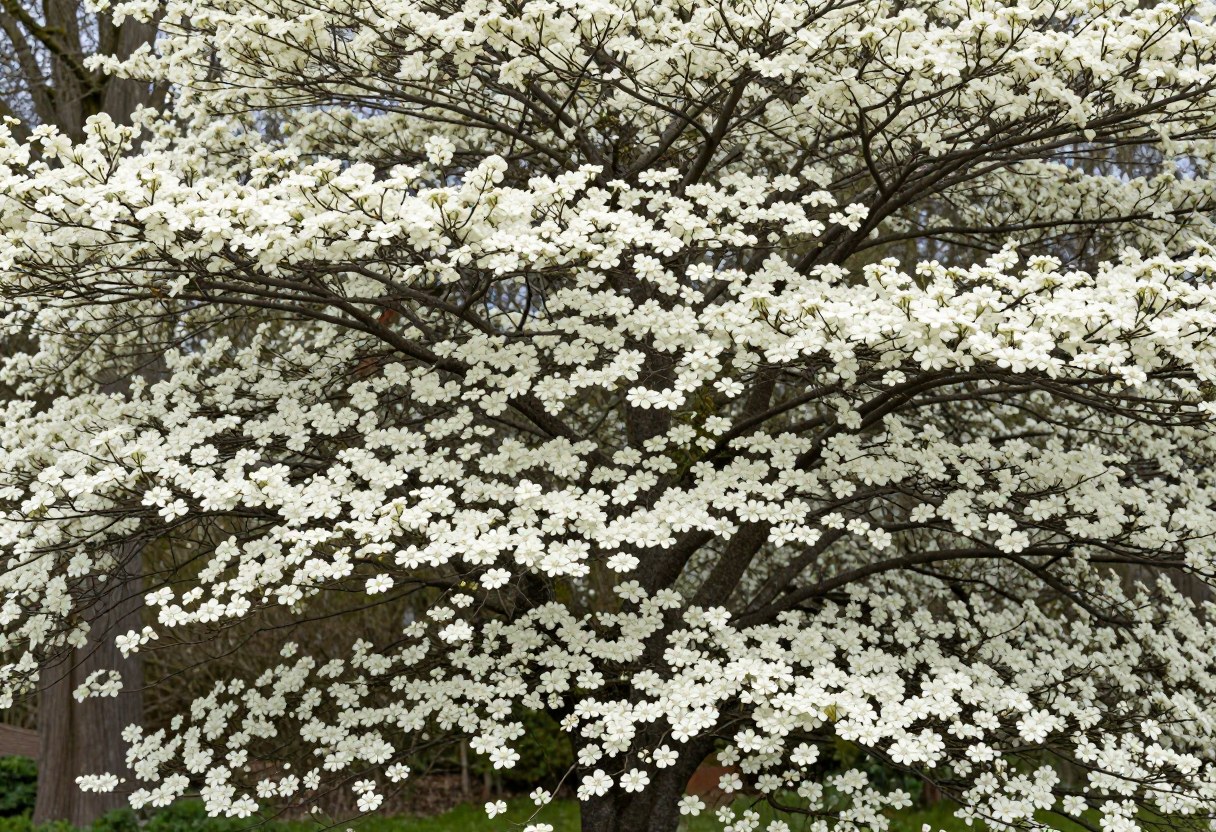
If there is one tree that defines Eastern American spring, it is the flowering dogwood. The white or pink bracts surrounding inconspicuous true flowers are breathtaking — horizontal tiers of pure color against bare branches in April and May. In summer, horizontal layered branches create a distinctive architectural silhouette. In fall, brilliant scarlet-red leaves and clusters of red berries appear. In winter, the elegant branching and persistent berries make it a four-season overachiever.
•Zones: 5–9. Mature Size: 15–25 feet tall and wide.
•Light: Full sun to part shade. In zones 7+, afternoon shade is beneficial.
•Soil: Well-drained, slightly acidic, rich in organic matter. Sensitive to drought and compaction.
•Wildlife Value: Exceptional. Berries eaten by over 36 bird species.
•Key Issue: Susceptible to dogwood anthracnose in the northeast, especially in shaded, moist sites.
•Best Cultivars: 'Cherokee Princess' (vigorous white bloomer), 'Cherokee Chief' (deep pink), 'Appalachian Spring' (white, very anthracnose-resistant).
Those horizontal tiers of white bracts against still-bare branches are what make flowering dogwood the tree most associated with Eastern American spring.
Kousa Dogwood (Cornus kousa) — The Refined Alternative
The Asian counterpart to our native dogwood blooms 2–4 weeks later (avoiding late frosts), is significantly more resistant to dogwood anthracnose, and sports large, raspberry-like ornamental fruit in late summer. Its exfoliating gray-tan bark creates exceptional winter interest.
•Zones: 5–8. Mature Size: 15–25 feet, often wider than tall at maturity.
•Best Cultivars: 'Milky Way' (heavy white bloomer), 'Wolf Eyes' (white-variegated foliage, compact), 'Satomi' (rich pink), 'Venus' (enormous white flowers, zones 5–9).
Eastern Redbud (Cercis canadensis) — Pink-Purple Spring Explosion
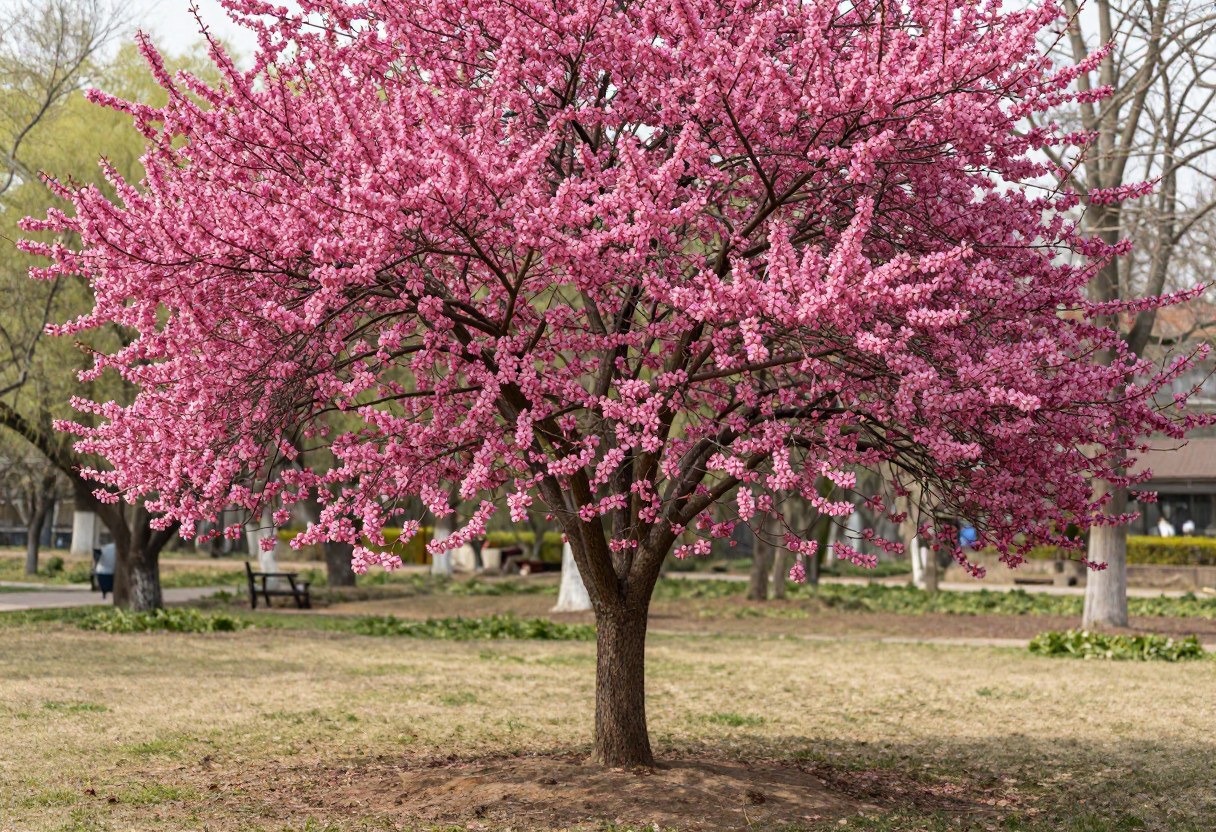
Before a single leaf appears, the entire tree — bark, branches, even the trunk — erupts in clusters of vivid rosy-pink to magenta flowers. Heart-shaped leaves follow, turning clear yellow in fall. The tree's irregular branching pattern gives it distinctive winter structure.
•Zones: 4–9 — one of the hardiest spring ornamentals. Mature Size: 20–30 feet tall and wide.
•Light: Full sun to part shade; grows naturally as an understory tree.
•Wildlife Value: Excellent — one of the most important early-season bee forage plants.
•Bonus: Redbud flowers are edible! They have a mild, slightly tart flavor.
Serviceberry / Juneberry (Amelanchier spp.) — Four Seasons in One Tree
If there is one ornamental tree that delivers the most complete four-season performance in the smallest footprint, it might be the serviceberry. In late March or early April — often the very first tree to bloom — clusters of delicate white star-shaped flowers appear before the leaves. Small blue-black berries ripen in June, beloved by birds and edible for humans. Fall foliage ranges from orange to brilliant scarlet-red. Winter reveals smooth, silvery-gray bark and an elegant multi-stemmed silhouette.
•Zones: 4–9. Mature Size: 10–25 feet (varies widely by species).
•Wildlife Value: Outstanding — berries are irresistible to over 40 bird species.
•Best Cultivars: Amelanchier × grandiflora 'Autumn Brilliance' (excellent fall color, reliable, zones 4–9), A. canadensis 'Rainbow Pillar' (columnar form for tight spaces), A. laevis (smooth serviceberry, native, excellent all-around).
Magnolias — From Subtle to Spectacular
•Star Magnolia (Magnolia stellata): Blooms earliest — sometimes in late February or early March — with fragrant white star-shaped flowers. Genuinely small-space friendly at 10–15 feet. Zones 4–8. Best Cultivars: 'Royal Star' (later-blooming, more frost-resistant), 'Jane' and other Little Girl series (bloom later, more frost-safe, beautiful pink-purple).
•Saucer Magnolia (Magnolia × soulangeana): The magnolia most people picture — enormous 3–4 inch saucer-shaped flowers in white, pink, or deep purple-rose before a single leaf appears. The display is breathtaking but brief (2–3 weeks). Zones 4–9. Mature Size: 20–25 feet. Best Cultivars: 'Galaxy' (red-purple, later-blooming, avoids many frosts), 'Alexandrina' (deep pink-purple, reliable).
Ornamental Cherry (Prunus spp.) — The Japanese Inspiration
No tree is more purely devoted to spring spectacle than the ornamental cherry. Some cultivars create such a dense cloud of white or pink flowers that you literally can't see branches through the bloom. Most ornamental cherries bloom for 1–2 weeks and then transition to pleasant but unremarkable summer foliage — a one-season tree that does that season so magnificently many gardeners decide it's worth it.
•Zones: 5–8 for most; some varieties push zone 4. Lifespan: 15–30 years (shorter-lived for trees).
•Best Cultivars: Yoshino (white to pale pink, fragrant, zones 5–8), Kwanzan (deep double pink, no fruit, zones 5–8), Okame (early-blooming, vibrant rosy pink, excellent orange-red fall color, zones 6–9), Weeping Higan cherry (graceful weeping form, zones 4–8).
Flowering Crabapple (Malus spp.) — The Year-Round Overachiever
For pure multi-season ornamental value in a compact package, the disease-resistant crabapple is hard to beat. Spring flowers in white, pink, or deep red cover the tree. Summer brings attractive foliage. Fall brings persistent, colorful fruit in red, orange, or gold — some hanging through January, providing critical winter food for birds. Always choose modern disease-resistant cultivars — it's a night-and-day difference in care and appearance.
•Zones: 4–8 for most varieties. Mature Size: 6–25 feet (enormous range).
•Best Disease-Resistant Cultivars: 'Prairifire' (crimson-red flowers, dark red persistent fruit — excellent all-rounder), 'Adirondack' (white flowers, persistent red-orange fruit, narrow upright form for tight spaces), 'Sugar Tyme' (white flowers, abundant small red fruit beloved by birds), 'Camelot' (very dwarf, rose-pink flowers).
☀️ Summer Bloomers — Color When Everything Else Has Faded
Crape Myrtle (Lagerstroemia indica) — The South's Summer Queen
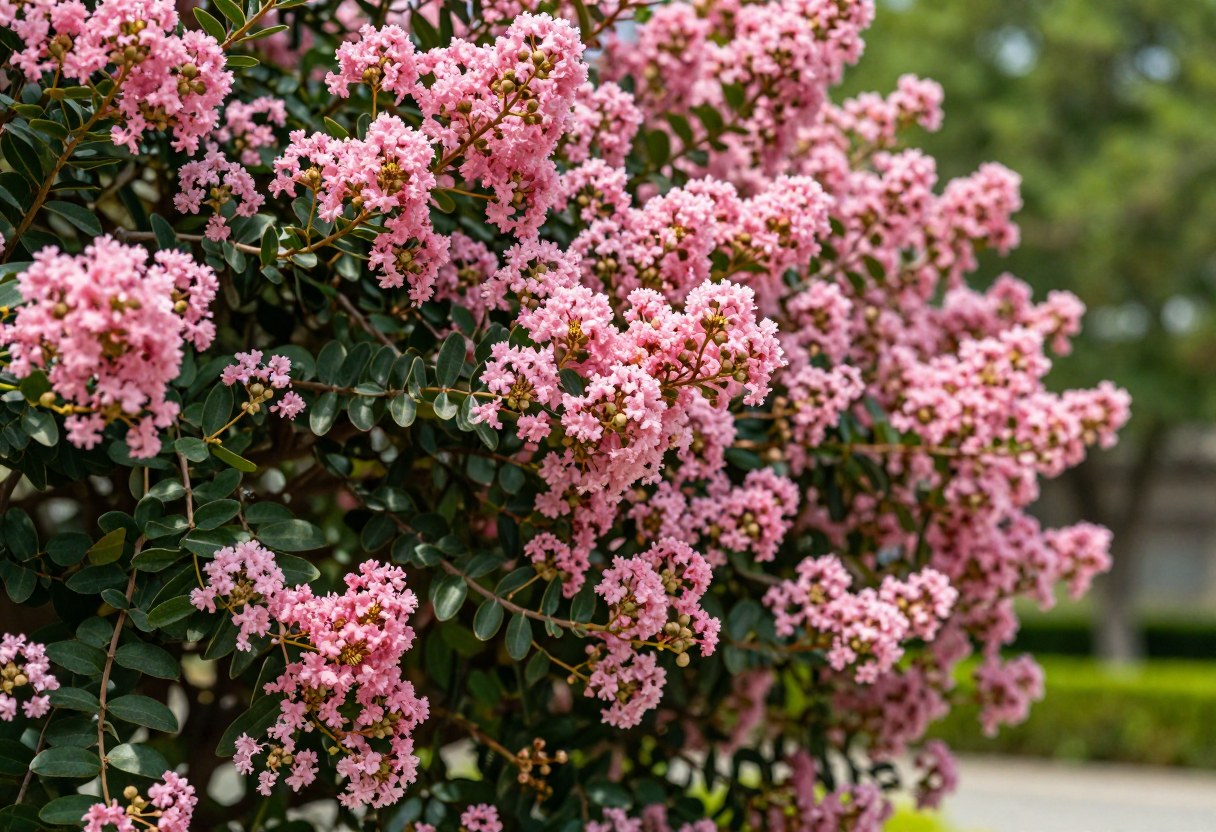
For the South and warmer climates, crape myrtle is irreplaceable: the only major tree that blooms heavily and continuously from July through September, when virtually no other tree is flowering. It produces enormous panicles of crinkled flowers in white, pink, red, lavender, or deep purple. Add brilliant fall foliage in orange-red and extraordinary exfoliating bark in winter (mottled gray, tan, and cinnamon) and you have genuine four-season interest.
•Zones: 6–10. Mature Size: Enormous range — 2-foot dwarfs to 30-foot trees. Know your cultivar's mature size before purchasing!
•Light: Full sun is mandatory. Shade = poor flowering, weak growth, disease.
•Best Cultivars by Size: Small (under 5 feet): 'Pocomoke', 'Chickasaw'; Medium (6–12 feet): 'Acoma' (white, arching form), 'Hopi' (pale pink, excellent mildew resistance); Large (15–25 feet): 'Natchez' (the gold standard — white flowers, outstanding cinnamon-orange bark), 'Muskogee' (lavender, very large).
Crape myrtle is the rare tree that blooms heavily straight through July and August, when almost nothing else in the Southern landscape is flowering.
🚫
Never "top" a crape myrtle. This practice, known as "crape murder," destroys the tree's natural form, eliminates the beautiful exfoliating bark, weakens structure, and reduces blooming. The correct fix when a crape myrtle is too large for its space is to replace it with a smaller-maturing cultivar, not to mutilate what you have.
Japanese Tree Lilac (Syringa reticulata) — The Forgotten Summer Bloomer
Most lilacs bloom in May and are finished before summer properly begins. The Japanese tree lilac blooms in late June and into July — filling a gap when almost nothing else is flowering. Massive panicles of creamy-white flowers with a honey-like fragrance cover the tree for 2–3 weeks. Zones 3–7 — excellent cold-climate ornamental.
•Mature Size: 20–25 feet tall, 15–20 feet wide.
•Key Strength: Very late-blooming (June–July) fills a gap when spring bloomers have finished.
•Best Cultivars: 'Ivory Silk' (compact 20 feet, more uniform than species, heavy bloomer).
Golden Rain Tree (Koelreuteria paniculata) — July Fireworks
One of very few trees that produces showy flowers in midsummer — long panicles of bright yellow blooms that cover the tree in June–July. The show continues with attractive inflated papery seed pods in bronze-pink through late summer and fall. Tolerates drought, poor soil, heat, and urban conditions exceptionally well. Zones 5–9. Mature size: 25–40 feet.
⚠️
Golden rain tree can self-seed aggressively in some climates. In parts of the southeastern US it is listed as invasive. Check local guidance before planting.
🍂 Exceptional Fall Color and Unique Features
Japanese Maple (Acer palmatum) — The Aristocrat
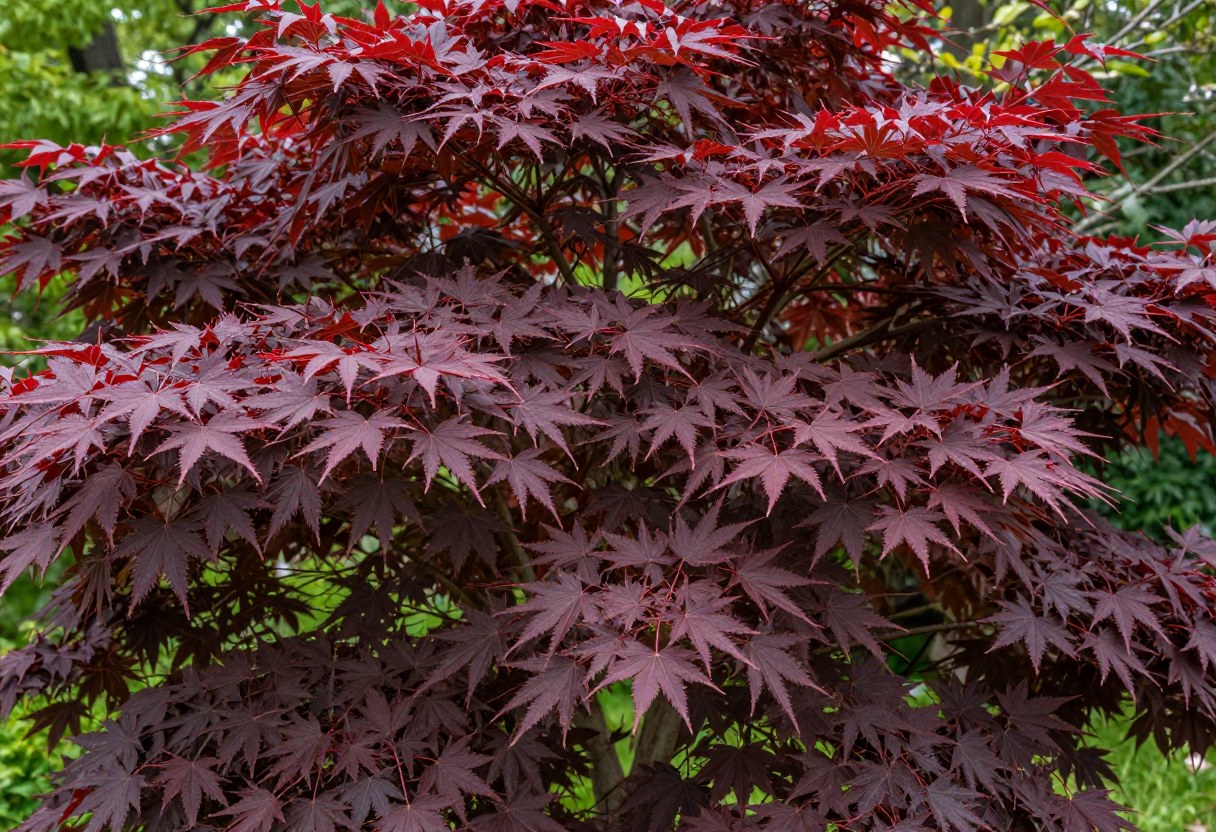
Over 1,000 named cultivars. Prized for extraordinary diversity of form — upright and arching, mounding and weeping, palmate and dissected lace-leaf — and foliage color: green, gold, bronze, deep purple-red, and variegated. Fall color ranges from brilliant yellow to incandescent crimson. Even in winter, the refined branching structure is sculptural and beautiful.
•Light: Part shade is ideal, especially in zones 7–8. Morning sun with afternoon shade protects foliage.
•Soil: Well-drained, acidic, rich in organic matter. Does NOT tolerate wet soils.
•Best Cultivars: 'Bloodgood' (upright to 15 feet, deep red-purple foliage, brilliant crimson fall color — the benchmark), 'Sango Kaku' / Coral Bark (coral-red winter bark, yellow fall color), 'Crimson Queen' (weeping lace-leaf, deep red all season), 'Waterfall' (weeping lace-leaf, green, cascading — elegant).
The refined, sculptural branching visible here is why Japanese maple earns a spot in the landscape even in winter, long after the leaves are gone.
Paperbark Maple (Acer griseum) — Winter's Greatest Treasure
Unlike most maples, which earn their keep in fall and then disappear into gray winter branches, the paperbark maple saves its finest trick for winter. The cinnamon-bronze bark peels away in thin papery curls, constantly revealing a fresh warm-toned layer beneath. In January sunlight, a mature paperbark maple glows like fire. It also delivers blue-green summer foliage and brilliant russet-red fall color. Slow-growing but worth every year of patience.
•Growth Rate: Slow — 6–12 inches per year. The beauty only improves with every decade.
River Birch (Betula nigra) — The Bark Star
No native tree offers more dramatic bark interest than river birch. The layered, peeling, exfoliating bark in shades of salmon-pink, tan, cinnamon, and reddish-brown is exceptionally ornamental, especially in winter sun. Naturally adapted to streambanks and wet soils, it tolerates heat and humidity far better than the European white birch.
•Zones: 4–9. Mature Size: 40–70 feet single-trunk; multi-stem forms typically 20–30 feet.
•Best Cultivar: 'Heritage' (most popular, creamy-white to exfoliating cinnamon bark).
•Tip: Multi-stem specimens multiply the bark interest dramatically — a clump of 3–5 trunks against a dark background or winter snow is spectacular.
Smoke Tree (Cotinus coggygria & C. obovatus) — Airy Summer Drama
The smoke tree earns its name from the billowing, feathery seed plumes that develop in summer and turn the tree into something that resembles a soft lavender-pink or purple cloud from a distance. The native American smoke tree (C. obovatus) is larger, has outstanding fall color, and better structural form. The non-native C. coggygria offers outstanding purple-foliage cultivars.
•Zones: 4–8. Mature Size: 10–15 feet for C. coggygria; 20–30 feet for C. obovatus.
•Best Cultivars: 'Royal Purple' (darkest purple foliage, purplish plumes), 'Grace' (hybrid — spectacular salmon-pink plumes, orange-red fall color on purple foliage).
Fringe Tree (Chionanthus virginicus) — Fragrant White Clouds
The native fringe tree blooms in May with extraordinary clusters of white, sweetly fragrant, strap-like flowers that hang in billowing masses from the branches — an effect like white smoke or lacy fabric draped through the tree. It's one of the most elegant flowering native trees, yet remains criminally underused.
•Wildlife: Outstanding — flowers support native bees and butterflies; berries eaten by birds.
Sweetgum (Liquidambar styraciflua) — Fall Color Machine
For sheer autumn color impact, few trees match the sweetgum. Foliage transitions through purple, red, orange, and yellow — often all at once on the same tree — creating one of the most spectacular fall displays in the American landscape. A large native tree well-suited to moist soils.
•Zones: 5–9. Mature Size: 60–75 feet — plan accordingly for large lots or back-of-property use.
•Best Cultivar: 'Rotundiloba' (seedless — eliminates the spiky gum ball litter problem, brilliant fall color, Zones 5–9) is the one to plant if you want the color without the mess.
Katsura Tree (Cercidiphyllum japonicum) — Autumn Fragrance
The katsura tree is one of the most distinctive ornamentals in the landscape. Its fall feature is unique in the tree world: the falling leaves emit a fragrance of burnt caramel or cotton candy as they dry — a delightful scent that drifts across the garden on cool autumn days. Heart-shaped leaves emerge reddish-purple in spring, mature to blue-green in summer, and turn brilliant apricot-gold to orange in fall. Zones 4–8. Mature size: 25–40 feet in most landscapes.
Planting and Ongoing Care
When to Plant
Timing
Why It Works
Best For
Fall (late Sept–Nov)
The single best time for most deciduous ornamentals in zones 5–9. Cooler temperatures reduce transplant stress, autumn rains support establishment, and roots continue growing in warm soil through mild winters.
Dogwood, redbud, serviceberry, Japanese maple, crabapple, magnolia
Early Spring (before bud break)
Second-best option. Plant while still dormant or as buds are just beginning to swell.
Bare-root trees; good for most ornamentals
Container-grown anytime
Technically can be planted almost any time the ground isn't frozen, but summer planting in hot climates requires aggressive watering.
Most nursery trees sold in containers
The Planting Process
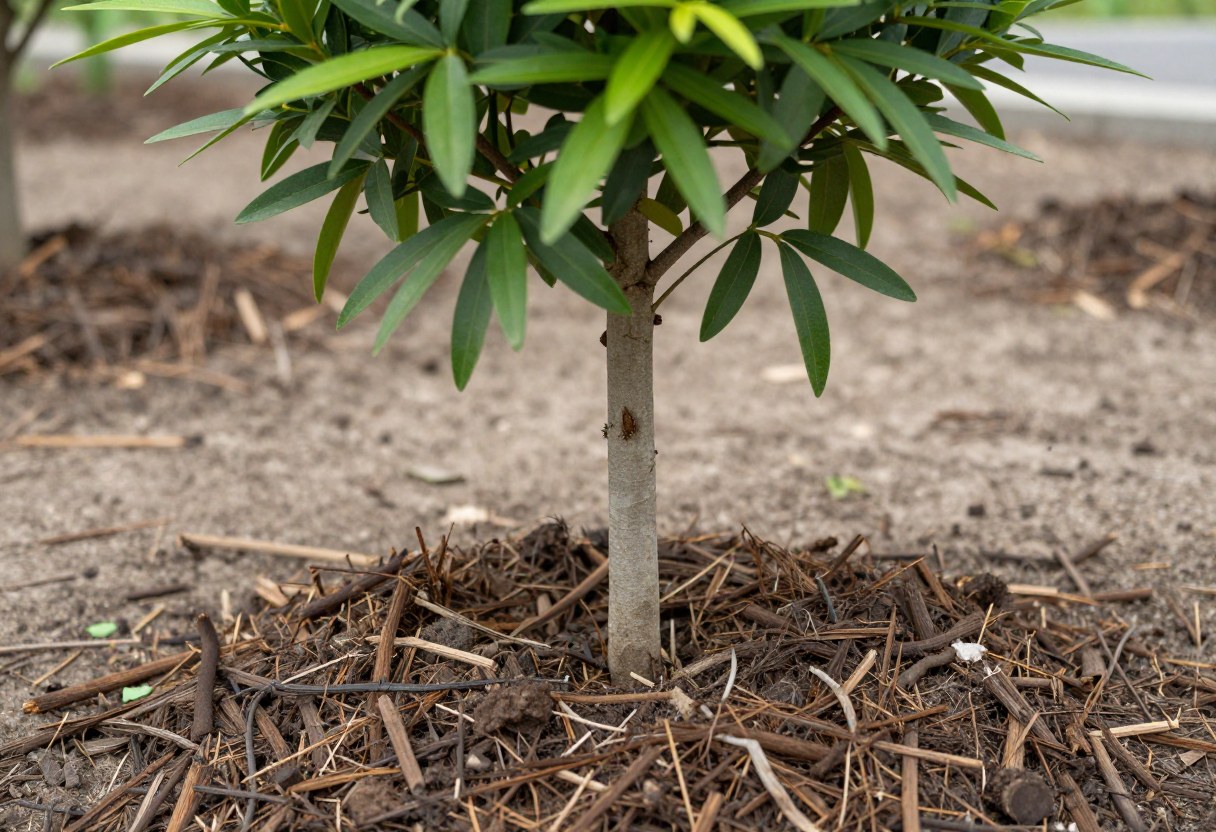
•Find the root flare — where the trunk visibly widens at the base. This must be at or 1–2 inches above the surrounding soil surface after planting. Burying the root flare is one of the most common causes of long, slow ornamental tree decline.
•Dig 2–3 times wider than the root ball, but only as deep as the root ball.
•Container trees: Score 4 vertical cuts down the root ball to break circling roots. Remove any roots tightly spiraling around the trunk base — these will girdle the trunk and kill the tree over 10–20 years.
•B&B trees: Remove ALL wire baskets, ropes, twine, and burlap once positioned. Burlap does NOT break down fast enough to avoid root restriction.
•Backfill with original native soil — do not create a highly amended "pocket" in the planting hole.
•Apply 2–4 inches of organic mulch in a ring extending to the drip line. Keep mulch 6 inches away from the trunk. The ring should look like a donut, not a volcano.
•Most ornamental trees with a reasonable root ball do not need staking. If staking is necessary, remove stakes after ONE growing season maximum.
That visible widening at the base — the root flare — needs to sit at or slightly above the soil surface; burying it is the single most common cause of slow ornamental tree decline.
Watering During Establishment
•Year 1: Deep water weekly during the growing season — 10–15 gallons per session for most ornamentals. Slowly delivered is better than fast.
•Year 2: Deep water every 10–14 days during dry spells.
•Year 3+: Most established ornamentals need supplemental irrigation only during extended drought (2+ weeks without rain).
💧
Signs of Water Stress: Wilting leaves (overwatering and underwatering can look identical). Leaf scorch (brown leaf edges). Premature fall color or leaf drop. When in doubt, push a finger 6 inches into the soil near the root zone — damp but not soggy is perfect.
Pruning — The Timing Problem
Pruning ornamental trees at the wrong time of year is one of the most common mistakes. The fundamental rule is tied to when the tree forms its flower buds:
•Spring-flowering trees: Flower buds form on wood grown the previous summer. Prune IMMEDIATELY AFTER FLOWERING — not in winter, not in late summer. If you prune a dogwood or redbud in February, you are pruning off this spring's flowers.
•Summer and fall-flowering trees (crape myrtle, smoke tree, golden rain tree): Flower on current season's new wood. Prune in late winter/early spring before growth begins.
•Evergreen and bark-interest trees: Prune in late winter to early spring. Remove dead, damaged, or crossing branches.
Tree
Best Pruning Time
Dogwood (C. florida / kousa)
Immediately after flowering (May–June)
Eastern Redbud
Immediately after flowering, or late winter for dead/crossing wood only
Serviceberry
Right after flowering (April–May)
Magnolia (deciduous)
Right after flowering. Avoid late summer/fall — magnolias callus wounds slowly.
Ornamental Cherry
Late spring after flowering; avoid fall/winter (disease risk)
Crabapple
Late winter/early spring OR immediately after flowering
Japanese Maple
Late winter while dormant. Minimal pruning needed.
Crape Myrtle
Late winter/early spring (Feb–Mar). Remove only suckers and crossing branches — NEVER top.
Japanese Tree Lilac
Immediately after flowering (June–July)
Fringe Tree
Right after flowering (May–June)
•Remove the 3 Ds first, always: Dead, Diseased, Damaged wood — any season, immediately.
•Remove crossing or rubbing branches — where they contact, bark wounds develop and let disease in.
•Remove suckers from the base (water sprouts arising from roots or the base of the trunk).
•Raise the crown ("limb up") by removing the lowest branches if needed for clearance — do this gradually over several years, not all at once.
•Never top an ornamental tree — it destroys form, creates weak regrowth, exposes large wounds to decay, and is almost impossible to recover from aesthetically.
•Cut to the branch collar — the slightly swollen ring where a branch meets the trunk. Never cut flush, never cut into the collar.
✂️
The Crape Myrtle Rule Worth Repeating: Crape myrtles do NOT need to be topped, stubbed back, or drastically cut each year. They bloom on new wood that grows naturally from the existing framework. The correct annual maintenance is: remove basal suckers, remove crossing or crowded interior branches, and enjoy the show. If your crape myrtle is too large for its space, replace it with a smaller cultivar — not commit crape murder year after year.
Common Pests & Diseases
Problem
Affects
Signs
Management
Dogwood Anthracnose
Dogwood (C. florida primarily)
Brown leaf spots with purple borders; twig dieback; cankers on lower trunk in severe cases.
Plant disease-resistant cultivars or C. kousa; avoid shaded, wet sites; good air circulation; remove infected plant material.
Dogwood Borer
Dogwood, birch, ornamental cherries
Sawdust-like frass at base of trunk; bark damage; tree decline. Attacks stressed or wounded trees.
Keep trees healthy; use trunk guards; avoid lawn mower and string trimmer wounds; targeted pesticide applications if needed.
Japanese Beetle
Crabapple, redbud, serviceberry, rose family trees
Skeletonized leaves (lacy appearance) in June–August. Adults feed communally.
Hand-pick or knock beetles into soapy water; neem oil sprays; milky spore for soil treatment; avoid beetle traps — they attract more beetles from the neighborhood.
Branch tips turn brown and bend into a "shepherd's crook." Looks like fire damage. Bacterial.
Plant resistant cultivars; avoid excess nitrogen; prune 12 inches below infected tissue with sterilized tools during dry weather; copper sprays during bloom.
Apple Scab
Crabapple (older varieties especially)
Olive-green to dark spots on leaves and fruit; early defoliation; weakens tree over time.
Plant modern disease-resistant crabapple cultivars — this largely eliminates the problem. Rake and dispose of fallen leaves.
Powdery Mildew
Crabapple, dogwood, crape myrtle, serviceberry
White powdery coating on new leaves and shoots; leaves may distort.
Plant resistant cultivars; improve air circulation; avoid overhead watering; sulfur or potassium bicarbonate sprays if severe.
Cherry Leaf Curl
Ornamental cherry
Leaves thicken, curl, and turn reddish. Fungal. Appears in cool wet springs.
Copper or lime-sulfur spray in fall after leaf drop and again in late winter before bud break. Timing is critical.
Girdling Roots
Any tree
Slow decline, reduced vigor, dieback from top down; roots crossing the root flare constrict the vascular system and eventually kill the tree.
Prevent at planting by removing circling roots. Monitor root flare annually — roots growing across the base should be corrected by a certified arborist.
Seasonal Care Calendar
Season
Key Tasks
Late Winter (Feb–Mar)
Prune summer/fall-blooming trees (crape myrtle, smoke tree). Apply dormant oil spray for overwintering insects. Plant bare-root trees. Check and refresh mulch.
Spring (Mar–May)
Plant container trees. Water all trees established under 3 years weekly. Watch for late frost on early-blooming magnolias — have frost cloth ready. Do NOT prune spring-blooming trees yet.
Late Spring (May–Jun)
Prune spring-flowering trees immediately after bloom. Apply fungicide preventively if wet spring threatens disease-prone trees (dogwood, crabapple).
Summer (Jun–Sep)
Deep water during drought, especially for Japanese maple and dogwood. Monitor for Japanese beetles. Enjoy crape myrtle and other summer bloomers.
Fall (Sep–Nov)
Excellent planting season. Enjoy fall color. Rake leaves under disease-prone trees (scab, anthracnose) — do not compost.
Winter (Dec–Feb)
Protect trunks of young trees from rodents with hardware cloth guards. Protect marginally-hardy trees from winter wind with burlap screens. Inspect for storm damage.
Design Principles for Ornamental Trees
The Specimen Tree Principle
A specimen tree is planted alone, in a prominent position, to command attention. Rules: it should be exceptional (ideally in multiple seasons), it should have adequate space to express its full mature form, and it should have a clear backdrop against which to be read.
•Best backdrops: A lawn (gives the tree space and a simple green base), evergreen plantings (dark green sets off white flowers and fall color brilliantly), or a path/driveway (the tree becomes part of the arrival experience).
•Siting for night interest: Place important specimen trees where they can be lit from below. Uplighting a Japanese maple's branching structure or a paperbark maple's peeling bark at night extends the aesthetic investment into the evening hours.
•Common mistake: Planting a specimen tree too close to the house so it's never seen from an angle. A specimen needs distance — generally at least 1.5 times its mature height between it and the primary viewpoint.
Layering: Creating Depth with Trees
The most visually rich landscapes have multiple layers of height, from ground level through short plants, taller shrubs, small ornamental trees, and then the canopy. Ornamental trees typically occupy the small-to-medium tree layer (10–30 feet), creating an intermediate height zone that connects the human-scale planting below with the larger tree canopy above.
In practical terms, this means: plant taller shade trees at the back or perimeter of a property, ornamental trees in the middle zone, then shrubs and perennials at the front and near the house. This creates depth, screens sightlines naturally, and ensures that small flowering plants aren't lost in the visual noise of too-dense planting.
Repetition and Unity
One of the most common landscape design mistakes is planting a different ornamental tree in every available spot — "collector syndrome." The result looks spotty, restless, and lacks visual coherence. A far more powerful approach is to repeat the same tree (or the same species in different cultivars) in multiple locations throughout the property.
A single weeping cherry is a nice accent. Three weeping cherries flanking a path or placed at three corners of a garden creates a unified, intentional composition. Two Japanese maples flanking an entryway create formal symmetry. A repeated dogwood threading through a planting bed creates a cohesive seasonal rhythm.
A lawn backdrop like this is exactly what a specimen tree needs — open space and a simple green base to read against.
Using Form and Shape
Form
Design Use
Examples
Weeping
Drooping, cascading branches; creates intimate enclosure; excellent near water, paths, and seating areas
Weeping cherry, weeping redbud, weeping birch
Columnar / Fastigiate
Very narrow upright form; creates vertical accent; excellent for small spaces, between windows, lining paths
Columnar hornbeam, Swedish columnar aspen, Sky Pencil holly
Vase-shaped
Branches arching outward and upward; provides canopy without bulk at base; excellent near entries and patios
Dogwood, Japanese maple (many cultivars)
Rounded / Globe
Symmetrical, full, mounding; provides mass and visual weight; excellent as lawn specimens
Crabapple (many cultivars), globe blue spruce
Multi-Stemmed
Several trunks from near ground level; informal, natural appearance; maximizes bark interest
River birch, serviceberry, witch hazel, smoke tree, multi-stem redbud
Companion Planting Under Ornamental Trees
•Under dogwood and redbud (part shade): Virginia bluebells, bleeding heart, native ferns, coral bells (Heuchera), foam flower (Tiarella), wild ginger. Spring-flowering bulbs create a spectacular carpet effect while the tree is blooming.
•Under Japanese maple (dappled shade): Hostas, Japanese forest grass (Hakonechloa), hellebores, epimedium, astilbe.
•Under crabapple and serviceberry (full to part sun): Daffodils and tulips for spring, then daylilies or ornamental grasses for summer, then asters or sedums for fall.
•Grass growing right up to the base of ornamental trees is almost universally detrimental — it competes aggressively for water and nutrients, and mowing risks trunk damage.
🌿
The Woodland Garden Approach: For naturalistic landscapes, consider creating woodland garden layers: large canopy trees at the back, ornamental understory trees in the middle, then shrubs, perennials, and groundcovers at the front. This mirrors natural forest structure, requires minimal maintenance once established, and supports remarkable biodiversity.
Quick Reference: Ornamental Trees at a Glance
Tree
Zones
Height
Best Season Appeal
Wildlife Value
Maintenance
Flowering Dogwood
5–9
15–25'
Spring flowers + fall berries + fall color
Excellent (native)
Low
Kousa Dogwood
5–8
15–25'
Late spring flowers + summer fruit + exfoliating bark
Good
Low
Eastern Redbud
4–9
20–30'
Spring flowers + heart-shaped leaves
Excellent (native)
Very low
Serviceberry
4–9
10–25'
Spring flowers + summer berries + fall color + winter bark
Outstanding (native)
Very low
Star Magnolia
4–8
10–15'
Early spring flowers
Moderate
Very low
Saucer Magnolia
4–9
20–25'
Spring flowers (spectacular but brief)
Moderate
Low
Ornamental Cherry
4–8
15–40'
Spring flowers (spectacular)
Low to moderate
Low (short lifespan)
Crabapple (disease-resistant)
4–8
6–25'
Spring flowers + persistent fruit + fall color
Good–excellent
Low (choose resistant variety)
Crape Myrtle
6–10
2–30'
Summer flowers + fall color + winter bark
Moderate
Low (don't top!)
Japanese Tree Lilac
3–7
20–25'
Early summer fragrant flowers + glossy bark
Moderate
Very low
Golden Rain Tree
5–9
25–40'
Yellow summer flowers + interesting seed pods
Low
Low
Japanese Maple
5–8
5–25'
Year-round foliage color + fall color + winter form
Low
Moderate (site carefully)
Paperbark Maple
4–8
20–30'
Exceptional exfoliating bark + fall color
Moderate
Very low
Sweetgum ('Rotundiloba')
5–9
60–75'
Outstanding multi-color fall foliage
Good (native)
Low (seedless cultivar)
River Birch
4–9
20–70'
Exfoliating bark + yellow fall color
Moderate (native)
Low
Smoke Tree
4–8
10–30'
Summer plumes + fall color
Low
Very low
Fringe Tree
3–9
12–20'
Fragrant white spring flowers + blue berries
Excellent (native)
Very low
Final Thoughts — Planting for Beauty That Lasts
Ornamental trees are the most personal investments in a landscape. They are chosen not for productivity or function but for pure delight — the way a redbud in full bloom stops you in your tracks on an April morning, the way a Japanese maple glows like fire in late October sun, the way a paperbark maple's cinnamon bark catches the low winter light and makes a gray January day feel less gray.
The principles here will guide you to better choices and better outcomes: know your site, choose the right tree, plant it with care, prune it at the right time, and then mostly leave it alone. The most important work happens in the first three years of establishment. After that, the tree largely takes care of itself — and the landscape takes care of you.
🌸
A few last thoughts worth carrying with you: Always choose native ornamentals when they offer equal or better beauty to non-native alternatives. Never plant invasive trees regardless of their flowers. Buy the best tree you can afford — quality nursery stock from a reputable source starts with a structural advantage that cheaper trees never fully overcome. And finally: plant small and let the tree grow, rather than planting a large balled-and-burlapped tree and waiting years for it to recover from transplant shock. A 2-inch caliper tree planted well will often surpass a 4-inch caliper tree poorly planted within just three years.
Ornamental trees give beauty in every season. Find the ones that speak to you, match them to your site, and plant them with confidence. The best time to plant a great ornamental tree is today.
🌿 Get Seasonal Gardening Tips
New guides, planting reminders, and growing tips — straight to your inbox.
No spam. Unsubscribe anytime.
About the Author
David Rodgers is the Founder & Head Gardener of Planting Atlas. With over 40 years of hands-on gardening experience in Oklahoma's Zone 7 climate, he researches, writes, and personally tests every guide on the site.
David draws from real backyard trials, soil testing, and trusted sources like Oklahoma State University Extension and USDA data to deliver practical, zone-specific advice that actually works.