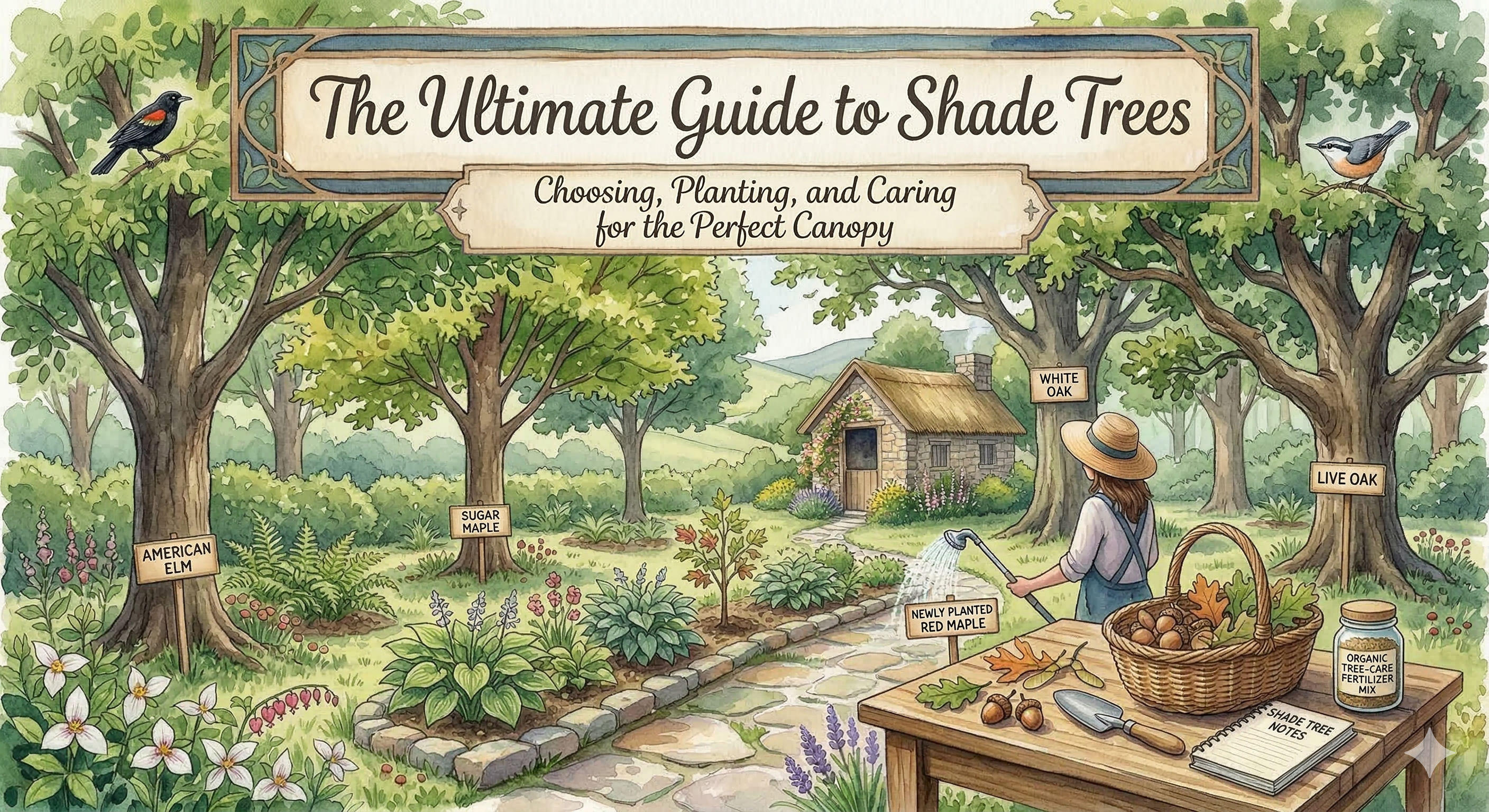
Choosing, Planting, and Caring for the Perfect Canopy
A shade tree is the one investment you can make today that your grandkids will still be sitting under someday. A well-chosen shade tree can drop the temperature under its canopy by up to 10°F on a hot summer day, slash energy bills, boost property value, clean the air, slow stormwater runoff, feed local wildlife, and make your yard the one everyone on the block envies. But the wrong tree in the wrong spot is a decades-long headache. This guide gives you everything you need to plant with confidence, care with wisdom, and love the result for years to come.
•Energy Savings: A well-placed deciduous shade tree on the south or west side can significantly reduce summer cooling costs. In winter, it drops its leaves to let warming sunlight back in — nature's genius at work.
•Property Value: Mature trees can add 10–15% or more to your home's market value. Buyers love the curb appeal and the cooling effect.
•Environmental Impact: Shade trees absorb CO₂, filter airborne pollutants, reduce urban heat island effects, prevent soil erosion, and manage stormwater runoff.
•Wildlife Habitat: Oaks alone support hundreds of species of birds, insects, and mammals. Squirrels, butterflies, songbirds — they all want to move in.
•Mental & Physical Health: Research shows spending time around trees reduces stress, lowers blood pressure, and improves mood.
•Outdoor Comfort: Nothing beats a lazy afternoon in the deep, dappled shade of a great tree with a cold drink in hand.
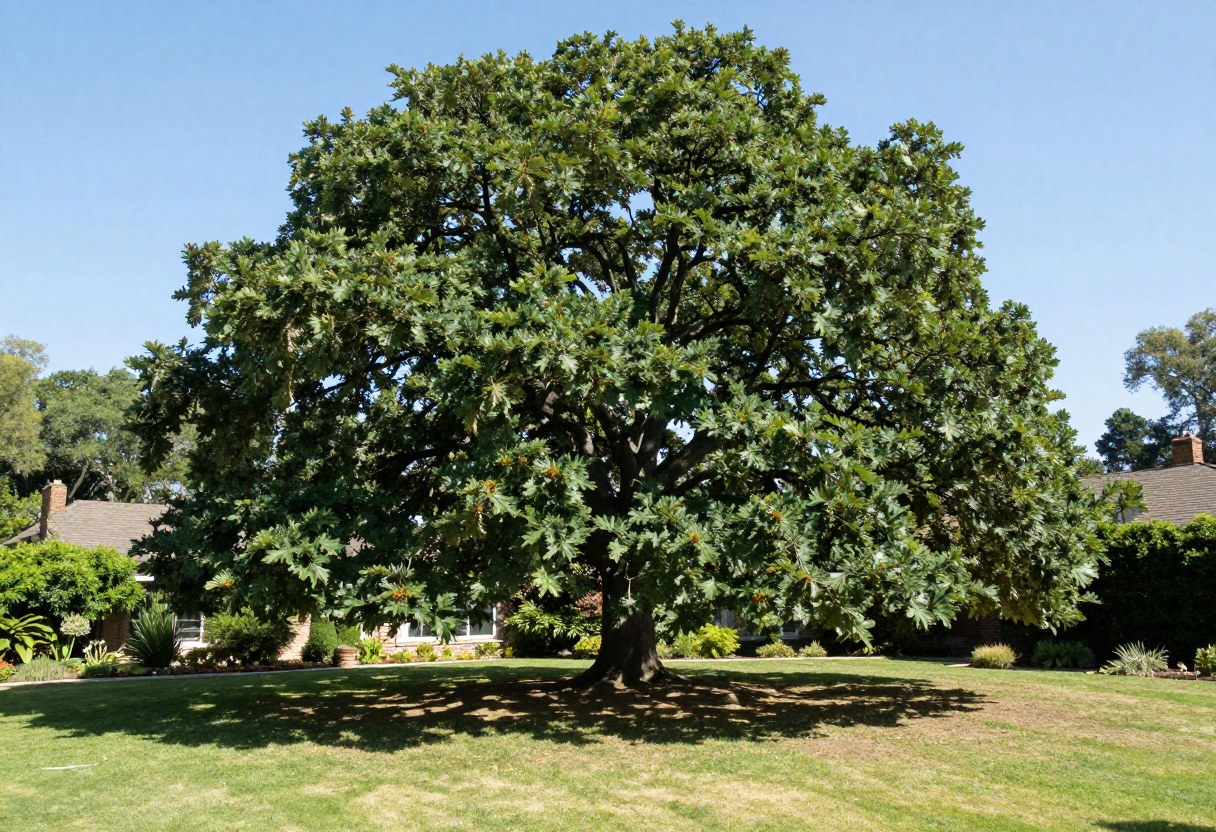
One well-placed tree, decades from now, casting exactly this kind of shade — that's the payoff for getting the choice right today.
Choosing the Right Shade Tree
Choosing a shade tree is like choosing a new roommate — except this one will outlive you. You need to be thoughtful, because once it's established, it's very hard to change your mind.
Step 1: Know Your USDA Hardiness Zone
The USDA Plant Hardiness Zone Map divides the United States into zones based on average annual extreme minimum winter temperature. The map was updated in 2023 — about half the country shifted a half-zone warmer. Find your exact zone at planthardiness.ars.usda.gov, then match your zone to the trees in this guide.
USDA Zones
Great Shade Trees
Where These Zones Are
Zones 3–4
Sugar Maple, Silver Maple, Paper Birch, Bur Oak, Quaking Aspen
Northern US, Canada border, upper Midwest
Zones 5–6
Red Oak, Pin Oak, American Elm, Ginkgo, Sweetgum, Tulip Poplar
Much of Midwest, Mid-Atlantic, Pacific NW
Zones 6–7
Red Maple, Willow Oak, Honeylocust, Dawn Redwood, Linden
Mid-South, lower Midwest, lower New England
Zones 7–8
Live Oak, Southern Magnolia, Crape Myrtle, Sycamore, Zelkova
South, Pacific Coast, lower Mid-Atlantic
Zones 9–11
Live Oak, Jacaranda, Royal Poinciana
Deep South, Southern CA, Hawaii, S. Texas
💡
Your zone tells you about winter cold survival, but not about summer heat, humidity, or rainfall. A tree rated for your zone might still struggle if your summers are brutal and dry. Always research beyond the zone number.
Step 2: Measure Your Space Honestly
Trees are like puppies — everyone sees the cute small version and forgets it's going to grow up. Plan for the tree's mature size, not its size when you plant it.
•Large Trees (60+ feet): Plant at least 20 feet from your home's foundation. Think oaks, tulip poplars, large maples.
•Medium Trees (30–60 feet): Good for smaller lots. Plant 15–20 feet from the house. Elms, medium maples, ginkgos.
•Small Trees (under 30 feet): Best near power lines, small yards, and patios. Japanese maples, redbuds, some dogwoods.
•Root spread: Tree roots can grow up to three times the diameter of the canopy. Surface roots can compete with nearby plants and become tripping hazards in lawns.
That small gap between sapling and foundation looks generous now — mature-size math is what makes it the right call.
⚡
Utility Lines Rule: If you have overhead power lines, your tree should mature to no taller than 20 feet. Breaking this rule results in constant utility trimming that mangles the tree's shape and compromises its health.
Step 3: Understand Your Soil and Sun
•Sun Exposure: Most shade trees prefer full sun (6+ hours/day) to flourish and develop a dense canopy.
•Soil pH: Target 5.0–6.5 for most shade trees. Have your soil tested through your local Cooperative Extension Office.
•Drainage: Avoid planting in low spots where water pools after rain. Most shade trees hate wet feet. River birch is a notable exception.
•Compaction: Compacted soil (common in lawns and new construction) limits oxygen and root penetration. Loosen the planting area and amend with compost if needed.
Step 4: Deciduous vs. Evergreen
Type
Best For
Examples
Deciduous
Drop leaves in fall; leaf out in spring. Allow winter sun through. Brilliant fall color. Best for summer shade while letting passive solar heating work in winter.
Oaks, Maples, Elms, Birches, Tulip Poplar, Ginkgo
Evergreen
Keep foliage year-round. Great for privacy screens and blocking cold north winds. Can block winter sun on south side of house.
Southern Magnolia, Live Oak, Arborvitae, Pine, Spruce
🌿
For energy efficiency, deciduous trees are the winners in most climates — they shade you in summer, then step aside in winter to let that precious sunlight warm your home.
•Interesting bark? River birch, paperbark maple, sycamore.
•Worried about seeds/mess? Look for seedless cultivars like 'Celebration' maple or thornless honeylocust.
•Wildlife habitat? Native oaks are the gold standard — they support entire ecosystems.
•Fast shade? Focus on growth rate; fast growers trade off longevity for speed.
•Low maintenance? Established oaks, lindens, and ginkgos are famously self-sufficient.
Top Shade Trees
The Heavy Hitters — Classic Large Shade Trees
Oak (Quercus spp.) — The King of the Yard: If you plant nothing else, plant an oak. Ecological powerhouses supporting hundreds of species of birds, insects, and mammals. Strong, long-lived (100–500+ years for some species), and magnificent in form. Best varieties: Red Oak (fast for an oak, zones 3–8), White Oak (zones 3–9, spectacular fall color), Pin Oak (zones 4–8, urban-tolerant), Willow Oak (zones 5–9, graceful fine-textured leaves), Live Oak (zones 7–10, evergreen, iconic Southern tree). Mature size: 40–100 feet depending on species.
Maple (Acer spp.) — The Rock Star of Fall Color: The most popular shade trees in the US for good reason — reliable shade, fast growth, and some of the most dazzling autumn color imaginable. Best varieties: Red Maple 'October Glory' and 'Autumn Blaze' (fast, gorgeous fall color, zones 4–9), Sugar Maple (zones 3–8, the full color experience), Japanese Maple (small, ornamental, zones 5–8). If helicopter seeds bother you, look for seedless cultivars.
American Elm (Ulmus americana) — The Comeback Kid: Nearly wiped out by Dutch Elm Disease in the 20th century, but disease-resistant cultivars like 'Valley Forge' and 'Princeton' are bringing it back. The graceful vase-shaped canopy once defined American main streets. Mature size: 60–80 feet. Growth rate: fast. Zones 3–9.
Tulip Poplar (Liriodendron tulipifera): One of the tallest native hardwoods in North America — fast-growing, straight-trunked, with gorgeous tulip-shaped yellow-green flowers in late spring. Its mature height of 70–90 feet makes it too large for small lots, but for spacious properties it's a showstopper. Zones 4–9.
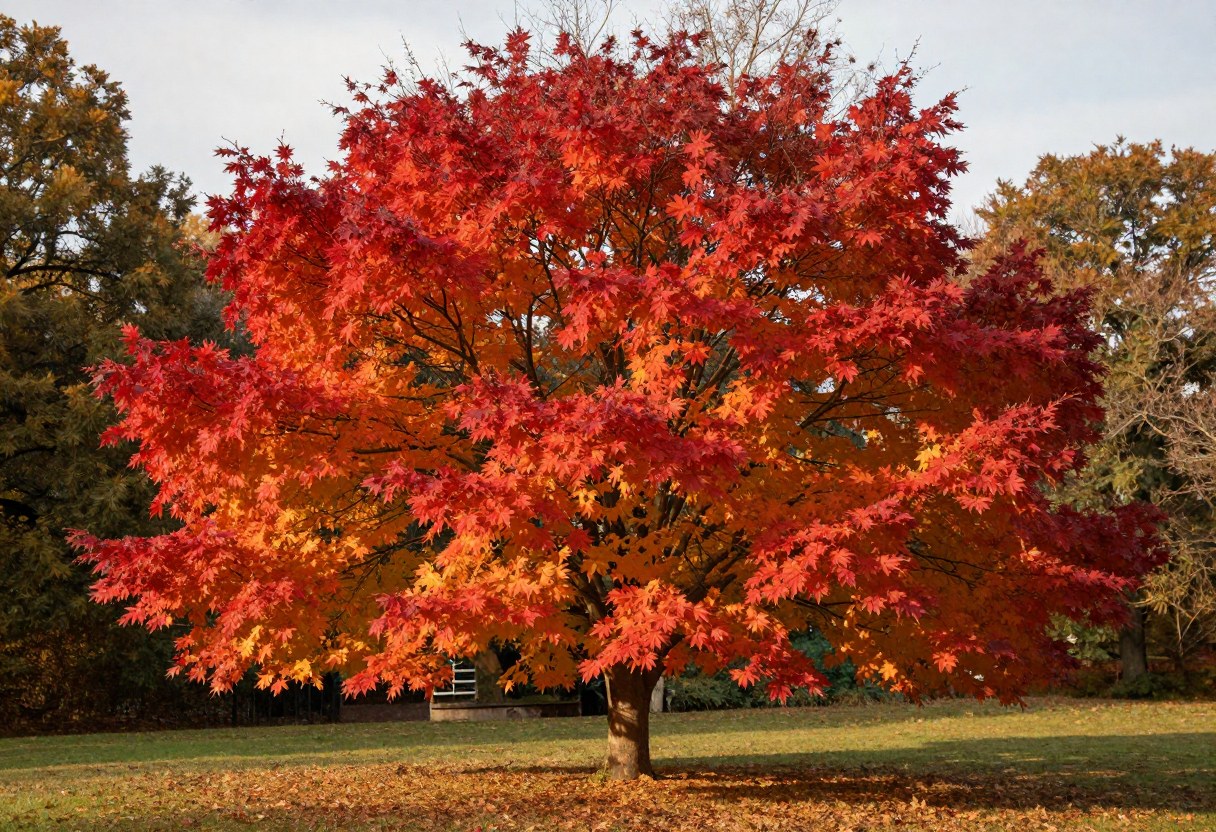
Fall color like this is the payoff of picking a maple or oak over a faster, blander grower — the wait is the whole point.
The Reliable Workhorses
Ginkgo (Ginkgo biloba) — The Living Fossil: On Earth for 270 million years. Incredibly tough and adaptable to urban conditions — pollution, salt, drought. Fan-shaped leaves turn a brilliant uniform yellow in fall before dropping all at once in a single glorious day. Plant only male trees — the female produces seeds that smell terrible. Zones 3–8. Mature size: 50–80 feet.
Honeylocust (Gleditsia triacanthos) — The Easy-Going All-Star: Thornless, seedless cultivars like 'Shademaster' and 'Skyline' tolerate drought, poor soil, pollution, and compaction. The delicate, ferny leaves cast a light dappled shade that lets grass grow underneath. Brilliant gold in fall. Zones 3–9.
River Birch (Betula nigra) — Bark That Steals the Show: Peeling cinnamon-and-cream bark is stunning year-round, especially in winter. Naturally handles wet soils beautifully and is resistant to bronze birch borer. 'Heritage' is the most popular cultivar. Zones 4–9. Mature size: 40–70 feet.
Linden / Basswood (Tilia spp.) — The Fragrant Canopy: Dense, heart-shaped leaves and wonderfully fragrant summer flowers that bees absolutely love. 'Greenspire' and 'Little Leaf Linden' are compact-growing, tidy, and dependable. Zones 3–8. Mature size: 40–60 feet.
Fast Growers — For Those Who Want Shade Now
⚠️
Speed often comes with trade-offs. Fast-growing trees tend to have weaker wood, shorter lifespans, and more maintenance needs than slower-growing counterparts. Use them thoughtfully.
•Red Sunset Maple: One of the fastest-growing maples, reliable brilliant fall color, nicely symmetrical oval crown. Better wood than silver maple.
•Quaking Aspen (Populus tremuloides): Fast-growing, stunning golden fall color, iconic shimmering sound in the breeze. Best in cooler climates (zones 1–6). Shorter-lived than oaks and maples, and its root system can be aggressive.
•Dawn Redwood (Metasequoia glyptostroboides): Thought extinct, rediscovered in China in the 1940s. A fast-growing deciduous conifer with feathery needles that turn rusty orange in fall. Pyramidal form, interesting ridged bark. Zones 4–8. Mature size: 70–100 feet.
Regional Champions
Region
Top Shade Tree Picks
Hot & Humid South (Zones 7–9)
Live Oak, Southern Magnolia, Bald Cypress, Shumard Oak, Willow Oak
Arid Southwest (Zones 8–10)
Desert Willow, Western Redbud, Arizona Ash, Native Oaks, Texas Live Oak
Pacific Northwest (Zones 7–9)
Big-Leaf Maple, Oregon White Oak, Black Cottonwood, Dawn Redwood, Zelkova
Upper Midwest / Great Plains (Zones 4–6)
Bur Oak, Hackberry, Northern Red Oak, American Linden
Northeast / New England (Zones 4–6)
Sugar Maple, Pin Oak, Paper Birch, American Elm (resistant), Ginkgo
Mountain West (Zones 4–7)
Quaking Aspen, Gambel Oak, Ponderosa Pine (for shade groves)
🌱
Native Trees First: Wherever possible, choose trees native to your region. They're adapted to your soil, rainfall, and climate; require far less maintenance; and support local wildlife far more richly than imported species.
Quick Reference at a Glance
Tree Name
Zones
Height
Growth Rate
Fall Color
Best For
Red Oak
3–8
60–75'
Moderate-Fast
Yellow-Red
Large yards, wildlife
White Oak
3–9
60–100'
Slow-Moderate
Red-Brown
Legacy plantings, wildlife
Sugar Maple
3–8
60–75'
Slow-Moderate
Orange-Red
Fall color, classic
Red Maple
4–9
40–60'
Fast
Red-Orange
Front yards, adaptable
American Elm
3–9
60–80'
Fast
Yellow
Street trees, large lots
Ginkgo (male)
3–8
50–80'
Slow-Moderate
Brilliant Yellow
Urban yards, unique
Honeylocust
3–9
30–70'
Fast
Yellow-Gold
Lawns, tough sites
River Birch
4–9
40–70'
Moderate-Fast
Yellow
Wet areas, ornamental bark
Linden
3–8
40–60'
Moderate
Yellow
Formal yards, fragrant flowers
Tulip Poplar
4–9
70–90'
Fast
Yellow
Large properties only
Dawn Redwood
4–8
70–100'
Fast
Rusty Orange
Unique specimen tree
Live Oak
7–10
40–80'
Moderate
Evergreen
Deep South, iconic
Planting Like a Pro
When to Plant
•Fall (late Sept–Nov): Often the best choice. Cooler temperatures reduce water stress, roots can grow through mild winters, and energy focuses entirely on root establishment.
•Early Spring (before bud break): Second best. Plant early before heat arrives and monitor water closely.
•Summer: Possible but demanding. Requires aggressive, consistent watering. Not ideal.
What to Buy
Type
What It Means
Best Timing
Bare Root
Dug dormant, no soil. Cheapest option. Must plant within 72 hours. Excellent long-term root development.
Late winter/early spring only
Balled & Burlapped
Field-grown, dug with soil and wrapped in burlap. Root ball should be 10–12x the trunk's caliper diameter.
Fall or early spring best
Container Grown
Convenient, widely available. Check for circling roots — score 4 vertical cuts before planting.
Almost any time; avoid peak heat
The Planting Process — Step by Step
🚨
The Single Biggest Planting Mistake: Planting too deep. A tree buried with the root flare underground will struggle, decline, and eventually die — sometimes years later. The root flare must be visible above ground.
•Dig 2–3 times WIDER than the root ball, but ONLY as deep as the root ball.
•The root flare (where the trunk widens at the base) should sit 1–3 inches ABOVE the surrounding soil grade.
•Container trees: Score 4 vertical cuts down the root ball to interrupt circling root patterns.
•B&B trees: Remove ALL burlap, wire baskets, and ropes before backfilling — these do not break down quickly.
•Backfill with the original native soil — don't heavily amend it. Rich amended pockets discourage outward root spread.
•Fill halfway with soil, water thoroughly to eliminate air pockets, then finish filling.
•Do NOT create a depression or moat at the base — water should drain away from the trunk.
Mulch: The Donut, Not the Volcano
Mulch is one of the best things you can do for a newly planted tree. It retains moisture, moderates soil temperature, suppresses competing weeds, and adds organic matter as it breaks down.
•Spread the mulch ring out to the drip line of the canopy — bigger is better
•Keep mulch AT LEAST 6 inches away from the trunk
🌋
Mulch Volcanoes Kill Trees: Never pile mulch against the trunk in a cone shape ("volcano mulching"). This causes stem girdling roots that slowly strangle the tree, invites bark rot, attracts rodents, and blocks water infiltration. The mulch ring should look like a donut — flat with a clear ring around the trunk.
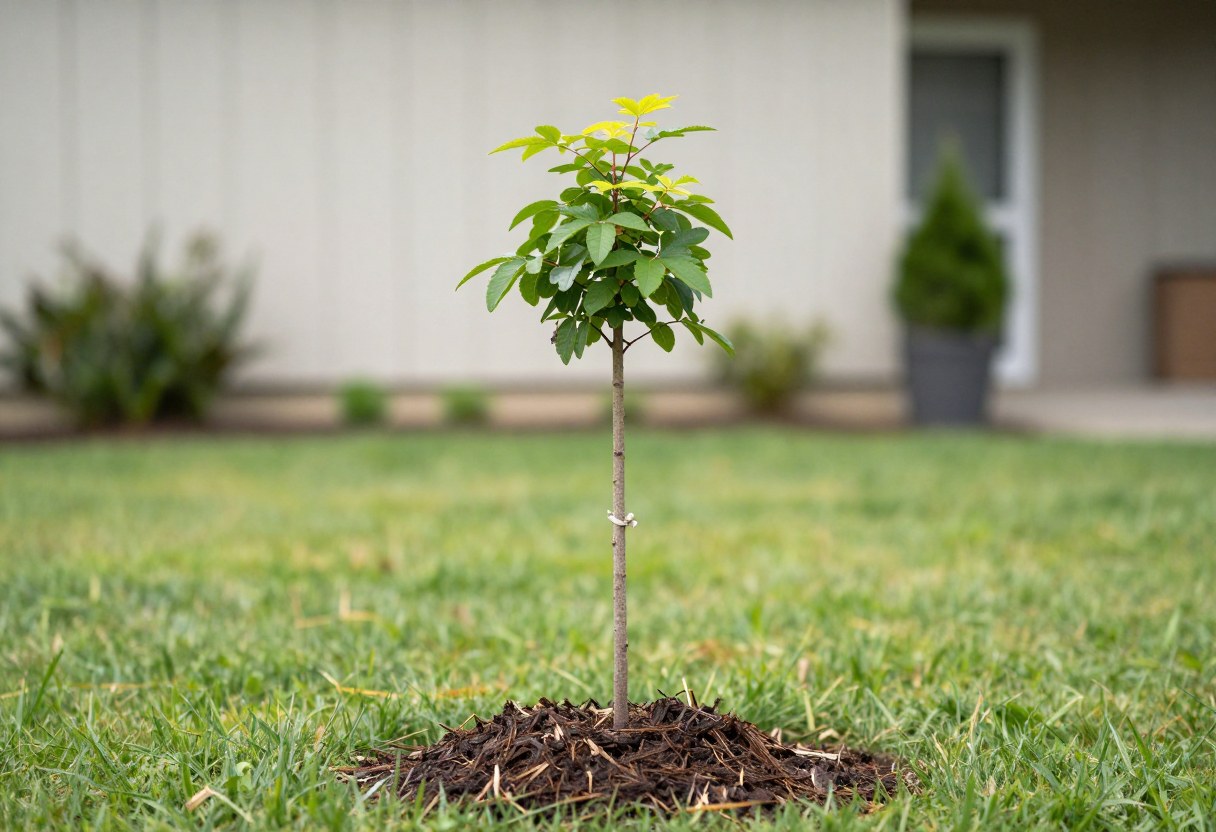
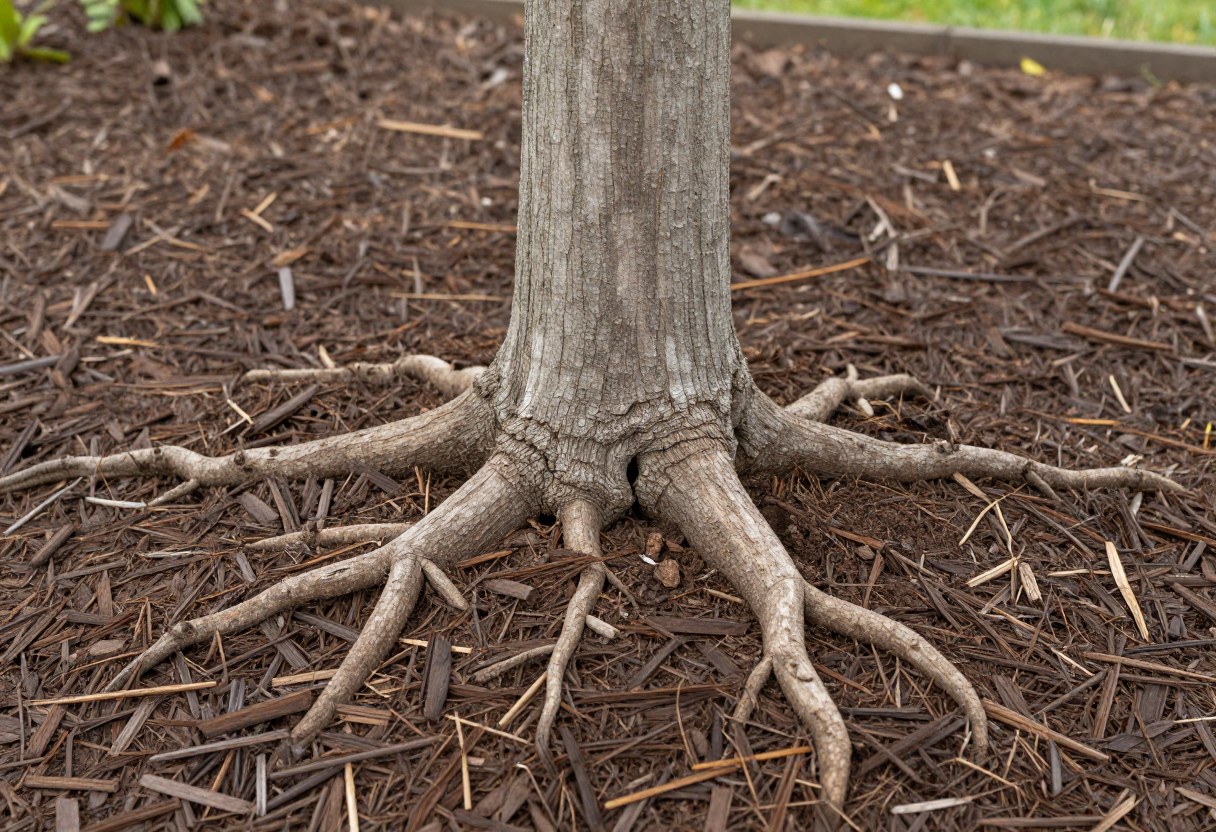
This is what "root flare visible" actually looks like — the trunk should widen and show bark texture change right at soil level, never disappear straight into a mulch pile.
📌
Staking: Trees that can stand on their own should be left unstaked — movement in the wind builds trunk strength. If staking is needed, use soft flexible ties and remove all stakes after one full growing season.
Ongoing Care — The Long Game
Watering — The Single Most Important Factor
Water is the most critical need for a newly planted tree. Most tree failures in the first few years come down to inconsistent or inadequate watering.
Phase
Watering Approach
Years 1–2 (Establishment)
Water deeply 1–2 times per week during growing season. 10–15 gallons per session. During heat spells (3+ days over 85°F), add a second weekly session.
Years 3–5 (Transitional)
Deep water every 10–14 days during dry spells. 20–25 gallons per week. Check soil moisture with a stick 3 inches down.
Established Trees
Most established shade trees survive on natural rainfall. Supplement with deep watering during extended drought (2–3 weeks with no significant rain).
💧
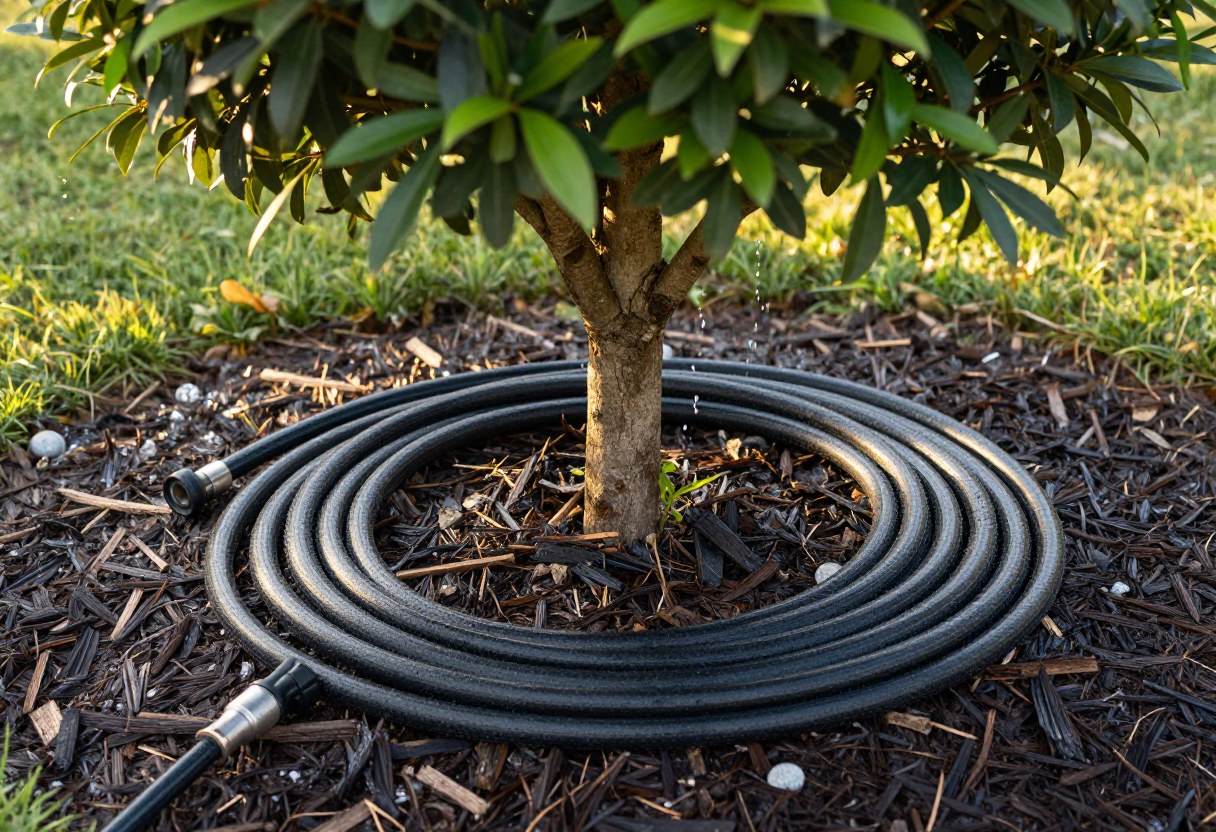
A slow drip for 30–60 minutes beats a quick 5-minute blast. Soaker hoses, drip rings, or 5-gallon buckets with small holes drilled in the bottom are excellent low-tech solutions. Deep, infrequent watering beats shallow frequent watering every time.
A coiled soaker hose left to run slowly for an hour delivers water exactly where it counts — at the root zone, not running off the surface.
Fertilizing — Less Is Often More
•Wait 1–2 years after planting before fertilizing — let the tree focus on root establishment.
•If growth seems slow or foliage looks pale, consider a soil test first to identify what's actually lacking.
•If fertilizing, use a slow-release balanced fertilizer (like 10-10-10) applied in early spring or late fall.
•Broadcast granular fertilizer evenly around the base, covering an area matching the canopy spread.
•Healthy, vigorously growing trees in decent soil can often skip fertilizer entirely.
Pruning — The Art of Making Smart Cuts
•Year 1: Hands off — remove only dead or broken branches. The tree needs all its leaves to fuel root establishment.
•Years 2–3: Begin structural pruning. Remove crossing or rubbing branches, and branches with narrow V-shaped crotches (prone to splitting in storms).
•Gradually remove lowest branches to raise the canopy as the tree grows ("limbing up").
•Remove sucker growth from the base at all times.
•Best time for structural pruning: late winter/early spring before bud break.
•NEVER top a tree. Topping destroys natural form, creates multiple weak sprouts, and ultimately shortens the tree's life.
•Always cut just outside the branch collar — never into it. The collar tissue is what heals over the wound.
•Avoid string trimmers near the trunk. Even a small bark wound lets pests and disease inside.
Seasonal Care Calendar
Season
Key Tasks
Spring
Water newly planted trees as temperatures rise. Begin structural pruning before bud break. Apply fertilizer if needed. Inspect for overwintering pests. Refresh mulch ring — maintain 2–4 inch depth.
Summer
Deep water during drought (every 1–2 weeks for established trees). Watch for signs of stress: wilting, leaf scorch, premature leaf drop. Monitor for insect pests. Keep mulch ring clear of grass.
Fall
Reduce watering frequency but continue until ground freezes. Excellent time to plant new trees. Inspect for structural issues before winter storms.
Winter
Protect young trunks with tree guards against frost crack and rodent damage. Inspect after ice or snow storms for broken branches — remove promptly.
Troubleshooting — When Things Go Wrong
Symptom
Likely Cause & Response
Yellowing leaves (not fall color)
Nutrient deficiency, overwatering, poor drainage, or root damage. Soil test is the first step.
Leaf scorch (brown edges/tips)
Drought stress, root damage, road salt exposure, or wind burn.
Premature leaf drop
Drought stress, disease, or pest infestation. Investigate closely.
Sparse canopy / die-back from branch tips
Girdling roots, root damage, drought, or vascular disease. Serious — consult a certified arborist.
Flat sides on trunk near base
Classic sign of stem girdling roots — a slow-motion strangling of the tree. Arborist consultation urgent.
Mushrooms or conks at base
Indicates internal decay — possible structural hazard. Get a professional assessment.
Holes in bark with sawdust
Borer insects — often secondary to tree stress. Address the underlying stress first.
Sticky honeydew on leaves
Aphid or scale infestation. Usually treatable with insecticidal soap or neem oil.
🔑
Most tree deaths are NOT caused by pests or diseases — they're caused by abiotic stressors like improper planting depth, drought, soil compaction, and volcano mulching. Pests and diseases often move in as opportunistic secondary invaders on already-stressed trees. Fix the underlying stress first.
When to Call a Certified Arborist
•You see mushrooms, conks, or significant decay at the base or on major branches
•Large branches are hanging dead or at risk of falling
•The tree is leaning suddenly or significantly
•You notice flat areas on the trunk (possible girdling roots)
•Any crown reduction or major structural pruning is needed
•The tree is near your house, power lines, or other structures
🏆
Always hire an ISA Certified Arborist — not just "a tree service." The ISA certification means genuine training and expertise. Find certified arborists at treesaregood.org/findanarborist.
Strategic Placement for Energy Savings
Thoughtful tree placement is a natural form of energy efficiency that works year after year without any electricity.
•South side of house: Plant deciduous trees here. They shade the roof in summer and drop leaves in winter to let warming sunlight in. AVOID planting evergreens on the south side if you rely on passive solar heating.
•West side: Often the hottest exposure — afternoon sun is brutal. A tree on the west side provides crucial relief for west-facing rooms.
•Southwest: Best for maximum summer shading of rooftops. Trees with high, spreading crowns are ideal.
•North side: Dense evergreens act as windbreaks, blocking cold winter winds and reducing heating costs.
•Shaded pavement: Shaded driveways, parking areas, and patios radiate dramatically less heat into your home's environment.
Trees and Lawn — The Age-Old Conflict
Let's be honest: grass and trees are in competition. Turfgrass is one of the most aggressive competitors for water, nutrients, and space that a tree faces. Under a dense tree canopy, grass is also fighting a losing battle for sunlight.
•Expand your mulch ring as the tree grows — this is better for the tree than fighting to maintain grass under it
•Replace struggling turf under trees with shade-tolerant ground covers like hostas, ferns, pachysandra, wild ginger, or native wildflowers
•Never fertilize turfgrass immediately against a tree's root zone with high-nitrogen products — this feeds the grass at the tree's expense
•Avoid using string trimmers near the trunk — mow in circles and let the mulch ring do the work
Companions to Plant Under Your Shade Tree
Several beautiful plants thrive in the dry shade created by a mature canopy:
•Hostas — the undisputed champion of shade gardening
•Bleeding heart (Dicentra) — elegant fern-like foliage and heart-shaped flowers
•Coral bells (Heuchera) — stunning foliage color even in shade
⚠️
Black Walnut Warning: Black walnuts release a compound called juglone from their roots that is toxic to many plants. Research "juglone tolerance" before planting companions near a black walnut tree.
Tree Inventory Checklist Before Buying
Before you hand over your money at the nursery, run through this quick checklist:
•Is the root flare visible? (If buried in the pot, look closer — or skip this tree)
•Are there any circling or girdling roots visible? (Minor is fixable; severe is a problem)
•Is the trunk straight and free of wounds or damage?
•Is there a strong central leader (the main vertical trunk)?
•Is the root ball firm, not loose or wobbly?
•Is the caliper (trunk diameter) proportional to the size of the tree?
•Does the tree look healthy — good leaf color, no unusual wilting, no visible pests?
The "Right Tree, Right Place" Philosophy
This phrase is the unofficial motto of professional arborists, and it's wisdom that can save you from years of headaches. The perfect shade tree — in the perfect spot — requires dramatically less maintenance, lives dramatically longer, and causes dramatically fewer problems than a tree that's fighting its site conditions.
•Space: Does the mature size fit without touching structures, utilities, or neighbors?
•Zone: Is this tree hardy in my USDA hardiness zone?
•Soil: Does this tree match my soil drainage, pH, and composition?
•Sun: Does the planting site provide the right sun exposure?
•Purpose: Does this tree do what I need — shade, privacy, wildlife, aesthetics?
✅
If you can answer yes to all five questions above, plant with confidence. Getting one or two wrong is manageable — getting three or more wrong is a recipe for a tree that struggles its entire life and eventually must be removed.
Final Thoughts — Plant Your Legacy
Planting a shade tree is one of the most genuinely meaningful things you can do on a piece of land. You're not just improving your yard for this weekend's BBQ — you're shaping the landscape of your property for decades, contributing to the local ecosystem, reducing your carbon footprint, and leaving something extraordinary behind for whoever comes after you.
Trees don't need you to be perfect. They need you to choose well, plant right, water faithfully in the early years, and get out of the way. Nature is extraordinarily good at the rest.
Pick your tree. Dig your hole wide. Keep the root flare visible. Water deeply. Mulch in a donut, not a volcano. Wait. Watch. And someday, you'll be sitting in the shade of something you made happen — and that's a pretty incredible feeling.
🌿 Get Seasonal Gardening Tips
New guides, planting reminders, and growing tips — straight to your inbox.
No spam. Unsubscribe anytime.
About the Author
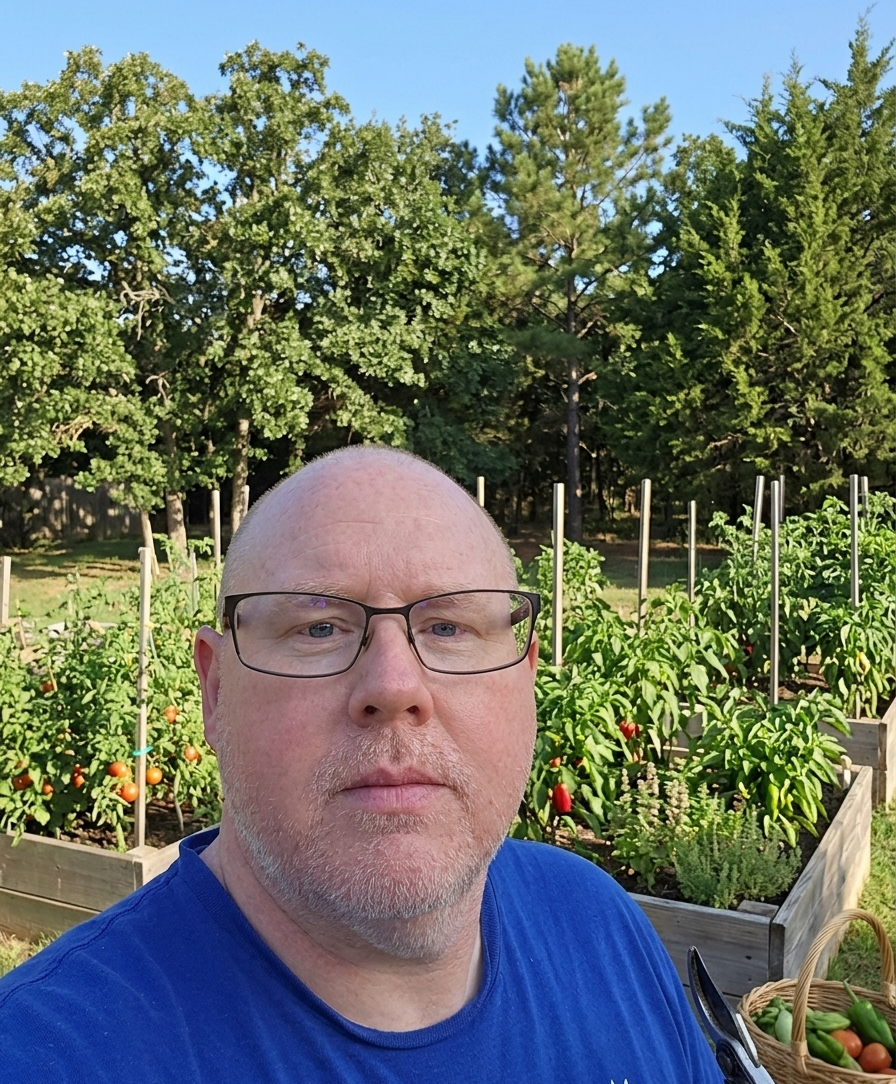
David Rodgers is the Founder & Head Gardener of Planting Atlas. With over 40 years of hands-on gardening experience in Oklahoma's Zone 7 climate, he researches, writes, and personally tests every guide on the site.
David draws from real backyard trials, soil testing, and trusted sources like Oklahoma State University Extension and USDA data to deliver practical, zone-specific advice that actually works.