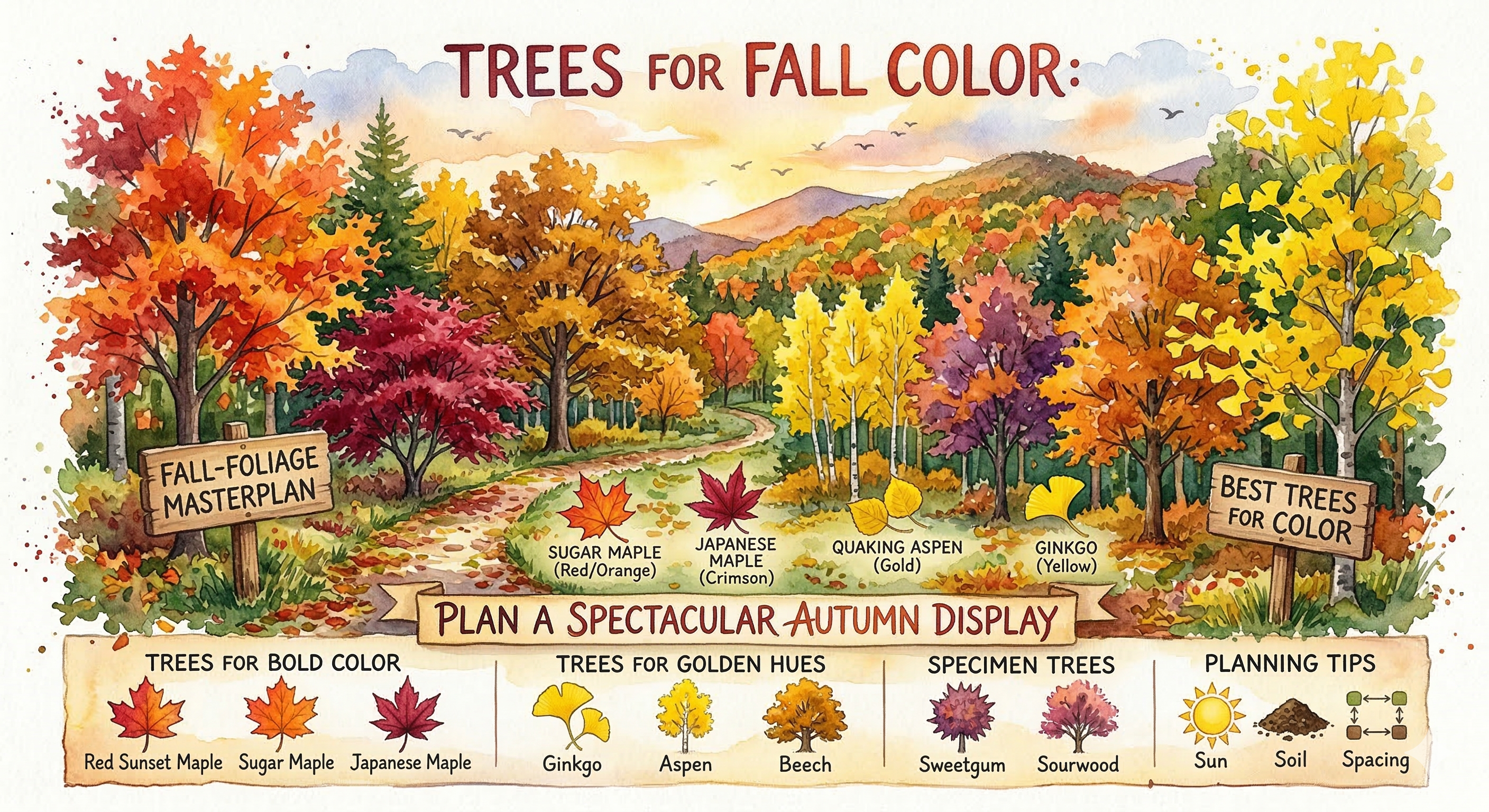
Plan a Spectacular Autumn Display with the Best Fall-Foliage Trees
Somewhere between the last hot day of summer and the first real cold snap of winter, something magical happens. Trees that spent nine months quietly doing their green photosynthesis thing suddenly break out their secret wardrobe and set the world on fire with crimson, gold, amber, and burgundy. No admission ticket. No reservation required. Just look up.
Why Fall Color Is the Most Spectacular Free Show on Earth
Somewhere between the last hot day of summer and the first real cold snap of winter, something magical happens. Trees that spent nine months quietly doing their green photosynthesis thing suddenly break out their secret wardrobe and set the world on fire with crimson, gold, amber, and burgundy. No admission ticket. No reservation required. Just look up.
But here's the thing most people don't know: a jaw-dropping autumn display in your own yard doesn't happen by accident. The trees that light up the hillsides in Vermont or the Blue Ridge Mountains were there for decades before anyone appreciated them — planted, usually by natural processes, in exactly the right conditions. In your yard, you get to engineer that same result, deliberately and beautifully.
This guide will give you the knowledge to do exactly that. We'll start with the actual chemistry behind why leaves change (it's more fascinating than you might think), then walk through the best species for every color and climate, teach you how to sequence a planting for maximum seasonal impact, and show you how to design a fall foliage display that starts in August and carries through to Thanksgiving — all in your own backyard.
🍂
Pro Tip: The best time to buy fall color trees is in the fall — when you can actually see the color the tree produces. Visit nurseries in September and October, evaluate real specimens at peak, and plant what you see. This eliminates any guessing about what cultivar you're getting.
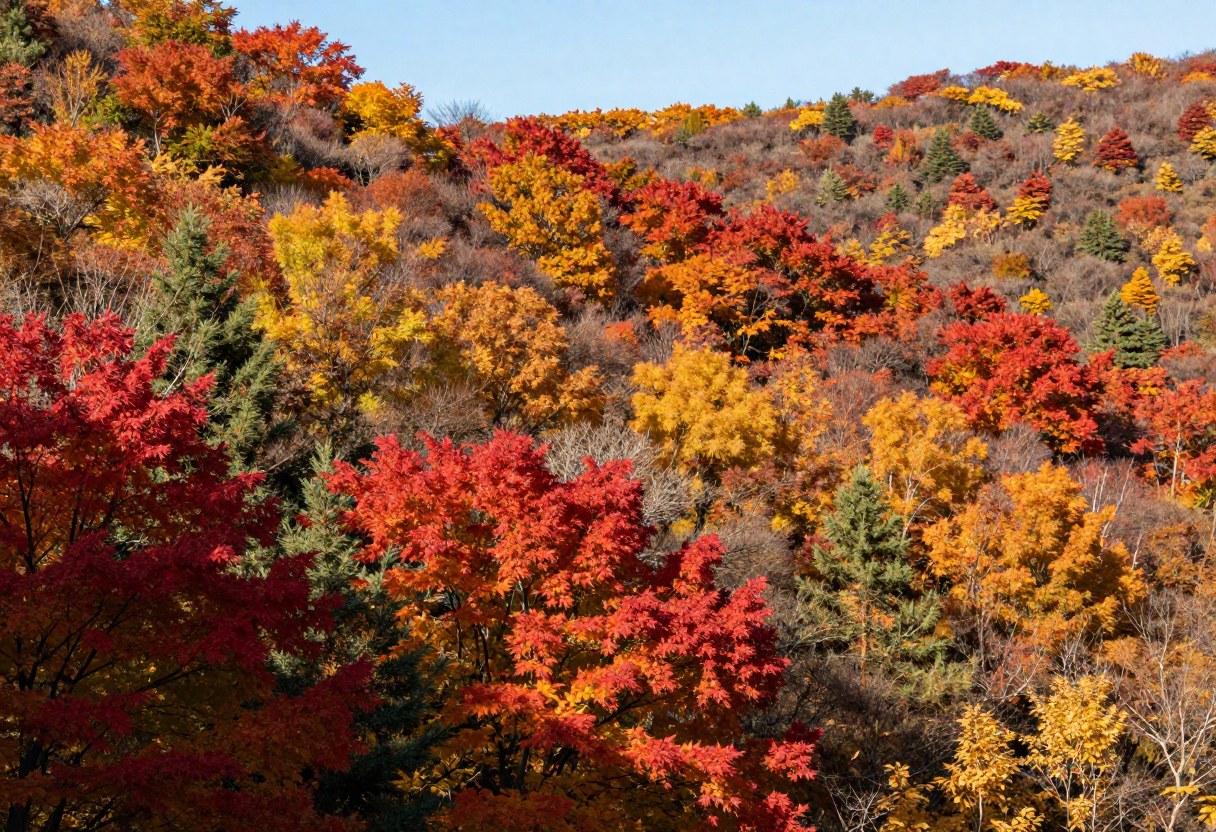
No admission ticket, no reservation required — and every tree in this hillside started as a deliberate planting decision generations ago.
The Chemistry of Color: Why Leaves Put on Such a Show
Before we talk about which trees to plant, let's talk about what's actually happening when leaves change. This isn't just pretty — it's brilliant biochemistry, and understanding it will make you a smarter fall-color gardener.
The Three Pigments Behind Autumn's Palette
Every fall color you've ever admired comes from just three categories of plant pigments, each with its own chemistry and behavior:
1. Chlorophyll — The Vanishing Act
Chlorophyll is the reason leaves are green — it's the dominant pigment during the growing season, constantly produced and constantly broken down during photosynthesis. It masks everything else. As days shorten in fall and nights lengthen, a tree gets the signal to begin shutting down. A corky layer of cells (the 'abscission zone') forms at the base of each leaf stem, cutting off water and nutrients. Chlorophyll production stops. Existing chlorophyll breaks down. And as the green fades... the curtain rises on everything else.
2. Carotenoids — The Hidden Understudy
Here's a surprise: the yellows and oranges of fall were there all along. Carotenoids — the same pigments that make carrots orange, corn yellow, and daffodils gold — are present in leaves throughout the growing season, completely invisible behind the chlorophyll curtain. When chlorophyll breaks down, carotenoids simply become visible for the first time. This is why yellow and gold fall colors are relatively consistent year to year — they don't depend on weather, just on chlorophyll disappearing.
3. Anthocyanins — The Star of the Show
The reds, crimsons, purples, and magentas — the colors that make New England famous in October — come from anthocyanins, and here's the twist: unlike carotenoids, anthocyanins are NOT present all summer. They are actively manufactured by the tree in fall, specifically in response to bright sunlight and excess sugars trapped in the leaf when the abscission zone cuts off the leaf's connection to the rest of the tree.
This is why weather matters so much for red fall color. The more sugar trapped (warm, sunny days) and the more it stays trapped (cool nights slowing sugar transport), the more anthocyanins are produced and the more brilliant the red. Rain leaches anthocyanins out. Early frost destroys leaves before they can build up. But a warm, dry summer followed by crisp fall days and cold-but-not-freezing nights? That's when you get the kind of fall color that stops traffic.
🔬
Science Bit: The pH of leaf cell sap actually affects what color anthocyanins appear. In more acidic cell environments, they produce reds. In more alkaline conditions, the same pigment can produce purple-to-blue. This is why some trees (like Black Tupelo) can show both red AND purple leaves simultaneously on different parts of the same branch.
The Perfect Fall Color Recipe: What Weather Does to Your Trees
Now you understand the chemistry — here's what drives it in the real world:
•Warm, sunny fall days: Keeps photosynthesis producing sugars in the leaf, building the raw material for anthocyanins
•Cool fall nights (32–45°F, not freezing): Slows the transport of sugars out of the leaf, trapping them for pigment production
•Moist summer: Well-hydrated trees produce healthier, more pigment-rich leaves
•Dry early fall: After a moist summer, dry fall weather helps pigments concentrate rather than being diluted or leached
•No early hard freeze: A killing frost before leaves reach peak destroys the pigments in mid-process, cutting the show short
•No extended drought: Drought-stressed trees produce fewer pigments and often drop leaves early without coloring
⚠️
Watch Out: Climate change is already affecting fall foliage — warmer fall temperatures delay color change, shorten the display window, and can dull intensity. Drought-stressed trees earlier in the growing season produce less vibrant fall color, even in ideal fall weather.
Color by Pigment: Which Trees Make What Colors
Fall Color
Pigment Type
Best Trees for This Color
🔴 Blazing Scarlet & Crimson
Anthocyanins
Sugar Maple, Red Maple, Black Tupelo, Sweetgum, Sourwood, Scarlet Oak
🟣 Deep Burgundy & Purple
Anthocyanins (acidic pH)
Japanese Maple, Black Tupelo, Sweetgum, Sassafras, Fothergilla
🟠 Vivid Orange
Mixed Carotenoids + Anthocyanins
Sugar Maple, Black Gum, Katsura, Serviceberry, Sassafras
Ginkgo, River Birch, Quaking Aspen, Redbud, Tulip Poplar
🟤 Russet, Bronze & Brown
Tannins
Oaks (many species), Beech, Ironwood, Hornbeam
🌈 Multi-color (same tree!)
Multiple pigment types
Black Tupelo, Sweetgum, Sassafras, Sugar Maple, Persian Ironwood
The Fall Color Hall of Fame: Top Trees for Every Yard
Not all fall color trees are created equal. Some deliver consistent, reliable brilliance every year. Others are finicky — spectacular when conditions are perfect, disappointing when they're not. The trees below are the reliable performers that professional landscapers and tree enthusiasts reach for when they need guaranteed autumn impact.
🍁 The Icon: Sugar Maple (Acer saccharum)
If fall color had a mascot, it would be the Sugar Maple. This is the tree on the Canadian flag, the tree that defines New England autumns, the tree that more US states have claimed as their state tree than any other species. In fall, a mature Sugar Maple can display yellow, orange, and scarlet simultaneously on different parts of its canopy — a single tree becoming a multi-color fireworks display.
•Fall color: Yellow → burnt orange → brilliant scarlet to crimson — often all at once
•Mature height/spread: 60–75 ft tall, 40–50 ft wide — a large, majestic tree
•USDA Zones: 3–8 — not for the South; thrives in cold winters
•Needs: Full sun for best color; prefers well-drained, slightly acidic soil; dislikes compaction and road salt
🍂
Pro Tip: Sugar Maple's fall color is most intense on the south and west sides of the tree, where leaves get more afternoon sun exposure. When siting your tree, position it where it will receive western afternoon sun to maximize color intensity on the side most visible from your house or street.
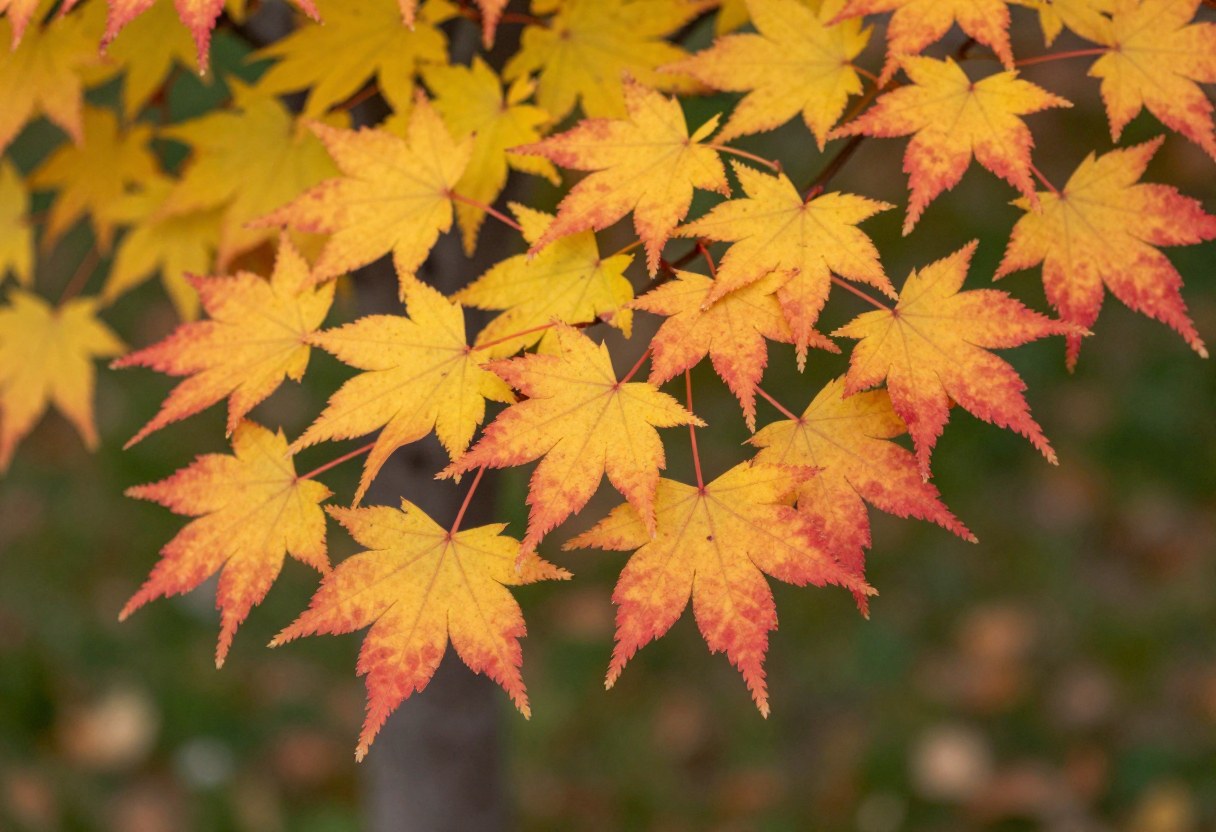
Yellow, orange, and scarlet on the same branch at once — a single mature Sugar Maple can become a multi-color fireworks display all by itself.
🔴 The Reliable Workhorse: Red Maple (Acer rubrum)
Called 'one of the most stunning of all North American trees in autumn' by tree experts, Red Maple has the widest climate range of any maple — thriving from Zone 3 all the way to Zone 9 — and delivers spectacular fall color across virtually every region. Michael Dirr, the dean of American dendrologists, noted it has something red in every season: red buds in winter, red flowers in spring, red leafstalks in summer, and blazing red foliage in fall. It's also significantly faster-growing than Sugar Maple.
•Fall color: Yellow, orange, or brilliant red-scarlet (varies by cultivar and location)
•Mature height/spread: 40–70 ft tall, 30–50 ft wide
•USDA Zones: 3–9 — the most climate-adaptable maple
•Timing: Early October — one of the first maples to turn
•Needs: Adaptable to wet and dry soils; full sun preferred; tolerates part shade
⚠️
Watch Out: Red Maple fall color can be variable in warm climates (Zone 7+). In the deep South, they often turn yellow rather than red. If you're in Zone 7–9, choose cultivars specifically selected for southern performance, like 'October Glory' or 'Autumn Flame.'
🎋 The Artist's Choice: Japanese Maple (Acer palmatum)
Japanese Maple is the fall color tree for gardeners who treat their yard like a canvas. No other tree offers such a range of forms, leaf shapes, and color options — and in autumn, the best cultivars stop people in their tracks. Cascading, lace-leaved forms glow like stained glass backlit by October sun. Upright specimens turn shades of gold, scarlet, and burgundy that seem almost unreal. And unlike most fall color trees, Japanese Maples deliver ornamental value in every single season.
•Fall color: Gold, orange, scarlet, or deep burgundy depending on cultivar
•Mature height/spread: 6–25 ft (highly variable by cultivar)
•USDA Zones: 5–9 — not reliably cold-hardy in Zones 3–4
•Needs: Part shade (especially afternoon shade in hot climates); moist, well-drained, acidic soil; shelter from drying winds
🎨
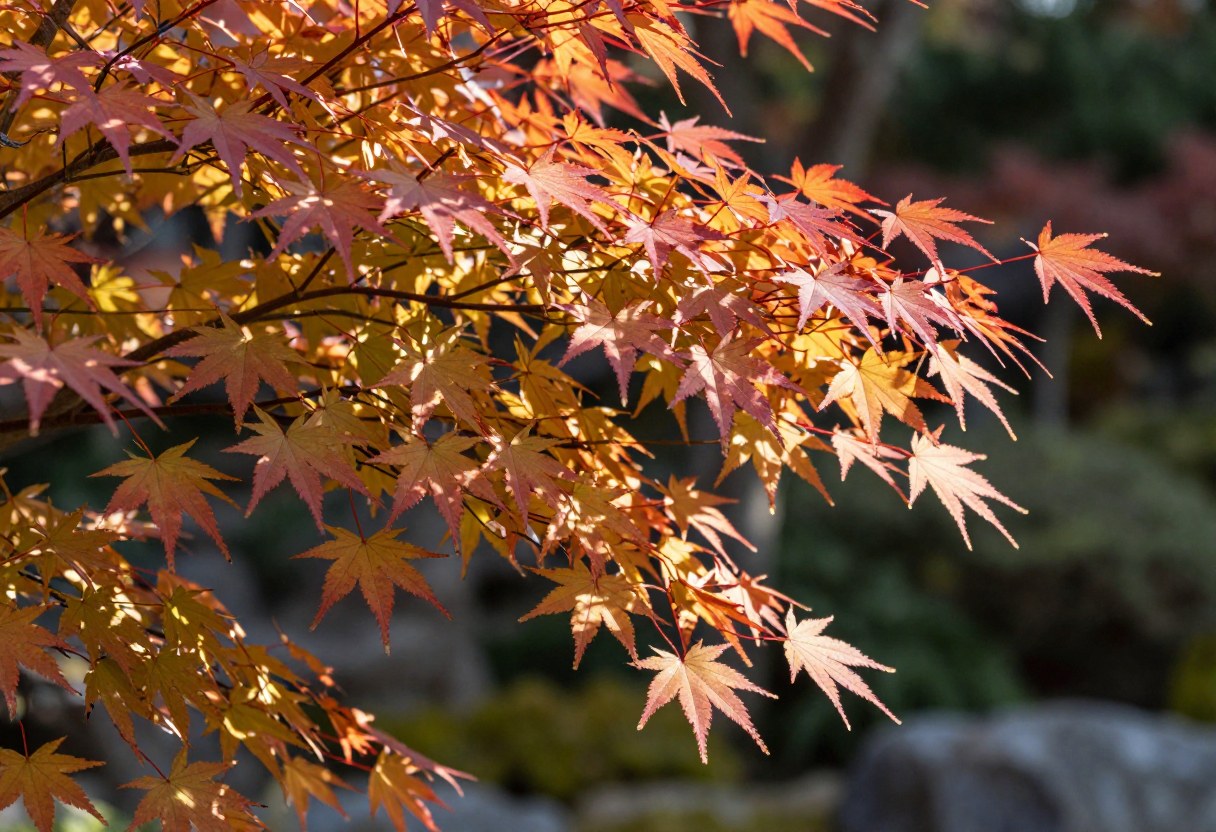
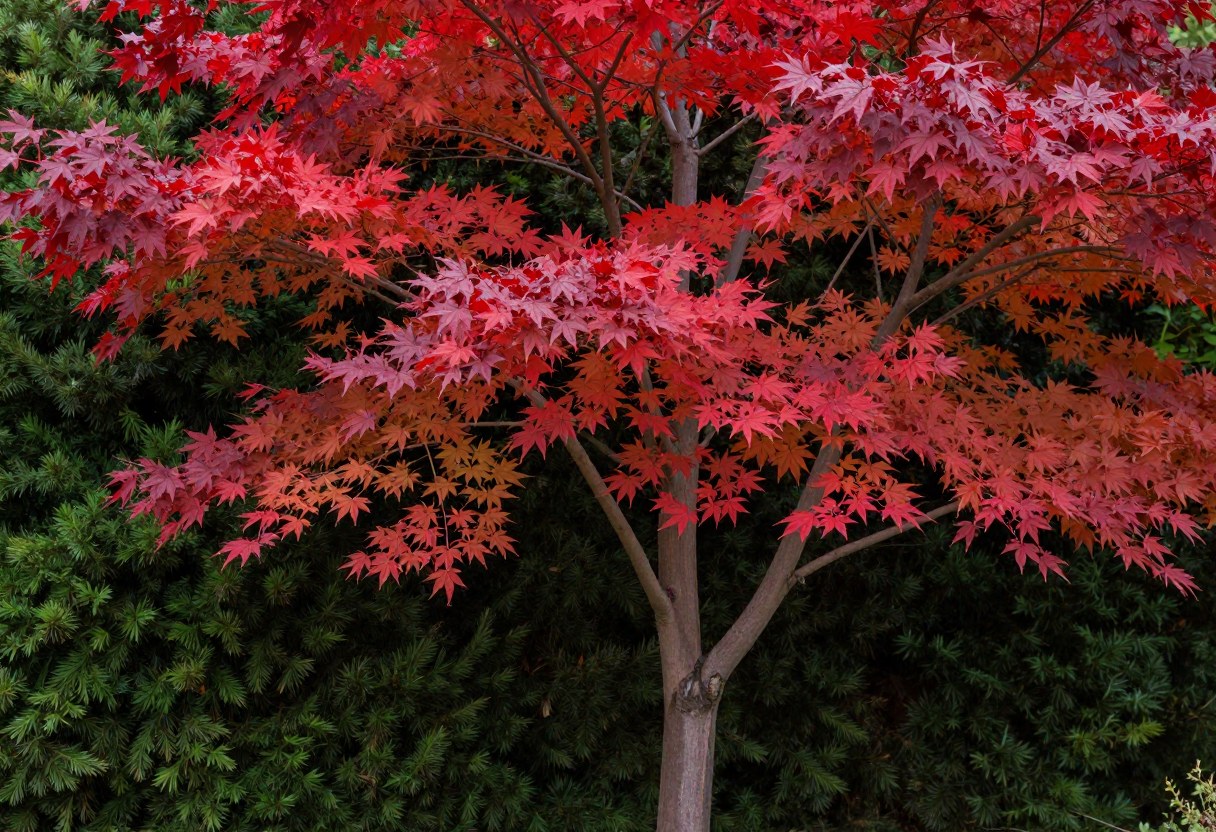
Design Tip: Japanese Maples create their most dramatic effect when backlit — placed where morning or afternoon sun shines through the leaves. Try siting one where it will catch the low October sun from the east or west. The leaves literally glow from within, creating a luminous stained-glass effect that photographs (and lives in memory) spectacularly.
This is the "stained glass" effect the design tip describes — sun coming through the leaves rather than bouncing off them.
🌟 The Native Showstopper: Black Tupelo / Black Gum (Nyssa sylvatica)
Tree expert Michael Dirr called Black Tupelo 'one of the best and most consistent native trees for fall color.' He wasn't exaggerating. On a single branch, you can find leaves turning yellow, orange, bright red, and purple simultaneously — a one-tree kaleidoscope. It also starts early — sometimes beginning to color in late August when everything else is still deep green. Hardy from Zones 3–9, native to eastern North America, loved by pollinators and wildlife, and reliably spectacular every single year.
•Fall color: Yellow, orange, red, and purple — often all on the same branch at once
•Mature height/spread: 30–50 ft tall, 20–30 ft wide — manageable for most yards
•USDA Zones: 3–9
•Timing: Late August through October — one of the EARLIEST fall color performers
•Best cultivars: 'Red Rage®' (intense scarlet), 'Green Gable™' (PHS Gold Medal 2023), 'Wildfire' (red new spring growth + great fall show)
•Needs: Full sun to part shade; adaptable to wet OR dry soils; mildly acidic soil preferred
•Transplanting tip: Buy small, container-grown specimens — the taproot makes large trees hard to move
⭐ The Long-Season Spectacular: Sweetgum (Liquidambar styraciflua)
If you want a tree that puts on a long, multi-colored autumn show that carries well into November after other trees have gone bare, plant a Sweetgum. The star-shaped leaves turn yellow, orange, red, and purple on the same tree simultaneously, and the display lasts significantly longer than maples. The one famous caveat: Sweetgum produces spiky round seed balls ('gumballs') that can be a nuisance on lawns. Choose seedless cultivars to solve this entirely.
•Mature height/spread: 60–80 ft tall, 30–50 ft wide
•USDA Zones: 5–9
•Timing: October through November — one of the longest-lasting fall color displays
•Best cultivars: 'Rotundiloba' (seedless AND stunning fall color), 'Slender Silhouette' (narrow columnar — perfect for tight spaces), 'Burgundy' (holds leaves very late)
•Needs: Full sun; adaptable to various soils including wet; dislikes drought once established
🍂
Pro Tip: 'Rotundiloba' Sweetgum solves both the gumball problem (sterile, no seed production) and delivers exceptional fall color. It's one of the best trees for fall display with zero mess — a win on both fronts that every professional landscaper loves.
🌸 The Earliest Bird: Sourwood (Oxydendrum arboreum)
Here's a secret weapon for fall color: Sourwood starts turning in late August — while everything around it is still summer green. By the time other trees are thinking about changing, Sourwood has already been putting on a show of deep red, orange, and maroon for weeks. It has the unusual bonus of producing long, fragrant white flower streamers in late summer right as the foliage begins to change — so you get flowers AND fall color simultaneously. A true four-season native gem.
•Fall color: Red, orange, maroon — rich and deep
•Mature height/spread: 20–30 ft tall, 10–20 ft wide — perfect for smaller spaces
•USDA Zones: 5–9
•Timing: August through September — EARLIEST fall color of any major garden tree
•Bonus: Fragrant white flower streamers in August coincide with early foliage change
•Needs: Part shade to full sun; moist, acidic, well-drained soil; not drought tolerant when young
🌕 The Living Fossil: Ginkgo biloba
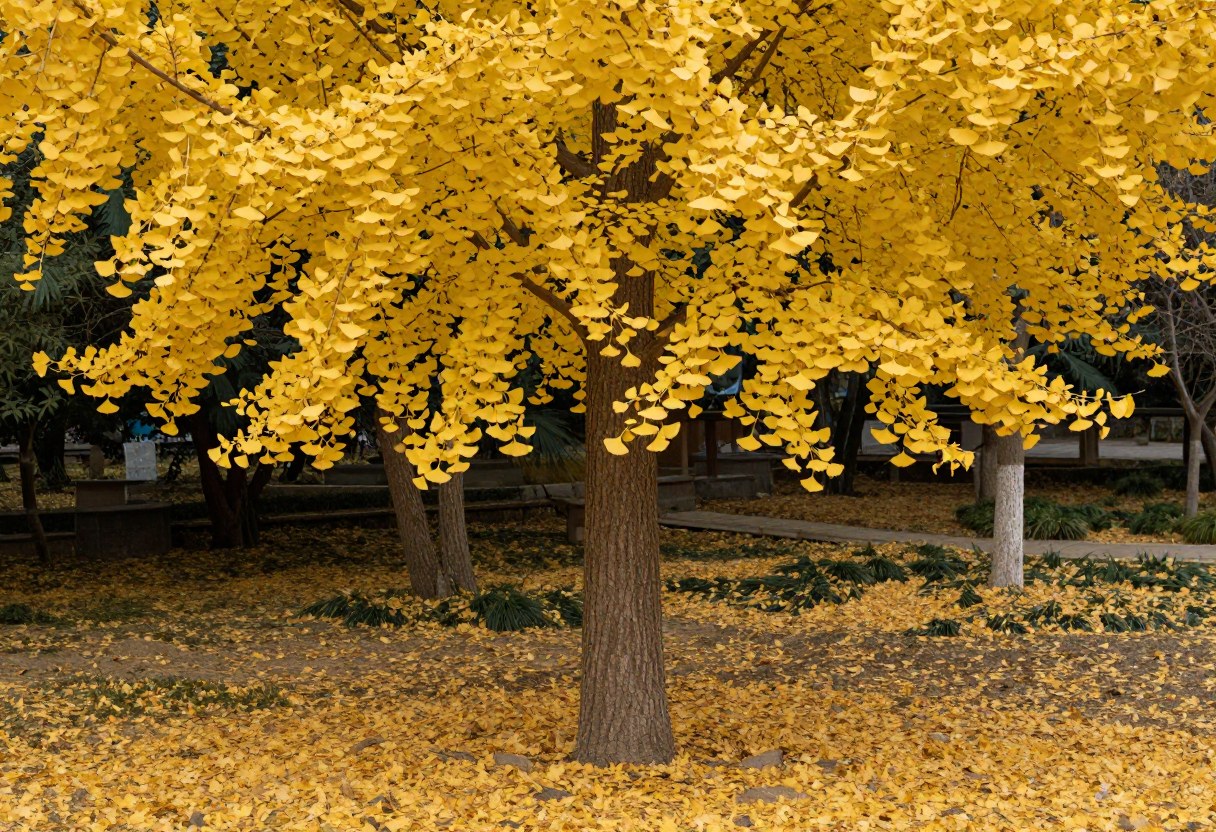
The Ginkgo has existed for 270 million years, survived mass extinctions, and will absolutely outlive anything else in your yard — often by centuries. In fall, it does something spectacular and unique: the fan-shaped leaves turn a pure, luminous, almost neon gold-yellow. Then, usually within a few days of a hard frost, the entire tree drops all its leaves simultaneously — carpeting the ground in gold coins. It's one of the most dramatic single events in the fall garden calendar.
•Fall color: Pure, brilliant gold-yellow — one of the most consistent yellows in any tree
•Mature height/spread: 50–80 ft tall, 30–40 ft wide
•USDA Zones: 3–9 — incredibly cold-hardy and urban tough
•Timing: October–November — the all-at-once golden drop happens fast
•CRITICAL: Always plant named MALE cultivars — female Ginkgo fruits produce a memorably unpleasant odor
Usually within days of a hard frost, the whole tree drops its leaves at once — one of the most dramatic single events in the fall garden calendar.
🍬 The Fragrant Surprise: Katsura Tree (Cercidiphyllum japonicum)
The Katsura Tree delivers fall color with an extra sensory dimension: the falling leaves smell like burnt sugar or cotton candy. Yes, really — the sweet-spicy scent of fresh caramel fills the air around a Katsura in October. The heart-shaped leaves progress from reddish-purple new growth in spring → blue-green in summer → spectacular gold, apricot, and amber in fall. It's a tree that delights multiple senses in the best possible way.
•Fall color: Gold, apricot, amber — warm and glowing
•Mature height/spread: 40–60 ft tall, 25–35 ft wide; weeping forms stay smaller
•USDA Zones: 4–8
•Timing: October — mid-season
•The scent: Fallen and falling leaves release a genuine caramel/cotton-candy fragrance
•Needs: Moist, well-drained soil; full sun to part shade; protect from drying winds
🌳 The Late-Season Anchor: Scarlet Oak (Quercus coccinea)
Oaks are the unsung heroes of fall color — they turn late, after the maples have already peaked and dropped, extending the show well into November. Scarlet Oak delivers what its name promises: brilliant, true scarlet-red leaves that persist on the tree long after most deciduous trees have gone bare. Where Sugar Maple gives you October brilliance, Scarlet Oak gives you November fire when the landscape desperately needs color.
•Fall color: Brilliant scarlet-red — one of the purest reds in any tree
•Mature height/spread: 50–70 ft tall, 40–50 ft wide
•USDA Zones: 4–9
•Timing: October–November — after maples, extending the season
•Needs: Full sun; deep, acidic, well-drained soil; tap root makes established trees drought tolerant
•Wildlife value: Acorns support deer, squirrels, turkeys, and over 100 bird species
🍊 The Wild Card: Sassafras (Sassafras albidum)
Sassafras is the quirky genius of fall color — it produces three completely different leaf shapes on the same tree (unlobed oval, mitten-shaped, and three-fingered), and each can turn a different color in fall. The full display runs from yellow through orange to red and deep purple, all on the same canopy simultaneously. It's also the tree whose roots originally flavored root beer, and crushed leaves release a distinctive spicy-sweet scent. An underused native with tremendous character.
•Fall color: Yellow, orange, red, and purple — the full spectrum, simultaneously
•Mature height/spread: 30–60 ft tall, 35–40 ft wide
•USDA Zones: 4–9
•Timing: October
•Note: Tends to sucker and form thickets in naturalized settings; manageable in cultivated landscapes
•Scent bonus: Bruise or scratch the bark or leaves — they release a distinctive spicy fragrance
🎭 The Four-Season Gem: Persian Ironwood (Parrotia persica)
Persian Ironwood is the tree that does it all, in every season. Witch-hazel-like flowers in late winter. Glossy summer foliage. A spectacular multi-color fall display of yellow, orange, red, and maroon, often all visible simultaneously. And then — after the leaves fall — gorgeous exfoliating bark in green, gray, white, and tan persists through winter. It's incredibly adaptable (drought tolerant, pest resistant, handles most soils), stays at a manageable size for most yards, and is criminally underplanted.
•Bonus: Spectacular exfoliating bark in winter rivals birch for off-season interest
✨ The Unique Double Act: Witch Hazel (Hamamelis virginiana)
Witch Hazel achieves something no other fall color plant can: it blooms while its leaves are turning. The native species (H. virginiana) produces fragrant, spider-like yellow flowers in October–November, right as the leaves turn gold. The effect — golden foliage dotted with bright yellow blossoms — is genuinely unlike anything else in the fall garden. And this happens at the exact moment most other flowering plants are done for the year.
•Fall color: Golden yellow — sometimes with orange tones
•Mature height/spread: 10–20 ft tall (can reach 30 ft)
•USDA Zones: 3–8
•Timing: October–November — late-season bloomer
•Species options: H. virginiana (native, yellow flowers in fall), H. x intermedia cultivars (hybrid, more flower color options, bloom in late winter)
•Needs: Part shade to full sun; moist, acidic, well-drained soil; excellent woodland understory tree
📊 Complete Fall Color Tree Quick-Reference
Tree
Fall Color(s)
Mature Ht.
Zones
Timing
Best For
Sugar Maple (Acer saccharum)
Yellow → orange → scarlet
60–75 ft
3–8
Mid-Oct
Statement specimens, large yards, the classic New England show
Red Maple (Acer rubrum)
Yellow, orange, or red
40–70 ft
3–9
Early Oct
Wide climate range, reliable early color, fast growth
Japanese Maple (Acer palmatum)
Gold, orange, scarlet, burgundy
6–25 ft
5–9
Mid-Oct
Small gardens, containers, ornamental focal points
Black Tupelo / Black Gum (Nyssa sylvatica)
Yellow, orange, red, purple (same branch!)
30–50 ft
3–9
Sept–Oct
Native, multi-color show, earliest fall color performer
Sweetgum (Liquidambar styraciflua)
Yellow, orange, red, purple simultaneously
60–80 ft
5–9
Oct–Nov
Bold multi-color show; long season; great shade tree
Scarlet Oak (Quercus coccinea)
Brilliant scarlet-red
50–70 ft
4–9
Oct–Nov
Bold red specimen; late-season color after maples fade
Red Oak (Quercus rubra)
Dark red to reddish-brown
60–75 ft
3–8
Oct–Nov
Large shade + wildlife tree; reliable late-season color
Sourwood (Oxydendrum arboreum)
Red, orange, maroon
20–30 ft
5–9
Aug–Sept
EARLIEST changer; starts in late summer; small space gem
Ginkgo (Ginkgo biloba)
Pure brilliant gold-yellow
50–80 ft
3–9
Oct–Nov
Dramatic all-at-once golden drop; urban tolerant
Katsura (Cercidiphyllum japonicum)
Gold, apricot, amber
40–60 ft
4–8
Oct
Cotton candy scent when leaves fall; elegant heart-shaped leaves
Long-lived; stately; holds leaves into winter for structure
Serviceberry (Amelanchier spp.)
Orange-red to deep red
15–25 ft
4–9
Oct
4-season interest; edible berries; perfect small garden tree
Persian Ironwood (Parrotia persica)
Yellow, orange, red, maroon mosaic
20–40 ft
4–8
Oct
Exfoliating bark; multi-season jewel; tough and adaptable
Dogwood (Cornus florida / kousa)
Red-purple, crimson
15–30 ft
5–9
Oct
Layered 4-season; spring bloom → fall color + berries
American Beech (Fagus grandifolia)
Warm golden-bronze
60–80 ft
3–9
Oct–Nov
Holds papery leaves into winter; stunning golden bark
Witch Hazel (Hamamelis virginiana)
Golden yellow, sometimes orange
10–20 ft
3–8
Oct–Nov
Fall flowers while coloring — unique dual display
Bald Cypress (Taxodium distichum)
Russet-orange (deciduous conifer!)
50–70 ft
4–11
Oct–Nov
Wet sites; feathery texture; surprising conifer fall color
Shopping by Color: Choose Your Palette First
Not sure which tree to plant? Start with the color you want most, then narrow by zone and size. Here's the definitive breakdown by fall color category:
🔴 Best Trees for Reds & Scarlets
•Red Maple (Acer rubrum 'October Glory', 'Red Sunset') — Zones 3–9, 40–70 ft
•Sugar Maple (Acer saccharum) — Zones 3–8, 60–75 ft
•Scarlet Oak (Quercus coccinea) — Zones 4–9, 50–70 ft
•Black Tupelo (Nyssa sylvatica 'Red Rage®') — Zones 3–9, 30–50 ft
•Sourwood (Oxydendrum arboreum) — Zones 5–9, 20–30 ft
•Japanese Maple (Acer palmatum 'Osakazuki') — Zones 5–9, 10–20 ft
•Flowering Dogwood (Cornus florida) — Zones 5–9, 15–30 ft
🟠 Best Trees for Orange
•Sugar Maple — often the best orange of any tree; Zones 3–8
•Black Tupelo — includes vivid orange in multi-color display; Zones 3–9
•Katsura (Cercidiphyllum japonicum) — warm amber-orange with cotton candy scent; Zones 4–8
•Serviceberry (Amelanchier spp.) — orange-red; Zones 4–9, 15–25 ft
•Sassafras — includes orange in multi-color palette; Zones 4–9
•Persian Ironwood — orange in the mosaic display; Zones 4–8
•Bald Cypress — unusual russet-orange from a conifer; Zones 4–11
🌕 Best Trees for Yellows & Golds
•Ginkgo (Ginkgo biloba) — pure, brilliant gold, all at once; Zones 3–9
•Katsura — warm gold with that fabulous caramel scent; Zones 4–8
•Witch Hazel (Hamamelis virginiana) — gold with simultaneous flowers; Zones 3–8
•Quaking Aspen (Populus tremuloides) — shimmering gold in groves; Zones 1–7
•River Birch (Betula nigra) — golden yellow; Zones 4–9
•Tulip Poplar (Liriodendron tulipifera) — clear yellow; Zones 4–9
•Redbud (Cercis canadensis) — soft yellow in fall after spring flower show; Zones 4–9
🟣 Best Trees for Purples & Burgundy
•Japanese Maple (Acer palmatum 'Bloodgood') — deep burgundy all season; Zones 5–9
•Black Tupelo — purple often appears alongside red on same branch; Zones 3–9
•Sweetgum — deep purple often in the multi-color display; Zones 5–9
•Sassafras — can show purple in fall color mix; Zones 4–9
•Kousa Dogwood (Cornus kousa) — deep crimson-purple; Zones 5–8
•Fothergilla (Fothergilla major) — large shrub/small tree; brilliant orange-purple; Zones 4–8
🌈 Best Trees for Multi-Color Displays (One Tree, Many Colors)
•Black Tupelo — the king of multi-color; yellow + orange + red + purple simultaneously
•Sweetgum — yellow + orange + red + purple on same canopy
•Sassafras — yellow + orange + red + purple, different leaf shapes too
•Sugar Maple — often yellow + orange + red on same tree
Timing the Show: Sequencing for a Season-Long Display
Here's the secret most fall-color gardeners miss: if you plant only peak-season trees (like Sugar Maple), your display starts and ends in roughly a 3-week window in October. But if you plan for sequential timing — early, mid, and late-season species — you can have spectacular fall color from late August through Thanksgiving. That's three full months of autumn glory, not three weeks.
The Fall Color Timeline
Stage
When
Best Trees
Early Fall
Late Aug – Mid Sept
Sourwood (starts AUGUST), Black Tupelo, Virginia Creeper, some Red Maple cultivars
Early-Mid Fall
Late Sept – Early Oct
Red Maple ('Autumn Flame'), Serviceberry, Quaking Aspen, Flowering Dogwood, Vine Maple
Peak Fall
Mid–Late October
Sugar Maple, Japanese Maple, Katsura, Sassafras, Black Tupelo, Persian Ironwood, Sweetgum (starts)
Late Fall
Late Oct – November
Scarlet Oak, White Oak, Ginkgo, Sweetgum, Witch Hazel, Bald Cypress, American Beech
Pro Tip: The magic three-tree combination for season-long color in a medium-sized yard: Plant Sourwood (early), Black Tupelo (mid), and Scarlet Oak (late). You'll have color from August through November — and they complement each other beautifully in both timing and color palette.
Fall Color Peak Timing by Region
Region / Zone
Peak Fall Color Window
Early Changers to Plant
Peak Show Trees
Late Season Lingerers
Far North / Zone 2–3 (MN, ND, MT, northern Canada)
Mid-Sept → early Oct
Quaking Aspen, Tamarack
Sugar Maple, Paper Birch, Quaking Aspen
White Oak, American Beech
Northeast / Zone 4–6 (New England, Great Lakes)
Late Sept → mid-Oct
Black Tupelo, Sourwood, Red Maple
Sugar Maple, Sweetgum, Scarlet Oak, Katsura
Ginkgo, White Oak, American Beech
Mid-Atlantic / Zone 6–7 (PA, VA, MD, DC)
Early–mid Oct
Black Tupelo, Sourwood, Dogwood
Sugar Maple, Sweetgum, Scarlet Oak, Black Tupelo
Sweetgum, Scarlet Oak, Ginkgo
Southeast / Zone 7–9 (NC, SC, GA, AL, TN)
Mid Oct → mid-Nov
Sourwood (Aug!), Black Tupelo
Sweetgum, Black Tupelo, Red Maple, Sassafras
Bald Cypress, Sweetgum, Ginkgo
Midwest / Zone 4–6 (OH, IN, IL, MO, IA, KS)
Late Sept → mid-Oct
Black Tupelo, Red Maple
Sugar Maple, Sweetgum, Scarlet Oak, Sassafras
White Oak, Ginkgo, Bald Cypress
Great Plains / Zone 4–6 (OK, TX Panhandle, NE, KS)
Mid–late Oct
Maples, Black Tupelo
Bigtooth Maple, Bur Oak, Sweetgum, River Birch
Bur Oak, Ginkgo
Pacific Northwest / Zone 6–9 (WA, OR, N. CA)
Oct → early Nov
Vine Maple, Bigleaf Maple
Japanese Maple, Persian Ironwood, Serviceberry, Katsura
Ginkgo, Sweetgum
Mountain West / Zone 3–6 (CO, UT, WY, ID)
Late Sept → mid-Oct
Quaking Aspen (Sept!)
Quaking Aspen, Bigtooth Maple, Gambel Oak
Bigtooth Maple
Southwest / Zone 7–10 (AZ, NM, S. CA, NV)
Oct → Nov
Bigtooth Maple, Chinese Pistache
Chinese Pistache, Sweetgum, Chinese Tallow
Ginkgo, Chinese Pistache
Designing Your Autumn Display: The Art of the Fall Garden
Knowing which trees have great fall color is step one. Knowing how to arrange them for maximum visual impact is what separates a yard that's nice in fall from one that makes neighbors slow their cars down to look.
Layer Your Planting for Depth and Drama
The most effective fall color displays use plants at multiple height levels — think of it as designing a stage set, with backdrop, midground, and foreground. Each layer plays a different role:
Layer
Role
Best Fall Color Plants
Background / Canopy
Largest trees; set the stage; provide the big color masses
Sugar Maple, Sweetgum, Scarlet Oak, White Oak, Ginkgo, Red Oak, Bald Cypress
Midground / Middle layer
Medium trees; add color at eye level and transition zones
Black Tupelo, Katsura, Sourwood, Sassafras, Persian Ironwood, Dogwood, River Birch
Foreground / Small trees
Under 25 ft; specimen impact; frame lower views
Japanese Maple, Serviceberry, Witch Hazel, Redbud, Fothergilla, Flowering Dogwood
Ground level companions
Shrubs and perennials that echo or contrast fall tree colors
Color relationships matter in the fall garden just as much as in any other design context. Here are proven combinations with an explanation of why each works:
Combination
How to Plant It
Why It Works
Fire & Gold
Plant a Scarlet Oak or Red Maple behind a golden-yellow Ginkgo or Katsura
The blazing red frames and intensifies the gold — a classic autumnal contrast
Purple Haze & Amber
Japanese Maple (deep burgundy) alongside Katsura or Witch Hazel (gold/amber)
Cool purple-red against warm amber creates sophisticated tension
The Gradient
Red Maple → Black Tupelo → Katsura in a left-to-right sweep
Blends red → orange → gold in a natural painterly sequence
Evergreen Anchor
Place bold scarlet or gold tree in front of dark evergreen backdrop
Evergreens (spruce, holly, cryptomeria) make fall colors pop dramatically
Multi-color Centerpiece
Sweetgum or Black Tupelo as solo specimen on a lawn
One tree with 4–5 simultaneous colors becomes a natural fireworks show
Layered Wave
Sourwood (early) + Sugar Maple (mid) + Scarlet Oak (late) in succession
Extends the season from August through November in a single planting area
The Evergreen Backdrop Rule
This is the single most powerful design principle in fall color gardening: the same red maple that looks merely pretty against a blue sky becomes incandescent when viewed against a wall of dark green evergreens. Evergreens — whether a Norway spruce hedge, a grouping of hollies, or a row of Cryptomeria — act as a dark, neutral backdrop that makes fall colors pop with almost electric intensity.
Before planting fall color trees, think about what's behind them from your key viewing angles. If there's a dark fence, a building, or existing evergreen trees — great, work with that. If not, consider planting a screen of evergreens as the 'frame' for your autumn canvas, even if those evergreens are less showy themselves.
🎨
Design Tip: Use an architectural evergreen (columnar Cryptomeria, Thuja Green Giant, or even a dark cedar fence line) as the visual 'wall' behind your fall color specimens. The contrast of vivid autumn foliage against deep green creates an effect out of proportion to the number of trees actually planted.
The same red maple that's merely pretty against blue sky becomes incandescent against a wall of dark evergreen — the single most powerful design move in this guide.
Small-Space Fall Color: Big Impact in Tight Quarters
Think you don't have room for a fall color display? Think smaller. Some of the most spectacular fall color trees are genuinely compact — perfect for urban yards, courtyards, or as focal points near entryways.
•Japanese Maple (6–25 ft depending on cultivar) — most are under 15 ft; spectacular in any size yard
•Sourwood (20–30 ft) — small native tree with enormous seasonal impact
•Persian Ironwood (20–40 ft) — multi-season interest in a manageable size
•Serviceberry (15–25 ft) — four seasons of interest in a neighborhood-friendly size
•Witch Hazel (10–20 ft) — the only fall-blooming tree; fits almost anywhere
•Dogwood (15–30 ft) — spring flowers + fall color + berries in a compact form
•Sweetgum 'Slender Silhouette' (60 ft × 6 ft!) — dramatic columnar form for very narrow spaces
Viewing Distance: Size the Tree to the Stage
The best fall color design matches tree size to viewing distance. A 70-ft Sugar Maple is breathtaking from 100 feet away but may be too large to appreciate from a small patio 15 feet away. A Japanese Maple is perfect for close-up viewing from a deck or window but gets visually 'lost' at long distances. Think about where you'll most often see each tree and size accordingly.
•Close-up viewing (patio, deck, window: 10–30 ft away): Japanese Maple, Sourwood, Serviceberry, Witch Hazel, Persian Ironwood
•Medium-distance viewing (50–100 ft): Black Tupelo, Katsura, Sassafras, Flowering Dogwood, River Birch
•Long-distance viewing (100+ ft): Sugar Maple, Sweetgum, Scarlet Oak, White Oak, Ginkgo, Red Maple
Planting for Color: Getting Them in the Ground Right
Good species selection and beautiful design mean nothing if the tree dies in Year 2. Here's how to plant fall color trees for long-term success.
When to Plant for Best Results
Fall is actually the ideal time to plant most fall-color trees (how fitting!). Cooler air temperatures reduce transplant stress on foliage, while soil remains warm enough for root growth. Trees planted in fall typically establish faster than those planted in spring because they spend the winter developing roots without the demand of supporting leaves.
•Fall planting (ideal for most species): 6–8 weeks before first expected frost in your area. Root establishment continues underground until the ground freezes.
•Spring planting (good second option): After last frost, before hot weather arrives. Requires more diligent summer watering.
•Summer planting (not recommended): Only if the tree will receive daily supplemental irrigation throughout the hot months.
•When NOT to plant: During extreme heat or drought without ability to water consistently.
🍂
Pro Tip: Shop for fall color trees IN fall — when you can actually evaluate the color. Take photos, compare specimens, and buy the tree with the color that made you stop. Then plant that specific tree, or order the confirmed cultivar from a reputable nursery. This eliminates the gamble of buying 'Red Maple' in spring without knowing which cultivar you're getting.
Soil Preparation for Maximum Color
Healthy, well-nourished trees produce more vibrant fall color. Stressed trees (from poor soil, compaction, or nutrient deficiency) produce muted, early-dropping foliage. Setting up good soil conditions pays dividends every October for the life of the tree.
•Test your soil pH: Most fall color trees prefer slightly acidic soil (pH 5.5–6.5). Sugar Maple, oaks, and others may yellow or green-fade in alkaline soil. Use your local extension service for a soil test — it's cheap and tells you exactly what you need.
•For acidic-loving trees (Japanese Maple, Sourwood, Sweetgum): If your soil is alkaline, amend with sulfur or use acidifying fertilizers. Mulch with pine bark or pine needles.
•Improve drainage before planting: None of the fall color trees in this guide want to sit in waterlogged soil. If your site pools water, address drainage before planting rather than hoping the tree adapts.
•Work organic matter into the planting area: Compost incorporated into the surrounding soil (not just the planting hole) improves moisture retention, aeration, and nutrient availability.
Step-by-Step Planting
•Dig the hole 2–3 times wider than the root ball, but NO deeper than root ball height. The trunk flare must sit at or slightly above final grade.
•Remove all container material. Check roots for circling — untangle or score them firmly. A circling root left in place will eventually girdle the tree decades later.
•Set the tree. Confirm the trunk flare will be at or above soil level. Backfill with native soil — research shows native backfill encourages roots to spread further than amended mixes.
•Water thoroughly. Settle the soil and eliminate air pockets with a slow, deep soak immediately after planting.
•Mulch correctly. Apply 2–3 inches of organic mulch in a ring 3–6 inches from the trunk. Do NOT pile mulch against the bark ('mulch volcano' = slow death by rot and rodents).
•Stake only if necessary — and for one season maximum. Remove stakes after the first growing season to allow trunk to develop strength from normal movement.
Caring for Fall Color Trees: Protecting Your Investment
Once planted, fall color trees need consistent care during establishment — and then mostly just appreciation for the rest of their very long lives.
Maximizing Fall Color Through Good Tree Health
The most direct thing you can do to maximize fall color year after year is keep your trees healthy. A stressed tree produces muted, early-dropping fall color. A healthy tree produces the kind of display that stops traffic. The key variables you control:
•Consistent soil moisture: A well-watered growing season (not drowning, not drought) produces healthy leaf tissue packed with pigment-building capacity. Deep water during dry stretches — especially late summer/early fall.
•Avoid late-season nitrogen fertilizing: Nitrogen applied in summer or fall promotes leafy growth at the expense of pigment concentration. If you fertilize, do it in early spring only.
•Maintain soil pH in the target range: Alkaline soil causes nutrient deficiencies that mute color. Annual soil testing every few years lets you stay ahead of drift.
•Protect from pests and disease: Defoliation (from caterpillars, leafminer, or fungal blight) in summer reduces the leaf tissue available to produce fall color. Monitor and treat problems early.
•Mulch, mulch, mulch: A good mulch ring retains moisture, regulates temperature, and feeds soil biology — all of which add up to healthier leaves and better fall color.
🔬
Science Bit: The brighter and sunnier your fall days, the more intense your red and purple fall colors will be. Anthocyanin production is light-dependent — the same tree will show more vivid reds in a sunny, south-facing spot than a shaded one. If you want maximum red-color intensity, site your fall color trees where they'll receive full sun in October.
Watering Schedule for Fall Color Trees
Period
Watering Guidance
Why It Matters
Year 1 (post-planting)
Every 2–3 days for first month; weekly thereafter during dry periods
Critical establishment period; root loss from transplanting means the tree can't access much native soil water yet
Years 2–3
Weekly during dry periods; skip when rainfall exceeds 1 inch/week
Still establishing; deep roots developing; consistent moisture prevents stress that dulls fall color
Established (Year 4+)
During droughts (2+ weeks without meaningful rain)
Well-established trees mostly self-sufficient; drought stress 6–9 months before fall can reduce color intensity
Late Summer (Aug–Sept)
Deep water if conditions are dry; 1–2 inches/week equivalent
Late summer moisture directly affects leaf health for the upcoming fall show — don't let trees drought-stress in August
Pruning Fall Color Trees
Most fall color trees need minimal pruning — their natural form is often a key part of their beauty. But a few guidelines:
•Best time: Late winter or early spring, before leaf-out. Pruning during dormancy minimizes stress and reduces disease risk.
•Japanese Maple exception: Prune in late spring, after leaf-out, when you can see the structure clearly and cuts heal quickly in warm weather.
•Remove crossing branches: Crossing branches that rub can create wounds and structural weakness. Remove the weaker of the two.
•Never top: Topping destroys natural form, creates weak regrowth, and leads to decline. If a tree is outgrowing its space, select a more appropriate tree for the site.
•Maples bleed sap when pruned in late winter: This is alarming-looking but not harmful. It stops when leaves emerge. If you prefer less mess, prune in late summer after the sap has been redistributed.
Troubleshooting: When Fall Color Disappoints
Sometimes, despite good planning, fall color falls short. Here's how to diagnose what went wrong and fix it going forward.
Problem
Most Likely Cause(s)
Solution
Leaves turn yellow instead of red/orange
Alkaline soil, warm fall nights, or the cultivar is a yellow-fall variety
Soil test and lower pH if needed; chose a confirmed red-fall cultivar
Color is dull or muted
Drought stress, cloudy fall weather, or warm nights
Deep water late summer; select species with more consistent genetics; can't fix weather
Leaves drop before coloring
Early frost, drought stress, or fungal leaf disease
Water consistently in August–Sept; treat leaf disease early; plant frost-tolerant species
Color varies dramatically year to year
Normal — anthocyanin production is weather-dependent
Plant species with carotenoid-based color (yellow/gold) for consistency; add these alongside red-fall trees
Some leaves brown and die early, others color normally
Localized insect damage, leaf scorch, or disease on some branches
Identify and treat the pest or disease; ensure irrigation; prune damaged branches
Tree shows poor color even in good weather years
Wrong cultivar, wrong climate, stressed tree from nutrient deficiency
Soil test; apply appropriate fertilizer; consider replacing with a confirmed good-color cultivar
Japanese Maple looks scorched in fall
Leaf scorch from heat/drought — not true fall color
Provide afternoon shade; water consistently; mulch to retain soil moisture
Ginkgo drops all leaves at once — still green!
Normal for Ginkgo — the all-at-once drop happens right after the first hard frost
No action needed; this is correct Ginkgo behavior; enjoy the golden carpet
The Fall Color Shopper's Guide
Knowing which trees to buy is half the battle. Here's how to shop smart and avoid common purchasing mistakes.
Always Buy Named Cultivars for Fall Color
This is the most important purchasing rule: when buying trees for fall color, always buy named cultivars — not just the species name. A tree sold as 'Red Maple' is a genetic lottery. It might turn brilliant red, or it might turn an uninspiring yellow. A tree sold as 'October Glory' Red Maple is a vegetatively propagated clone of a specific tree selected specifically for its outstanding crimson-red fall color. Named cultivars give you predictability.
•Red Maple for red fall color: 'October Glory', 'Red Sunset', 'Autumn Flame', 'Brandywine'
•Ginkgo: Always buy a NAMED MALE cultivar — 'Autumn Gold', 'Magyar', 'Princeton Sentry'
Container vs. Balled & Burlapped (B&B)
For most fall color trees, container-grown plants establish better than larger B&B specimens. The root system is intact and undisturbed, transplant shock is reduced, and a well-planted 3-gallon container tree typically outperforms a 3-inch caliper B&B tree within 3–5 years.
•Exceptions: For trees with taproots (Black Tupelo, Sassafras, some oaks), always buy small — either 1-gallon containers or small B&B specimens. Large B&B taproot trees have very low transplant survival.
•Japanese Maple: Always buy container-grown. B&B Japanese Maples perform poorly.
•Sugar Maple, Red Maple, Sweetgum: B&B acceptable in larger sizes; container also fine.
Your Fall Color Quick-Start Planting Checklist
Ready to build your autumn display? Run through this checklist before purchasing:
☐
Planning Action
☐
Identified my USDA Hardiness Zone
☐
Decided what fall color palette I want (reds, golds, multi-color, etc.)
☐
Chosen species that match my zone AND my target color
☐
Selected named cultivars with confirmed fall color performance
☐
Planned for sequential timing — early, mid, and late-season trees
☐
Measured available space and chosen trees appropriate for mature size
☐
Identified a dark evergreen backdrop to maximize color contrast
☐
Assessed sun exposure (full sun = best red/scarlet colors)
☐
Tested soil pH or scheduled a soil test
☐
Planned planting locations for optimal viewing angles from house/patio
☐
Budgeted for watering system or schedule for establishment
☐
Sourced organic mulch for post-planting application
☐
Scheduled planting for fall (ideal) or early spring
☐
Shopped for trees in FALL so I can evaluate actual color before buying
The Best Time to Plant Was Last Autumn. The Second Best Time Is Now.
There's something deeply satisfying about fall color that no other gardening achievement quite matches. A summer vegetable garden feeds you for a season. A perennial border blooms for weeks. But a well-planted fall color tree gifts you with that annual October spectacle for literally the rest of your life — and well beyond. A Sugar Maple planted today could still be blazing scarlet for your grandchildren's grandchildren.
Plan your palette. Know your zone. Choose your cultivars. Plant at the right depth, at the right time, in the right spot. Water through the first year. Then step back, be patient, and wait for October to arrive. Every year, it will arrive. And every year, for as long as you're there to see it, that tree will put on its show.
That's the deal fall color trees offer. And it's a very, very good deal.
Happy planting — and happy leaf-peeping! 🍁🍂🍁
🌿 Get Seasonal Gardening Tips
New guides, planting reminders, and growing tips — straight to your inbox.
No spam. Unsubscribe anytime.
About the Author
David Rodgers is the Founder & Head Gardener of Planting Atlas. With over 40 years of hands-on gardening experience in Oklahoma's Zone 7 climate, he researches, writes, and personally tests every guide on the site.
David draws from real backyard trials, soil testing, and trusted sources like Oklahoma State University Extension and USDA data to deliver practical, zone-specific advice that actually works.