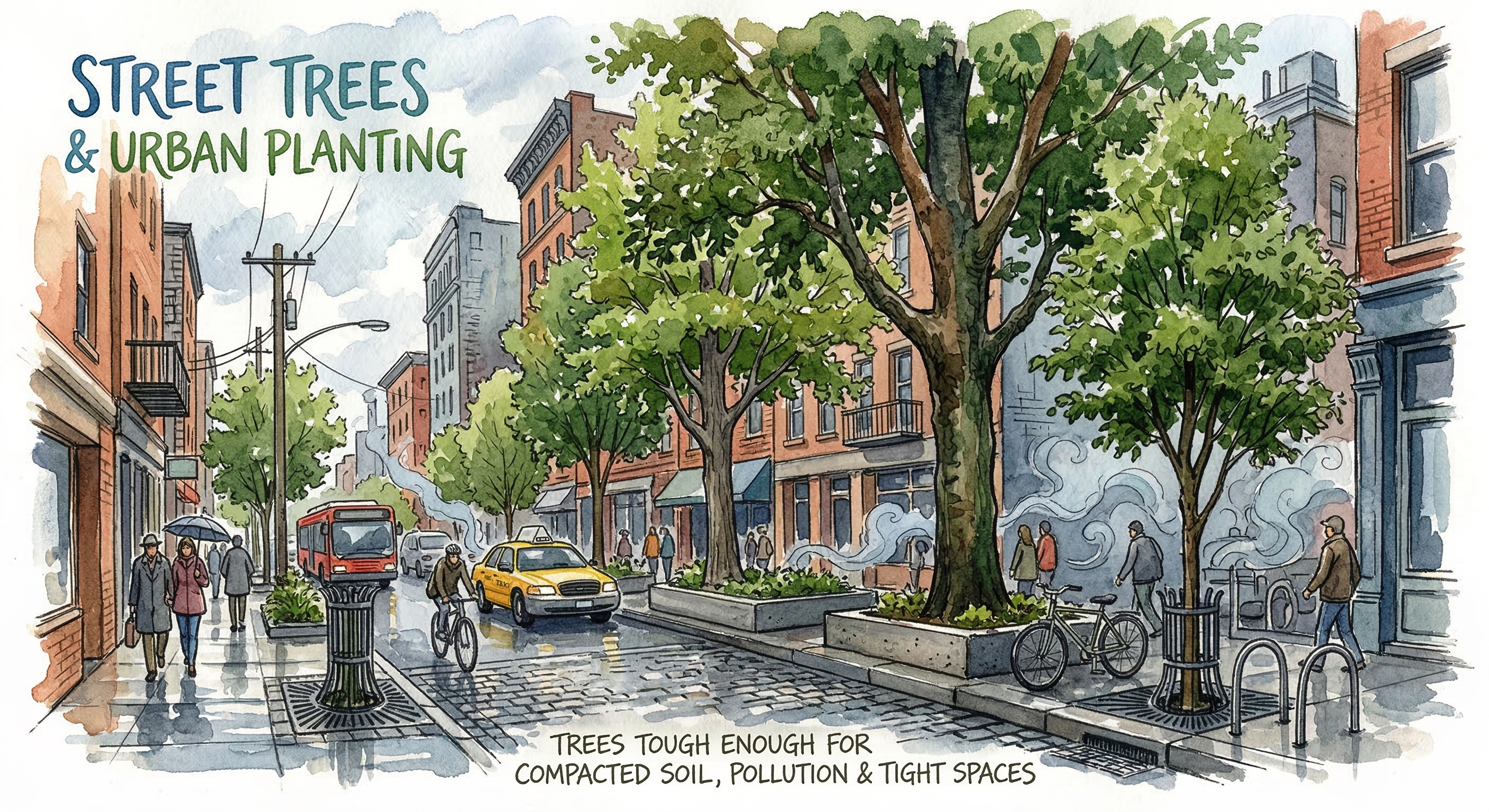
Trees Tough Enough for Compacted Soil, Pollution & Tight Spaces
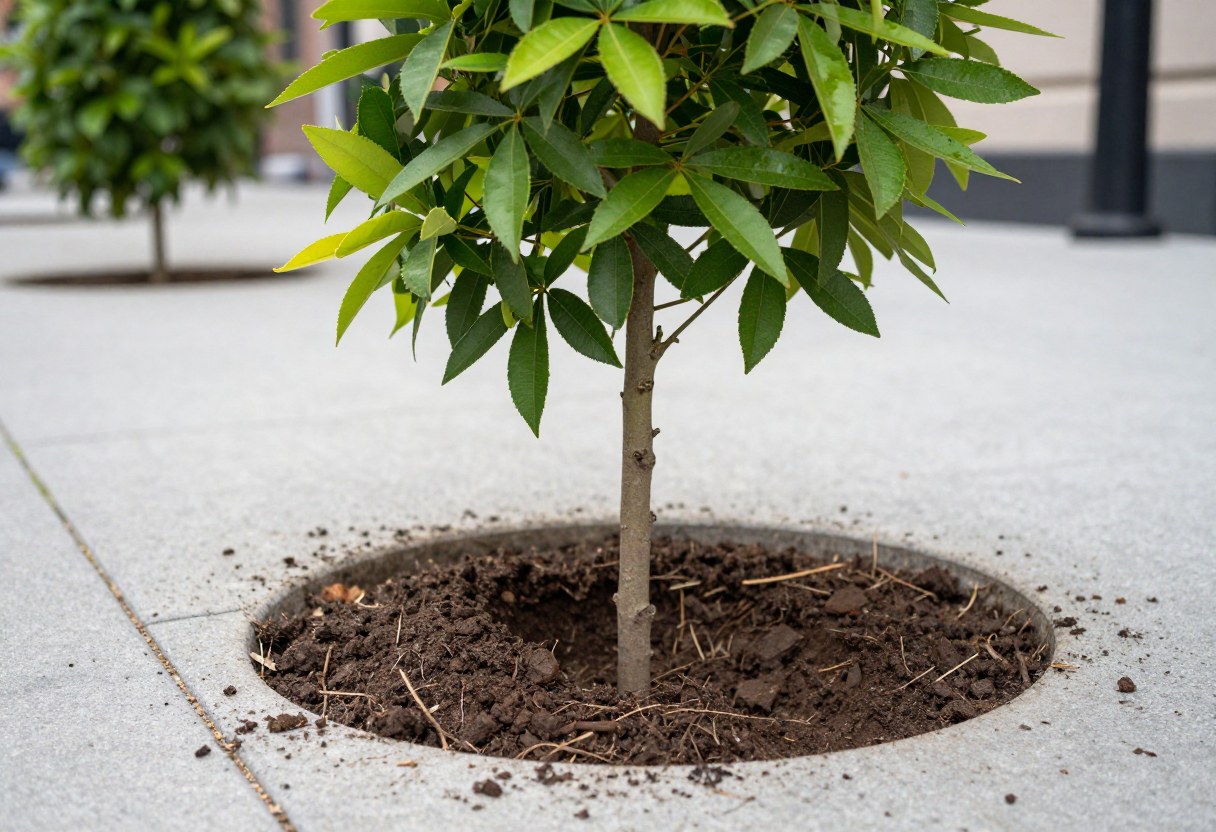
Somewhere between a diesel exhaust cloud and a sidewalk so hot you could fry an egg on it, a tree is trying to survive. It has 36 square feet of cracked, compacted soil to call home. Its roots are squeezed between a gas main and a fiber optic cable. The guy with the delivery truck parks within two inches of its bark every single day. Salt gets dumped on its root zone every February. And yet — somehow, if you pick the right tree and plant it right — it thrives.
The Urban Jungle: Why City Trees Have the Hardest Job in Horticulture
Somewhere between a diesel exhaust cloud and a sidewalk so hot you could fry an egg on it, a tree is trying to survive. It has 36 square feet of cracked, compacted soil to call home. Its roots are squeezed between a gas main and a fiber optic cable. The guy with the delivery truck parks within two inches of its bark every single day. Salt gets dumped on its root zone every February. And yet — somehow, if you pick the right tree and plant it right — it thrives.
That's the miracle and the art of urban tree planting. Done well, a street tree is one of the highest-ROI investments a city or homeowner can make. It cools sidewalks, cleans air, manages stormwater, calms traffic, boosts property values, and transforms a bleak concrete corridor into something genuinely livable. Done poorly — wrong tree, wrong spot, wrong soil — it's an expensive failure that dies in 7–10 years and leaves nothing but a stump and a pothole.
This guide will make sure you're in the first category. We'll dig into the brutal realities of urban tree stress, walk you through the best performers species by species, explain the game-changing soil technologies that help trees beat concrete, and give you a step-by-step planting process built specifically for tight city spaces.
🏙️
City Fact: Studies show the average street tree in a standard compacted tree pit lives only 7–10 years. With proper soil volume and species selection, that same tree can live 80+ years and deliver exponentially more value.
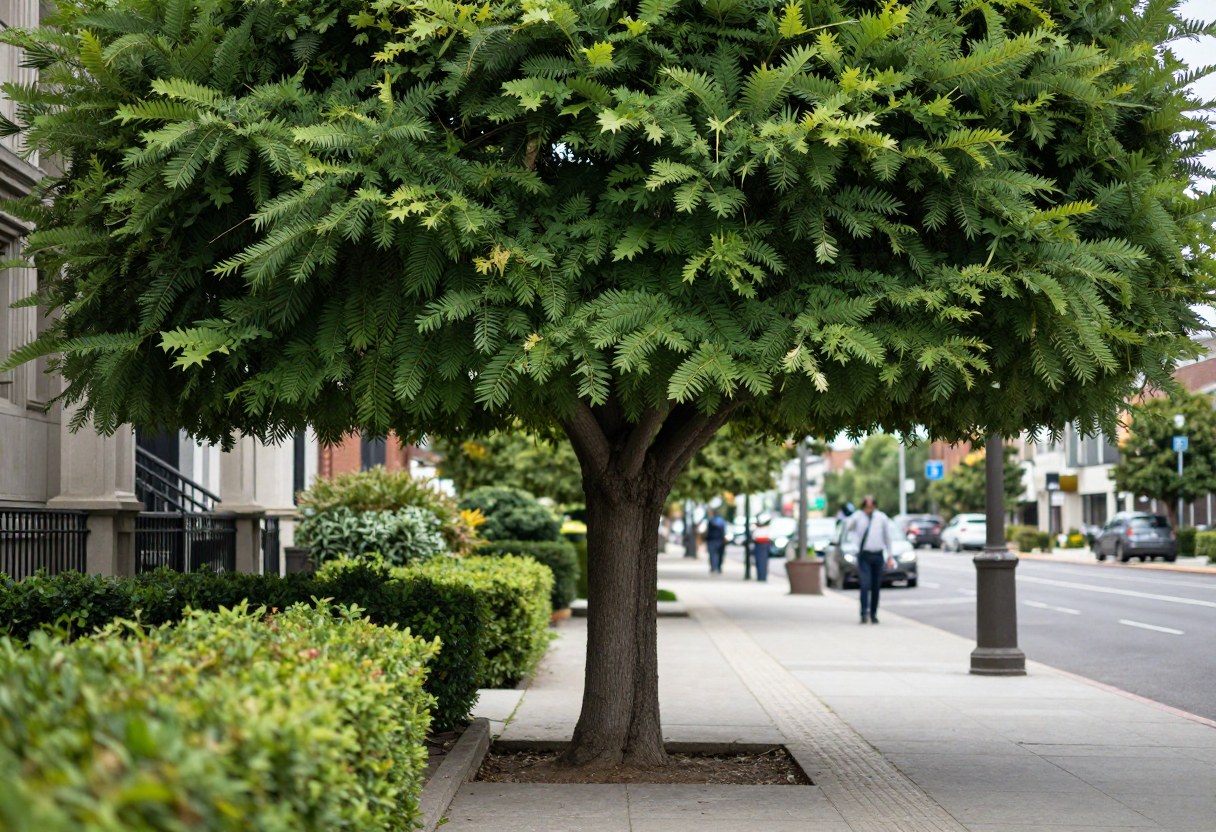
Done well, a street tree is one of the highest-ROI investments a city can make — this is what 80 years of the right species in the right spot looks like.
Understanding Urban Tree Stress: The Enemy's Playbook
Before you can choose the right tree, you need to understand what you're defending against. City environments assault trees from every direction simultaneously. Here's what street trees actually deal with every day:
☣️ The 8 Urban Killers
1. Compacted Soil — The Silent Suffocator
This is the #1 killer of urban trees. When construction equipment, foot traffic, and pavement compact soil to 95% Proctor density (standard for road base), it creates conditions hostile to root growth. Compacted soil blocks the gas exchange roots need — oxygen in, CO₂ out. Roots can't penetrate it, water can't infiltrate it, and microorganisms that support soil health can't survive in it. A tree planted in a standard 4×4-foot sidewalk pit in compacted soil is, functionally, being kept alive in a cement swimming pool.
2. Air Pollution — Invisible Leaf Damage
Urban trees absorb nitrogen dioxide, ozone, particulate matter, and sulfur dioxide through their leaves — which is a good thing for us, but not so great for them. Pollution clogs stomata (the tiny pores trees breathe through), reduces photosynthesis efficiency, and weakens foliar defenses. Some species handle this with grace; others curl up and suffer.
3. De-icing Salts — Chemical Root Burn
Every winter in cold climates, roads and sidewalks get dosed with sodium chloride, calcium chloride, or magnesium chloride. These salts splash onto bark and foliage, accumulate in soil, displace calcium and potassium in root zones, and create toxicity that literally burns feeder roots. Over time, salt stress weakens trees to the point where secondary pests and diseases finish them off.
4. Urban Heat Island Effect — A City That Never Cools Down
Asphalt and concrete absorb solar radiation all day and re-radiate it at night, making city temperatures 5–10°F hotter than surrounding rural areas. Trees planted in this zone face dramatically elevated transpiration demand — they need to pump far more water to cool themselves — but they're surrounded by paved surfaces that shed water rather than storing it. It's a cruel combination: more demand for water, less availability of it.
5. Physical Damage — Death by a Thousand Cuts
Delivery trucks scraping bark. Landscapers mowing against trunks. Utility crews cutting roots to install lines. Vandalism. Construction compaction of root zones. Each individual event may not kill a tree, but cumulative physical stress weakens defenses until opportunistic borers, canker fungi, or bacterial diseases find their opening.
6. Limited Soil Volume — Stunted by Geography
A large canopy tree needs 1,000+ cubic feet of quality soil to reach maturity and provide meaningful shade. A standard urban tree pit might provide 30–60 cubic feet. The math simply doesn't work. When roots run out of room, trees plateau, decline, and die — or their roots find escape routes through sidewalks and building foundations, creating a whole different set of problems.
7. Drought + Poor Drainage — Both at Once
It sounds contradictory, but urban trees often face drought stress and waterlogging simultaneously — in different parts of their root system. Impervious surfaces shed water rapidly but the compacted soil beneath tree pits can puddle and hold water in the few feet directly around the trunk while nearby soil remains dry. Neither condition is good for root health.
8. Pest & Disease Pressure — A Weakened Immune System
Stressed trees attract pests. It's as simple as that. Emerald Ash Borers, Asian Longhorned Beetles, Spotted Lanternflies, and a host of fungal pathogens preferentially attack trees already weakened by the stressors above. A healthy tree in good soil can fight off most attacks. A stressed tree in bad soil becomes a buffet.
Urban Stressor Quick-Reference Table
Urban Stressor
What It Does to Trees
Best Species Choices
Compacted soil
Blocks oxygen/water to roots; stunts growth; causes root suffocation
Honey Locust, London Plane, Kentucky Coffee Tree, Swamp White Oak
Zelkova, Willow Oak, Honey Locust, Japanese Zelkova, Ginkgo
Drought / restricted water
Desiccates roots; triggers pest outbreaks; premature leaf drop
Ginkgo, Honey Locust, Willow Oak, Persian Ironwood, Hedge Maple
Limited root space
Prevents structural root anchoring; destabilizes tree
Serviceberry, Japanese Tree Lilac, Hedge Maple, Columnar trees
Physical damage (cars, trucks)
Bark wounds; root cutting; trunk scarring
London Plane, Honey Locust, Zelkova (tough bark + structure)
Poor soil nutrition
Nutrient deficiency; chlorosis; slow growth
Ginkgo, Kentucky Coffee Tree, Honey Locust, Black Tupelo
Why It's Worth Every Bit of the Effort: The Urban Tree ROI
Before we get into the nitty-gritty of species and planting, let's make sure we're clear on why this matters so much. Urban trees are not decoration — they are critical infrastructure with measurable, monetizable returns.
Cooling Power
Urban trees reduce sidewalk surface temperatures through shade and transpiration (think of it as nature's air conditioning — trees literally sweat, cooling the air around them). Research shows temperatures can vary by more than 2.5°C across a study area based solely on canopy cover. Locations without canopy were up to five times more likely to exceed dangerous heat thresholds than tree-covered locations. Well-placed street trees can cut building cooling energy use by up to 30%.
Air Filtration
Trees are living air filters. Leaf surfaces — especially rough, textured, or hairy ones — capture and hold particulate matter from exhaust and industrial sources. Stomata actively absorb nitrogen dioxide, ozone, and sulfur dioxide. A single mature tree can remove pounds of air pollutants annually. In dense urban corridors where people walk, bike, and wait for buses right at exhaust pipe level, this filtration happens exactly where it's most needed.
Stormwater Management
Canopies intercept rainfall, slowing its fall and allowing much of it to evaporate before reaching the ground. Root systems open compacted soils, allowing water to infiltrate rather than run off into storm drains. Studies consistently show urban tree planting reduces stormwater runoff and the peak flow loads that cause flooding and overflow of combined sewer systems. Every gallon of stormwater a tree absorbs is a gallon a city doesn't have to pay to treat.
Property Value & Economic Lift
Studies show homes on tree-lined streets sell faster and for higher prices than equivalent properties on bare streets. Commercial districts with mature street trees see higher retail sales. Restaurant and café patrons spend more time — and more money — on outdoor seating under shaded canopies. The economics of urban trees are not soft numbers; they are documented and substantial.
Public Health & Mental Well-being
The evidence connecting urban greenery to human health outcomes is growing. Tree-lined streets correlate with lower rates of asthma, cardiovascular disease, and stress-related illness. Exposure to nature — even in brief sidewalk moments — measurably reduces cortisol levels. Greener neighborhoods show lower rates of violent crime. Trees make people feel safer, calmer, and more connected to their environment.
🏙️
Without Street Trees Higher surface temps • Increased stormwater runoff • Noise amplified by hard surfaces • Higher cooling costs • Less pedestrian dwell time • Urban heat island intensified • Mental fatigue from gray environments
Choosing the Right Urban Tree: The Five-Question Framework
Choosing a street tree isn't like picking a tree for your backyard. The margin for error is much smaller, the consequences of a poor choice are more expensive, and the tree has far fewer resources to compensate for a bad planting decision. Run through these five questions before buying anything.
Question 1: What are the overhead constraints?
The single most dangerous mistake in street tree selection is planting a large-canopy tree under or near power lines. It leads to one outcome: brutal, disfiguring utility pruning that turns a tree into something resembling a lollipop on a stick. Know your clearances before you pick a species.
•Under power lines (under 25 ft clearance): Japanese Tree Lilac, Serviceberry, Hedge Maple, Persian Ironwood
•Near power lines (25–40 ft clearance): Flowering Cherry, Zelkova (pruned), smaller Honeylocust cultivars
•Away from power lines (40+ ft): London Plane, Ginkgo, Zelkova, Swamp White Oak, American Elm
Question 2: What is the available planting space?
Measure the tree pit, planting strip, or parkway before you fall in love with any species. Street tree spaces come in several configurations, each with different implications for species selection and soil systems.
•Tree pits (4×4 ft to 6×6 ft in pavement): Use compact or columnar species; strongly consider soil cells for longevity
•Continuous planting trenches (connected pits along a block): Allows root sharing; supports larger species
•Planting strips (grass or mulch between curb and sidewalk): Most hospitable; can support larger trees
•Plaza or courtyard plantings: Often offer more soil volume; good for specimen trees
Question 3: What stressors does this site have?
Do an honest site assessment. Walk the block in winter — where does salt pile up? Is there a bus stop (constant exhaust and compaction from bus idling)? A loading zone (daily truck traffic)? A fire hydrant (winter salt concentration)? Each stressor narrows your species list. Refer to the stressor table earlier in this guide to match conditions to species.
Question 4: What is your climate and hardiness zone?
This eliminates a huge swath of bad choices immediately. A Honey Locust works from Zone 3 to Zone 9. A Southern Magnolia is a Zone 6–10 plant — beautiful in Atlanta, dead in Minneapolis. Check your USDA zone first, then filter your species list.
Question 5: What aesthetic and functional goals do you have?
Form follows function, but both matter. Think through what you actually want from this tree:
•Dense shade for a hot sidewalk? Go large canopy: London Plane, Zelkova, Linden
•Seasonal color for a pedestrian district? Zelkova, Black Tupelo, Serviceberry, Flowering Cherry
•Year-round structure? Southern Magnolia, some Holly species
•Fragrance for an outdoor dining area? Japanese Tree Lilac, Linden
•Native species for ecological value? Serviceberry, Black Tupelo, Swamp White Oak, Willow Oak
•Formal symmetrical boulevard look? Columnar Ginkgo, Zelkova, American Elm DED-resistant cultivars
The Top Urban Street Trees: The Proven Performers
These are the trees that urban foresters, arborists, and city planners actually reach for when they need reliable performers in tough conditions. Each has earned its reputation through real-world success in some of the most demanding urban environments in North America and Europe.
🏆 The GOAT: Honey Locust (Gleditsia triacanthos)
If you had to pick one tree that exemplifies urban toughness, it's the Honey Locust. Research ranking urban tree tolerance across nine major stressors found Honey Locust ranked #1 — tolerant of more stressors simultaneously than any other evaluated species. Compaction. Salt. Drought. Air pollution. Heat. Poor soil. It handles all of them, and keeps growing.
•Mature height/spread: 30–70 ft tall, 30–50 ft wide
•USDA Zones: 3–9 — nearly the entire continental US
•Growth rate: Moderate to fast
•Canopy: Dappled, light — allows grass/plantings to grow underneath
•Best cultivars: 'Skyline' (upright), 'Shademaster' (broad), 'Sunburst' (golden new growth)
•Important: Always choose thornless, seedless selections (Gleditsia triacanthos var. inermis) — the native species has formidable thorns and heavy seed pods
🌳
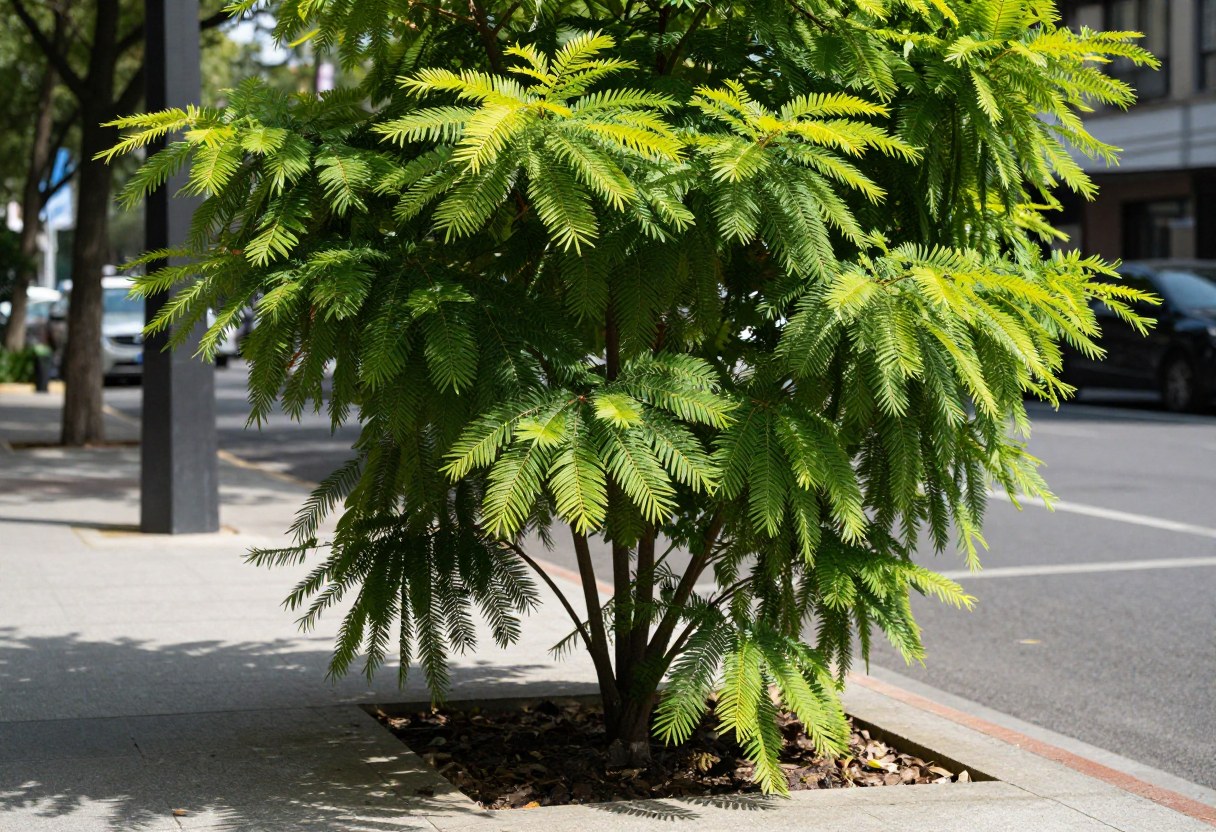
Pro Tip: Honey Locust's dappled canopy is a feature, not a bug. Its fine, feathery foliage creates beautiful filtered light, works well with understory plants, and produces less leaf litter than most alternatives. In a downtown setting where leaf cleanup is a headache, this matters.
🧬 The Immortal: Ginkgo biloba
The Ginkgo has been on Earth for 270 million years. It survived the mass extinction that killed the dinosaurs, shrugged off nuclear radiation in Hiroshima (where Ginkgos were among the first plants to resprout after the 1945 bombing), and is now arguably the world's best urban tree for air pollution tolerance. Ranked #1 in pollution tolerance in multiple studies, it handles drought, compaction, salt, extreme temperatures, and virtually every pest and disease you can throw at it.
•Mature height/spread: 50–80 ft tall, 30–40 ft wide
•USDA Zones: 3–9
•Growth rate: Slow to medium — patience required
•Fall color: Spectacular all-at-once golden yellow drop — one of the most dramatic fall events in any urban tree
•Important: ALWAYS plant male clones — female trees produce fruit that smells like rancid butter. Named male cultivars include 'Autumn Gold', 'Magyar', and 'Princeton Sentry' (columnar)
⚠️
Watch Out: Female Ginkgo trees produce berry-like seeds containing butyric acid — the same compound that makes vomit smell the way it does. Planting an unlabeled 'Ginkgo' risks getting a female. Buy only from reputable nurseries that guarantee named male cultivars.
💪 The Toughest Shade Tree: London Plane (Platanus × acerifolia)
The London Plane Tree might be the most durable large shade tree ever deployed in city streets. A hybrid of the American Sycamore and Oriental Plane, it combines the American species' adaptability to wet, poor soils with broad urban tolerance. It has lined the grand boulevards of Paris, London, and Philadelphia for over a century — some specimens over 200 years old. It's fast-growing, recovers quickly from pruning, and produces an abundance of large leaves that provide exceptional shade.
•Mature height/spread: 70–100 ft tall, 60–80 ft wide — this is a BIG tree
•USDA Zones: 5–9
•Growth rate: Fast — 2–3+ feet per year
•Bark: Spectacular camouflage pattern of green, gray, and cream — visually striking year-round
•Best for: Large-scale streetscapes, parks, plazas, boulevards with plenty of room
•Caution: Too large for tight residential streets; its roots need room
🍂 The Boulevard Aristocrat: Japanese Zelkova (Zelkova serrata)
Zelkova has become the go-to replacement for the American Elm on countless boulevards — and it's earned that status. Its elegant vase-shaped crown creates the same cathedral effect as the Elm, while being far more tolerant of urban conditions. Striking multi-season interest with rich green summer foliage, burgundy-to-russet fall color, and attractive gray-brown bark with orange undertones. Disease resistant, pollution tolerant, and structurally strong.
•Mature height/spread: 50–80 ft tall, 50–60 ft wide
•Best for: Major boulevard plantings, commercial streetscapes, parks
🌳 The Long-Game Champion: Swamp White Oak (Quercus bicolor)
Oaks are the kings of ecological value — a single mature oak can support over 2,300 species of wildlife. The Swamp White Oak stands out among urban oaks for its remarkable adaptability: it thrives in poorly drained, wet soils AND tolerates drought once established. Hardy from Zones 3–8, it's a go-to choice for northern cities and has proven itself on some of the most demanding streetscapes in North America. The tree at the Scott Arboretum of Swarthmore College planted in 1881 towers nearly 100 feet today.
•Mature height/spread: 50–60 ft tall, 40–50 ft wide
•USDA Zones: 3–8
•Growth rate: Medium — worth every year of the wait
☕ The Native Sleeper: Kentucky Coffee Tree (Gymnocladus dioicus)
Underused and underappreciated, the Kentucky Coffee Tree has quietly emerged as one of the best large street trees for Midwest and Eastern cities. Native to many states, it's adapted to degraded urban soils from the start — in nature it colonizes disturbed, difficult sites. Its small leaflets create beautiful dappled shade, and the tree develops a commanding, sculptural silhouette over time. Virtually pest-free and disease-free. Recommended for male clones to avoid the heavy seed pods of female trees.
•Mature height/spread: 60–80 ft tall, 40–50 ft wide
•USDA Zones: 3–8
•Growth rate: Medium
•Best male cultivars: 'Espresso™', 'Prairie Titan®'
🔴 The Fall Color Payoff: Black Tupelo / Black Gum (Nyssa sylvatica)
Want to stop pedestrians in their tracks every October? Black Tupelo delivers some of the most reliable, intense, fire-engine red fall color of any North American native tree — and it does it while tolerating compacted soil, air pollution, salt spray, and drought. A native tree with year-round interest: lustrous green summer foliage, brilliant fall color, small black fruits that birds love, and attractive horizontal branching for winter structure.
•Mature height/spread: 30–50 ft tall, 20–30 ft wide — manageable urban scale
•USDA Zones: 3–9
•Growth rate: Slow to medium — but worth it
•Best cultivars: 'Red Rage®', 'Green Gable™' (PHS Gold Medal 2023), 'Wildfire' (red new growth)
•Transplanting tip: Buy small, container-grown specimens — the taproot makes large B&B trees difficult to establish
🌸 The Fragrant Pedestrian Pleaser: Japanese Tree Lilac (Syringa reticulata)
Most street trees are chosen for shade or toughness. The Japanese Tree Lilac brings something else: spectacular June fragrance and creamy-white flower clusters that stop everyone on the block for a few weeks every summer. Hardy and disease-resistant (unlike its shrubby lilac cousins), it's extremely manageable for tight spaces — maxing out at 20–30 feet — and is perfectly comfortable under utility lines.
•Mature height/spread: 20–30 ft tall, 15–25 ft wide
•Best for: Residential streets, outdoor dining corridors, areas under power lines
🍃 The Native Multi-Season Star: Serviceberry (Amelanchier spp.)
Serviceberry is the complete urban native package. In early spring — often before any other tree leafs out — it covers itself in delicate white blossoms. By June, it produces edible blueberry-flavored fruits that birds devour (and humans can enjoy too). Fall brings orange-red foliage. And through all of it, it tolerates compacted soils, partial shade, and difficult urban conditions better than most trees its size.
•Mature height/spread: 15–25 ft (varies by species), 10–20 ft wide
•USDA Zones: 4–9
•Growth rate: Medium
•Best species: A. x grandiflora (Apple Serviceberry), A. canadensis (Shadblow)
•Best for: Residential streetscapes, nature-forward urban designs, wildlife corridors, areas under utilities
🏛️ The Classic Restored: American Elm (Ulmus americana) — DED-Resistant Cultivars
The American Elm built the cathedral-like boulevards of 19th and early 20th century America — then Dutch Elm Disease nearly wiped it off the map. But plant breeders fought back. Today's DED-resistant cultivars restore the iconic vase-shaped canopy with genuine disease resistance, and these trees are again proving their worth as urban performers: fast-growing, pollution tolerant, and capable of the kind of grand, arching street presence nothing else quite replicates.
•Mature height/spread: 60–80 ft tall, 40–60 ft wide
Ranked #1 for simultaneous tolerance of compaction, salt, drought, and pollution — this is the tree urban foresters reach for first.
Trees to Avoid on Urban Streets (And Why)
Sometimes the most useful advice is a list of 'don'ts.' These trees — some popular, some pretty — consistently underperform or cause problems in urban street settings.
Tree to Avoid
The Problem
Silver Maple (Acer saccharinum)
Aggressive surface roots crack sidewalks and invade sewers; brittle wood breaks in storms; short-lived under urban stress
Bradford/Callery Pear (Pyrus calleryana)
Notoriously weak branch structure causes catastrophic splitting; invasive in many regions; banned in several states
Weeping Willow (Salix babylonica)
Roots aggressively seek water lines, sewers, and foundations; inappropriate for street planting
White Mulberry (Morus alba)
Messy fruit stains sidewalks; invasive in many regions; aggressive roots
Invasive in much of North America; outcompetes natives; aggressive surface roots; becoming restricted in many areas
Black Walnut (Juglans nigra)
Produces juglone, toxic to many plants; messy fruit; allelopathic around paving
Eastern Cottonwood (Populus deltoides)
Cotton creates allergy and fire hazard; very aggressive roots; short-lived and brittle
Ash species (Fraxinus spp.)
Emerald Ash Borer has killed hundreds of millions of ash trees; planting new ash is high-risk without proven EAB-resistant cultivars
White Pine (Pinus strobus)
Ranked among the most intolerant trees to urban stressors including air pollution; not suited for street planting
Cracking the Concrete Code: Urban Soil Technologies
Here's the uncomfortable truth about standard urban tree pits: a tree planted in 30–60 cubic feet of compacted fill soil under concrete is being set up to fail. The solution is engineering the soil environment so the tree actually has room to grow. Several technologies have been developed to solve this, ranging from low-tech and affordable to sophisticated and transformative.
🏙️
City Fact: A large canopy tree needs 1,000+ cubic feet of quality soil to reach full maturity. A standard 4×4 ft tree pit provides about 30–60 cubic feet. That's why most street trees in standard pits plateau and decline within a decade.
Approach 1: Standard Compacted Soil (What Not to Do If You Can Help It)
The default approach — backfill native soil, compact to meet engineering standards — results in soil too dense for roots to penetrate. Trees planted this way can survive for several years drawing on the soil ball from the nursery, but once they exhaust that resource, they hit a wall. Growth slows, then stops, then reverses. This approach is cheap upfront and expensive over time.
Approach 2: Open Planting Strips (The Best Option When Available)
If there's a continuous unpaved planting strip between curb and sidewalk, use it. This is the gold standard for residential street tree planting — no engineering systems needed, just a well-prepared planting hole, good soil amendment where needed, and proper mulch. Trees in genuine planting strips can be treated more like park trees and will grow accordingly.
Approach 3: Structural Soil (CU-Structural Soil®)
Developed by Cornell University, structural soil mixes 80% crushed rock with 20% clay loam soil bound with a tackifier gel. The crushed rock transfers compressive loads from traffic and pavement while the soil fills the void spaces between stones, creating pathways for roots. It can be compacted to support vehicle traffic while still allowing root growth — a genuine engineering innovation.
•Advantages: Can be installed under existing pavements; supports vehicle loading; cheaper than soil cells
•Limitations: Only about 20% of the volume is actually soil; root growth is slower than in quality loam; more prone to sidewalk cracking from roots than soil cells
Approach 4: Stockholm Tree Pits
A newer variation using larger crushed stone with soil and biochar washed into the gaps between stones. The biochar improves water and nutrient retention while the large stone aggregate provides excellent structural support and greater void space than standard structural soil. Increasingly popular in European cities and gaining traction in North America.
Approach 5: Silva Cells / Soil Cells (The Gold Standard)
Soil cells (DeepRoot Silva Cells, CityGreen StrataCells, and similar products) are modular plastic or fiberglass frames that support pavement while creating a protected subsurface space filled with quality loam soil. With 90%+ void space vs. the 20% of structural soil, trees growing in soil cell systems have dramatically better access to water, oxygen, and nutrients. Research consistently shows trees in soil cell installations grow faster, live longer, and develop larger canopies.
•How they work: Frames are excavated into the subbase, filled with quality loam soil, then covered with geotextile and aggregate; pavement is installed on top with an opening for the tree trunk
•Tree growth: Studies show trees in Silva Cells achieve similar growth to open-ground park trees — vastly superior to compacted soil or structural soil
•Stormwater bonus: Soil cells can double as bioretention systems, managing stormwater on-site while growing trees
•Real-world success: The Willow Oak installation on a Washington DC street (connected tree pits sharing 700 cu ft of soil per tree) now has trees with 19-inch trunk diameters and 71-foot heights
•Cost: Higher upfront investment ($25,000+ per tree in complex urban installations) but dramatically lower lifetime costs from reduced replacement and maintenance
⚠️
Watch Out: Tree grates — the decorative metal rings around sidewalk tree openings — can strangle trees if not maintained. As the trunk flares and grows, grate rings must be removed or the tree is effectively girdled. Many municipalities have moved away from fixed tree grates for exactly this reason.
Soil System Comparison Table
Method
How It Works
Best For
Cost Level
Compacted fill (standard)
Native soil backfilled and compacted to 95% Proctor to support pavement load
Budget projects; minimal infrastructure
Low ($)
Structural soil (CU-Structural Soil®)
80% crushed rock + 20% soil mix; supports pavement while allowing root growth through voids
Large crushed stone with soil + biochar washed into gaps; allows high load AND root penetration
Mid-range budgets; broad applicability
Medium ($$)
Silva Cells / Soil Cells
Plastic structural frames support pavement; 90%+ void space filled with quality loam soil
High-priority streetscapes; maximum tree longevity
High ($$$)
Open planting strip
Trees in unpaved soil strip (no structural system needed)
Residential streets with planting strips; lower density areas
Lowest ($)
A standard 4x4 tree pit holds 30-60 cubic feet of soil; a mature canopy tree needs 1,000+ — the gap is exactly what these soil technologies exist to close.
Planting Urban Trees: The Step-by-Step Process
Urban tree planting differs from residential planting in important ways. The stakes are higher (literally — city infrastructure is expensive to repair), the site is more constrained, and the first year of establishment is absolutely critical. Here's how to do it right.
Before You Dig: The Urban Site Checklist
•Call 811 — Always. No exceptions. Gas, electric, water, fiber, telecom lines all run under urban sidewalks and streets. This is the law, it's free, and it could save your life.
•Check overhead utilities — Measure clearance before selecting any species
•Review local permit requirements — Many municipalities require permits for street tree planting
•Identify irrigation access — Is there a nearby water source for the critical establishment period?
•Assess drainage — Standing water after rain means you need a drainage-tolerant species or drainage improvements
•Check existing root competition — Adjacent large trees create root competition that affects your new tree
Choosing the Right Size Tree to Plant
Counterintuitive urban tree truth: bigger is not always better. Research and field experience consistently show that smaller container-grown trees — 1.5 to 2-inch caliper — typically outperform larger balled-and-burlapped (B&B) specimens in urban settings over a 4–5 year period. Why?
•Container trees establish faster: Their root systems aren't disrupted by digging
•B&B trees lose 90%+ of their root system when dug from the nursery field — they spend years rebuilding rather than growing
•Smaller trees handle transplant stress better in the hot, dry, compacted urban environment
•In 4–5 years, a well-planted 2-inch container tree typically overtakes or equals a 4-inch B&B specimen planted at the same time
🌳
Pro Tip: If budget allows for one large B&B specimen OR three smaller container trees, choose three. You get three chances of success, faster canopy coverage, more root competition for available soil resources, and better odds of long-term success.
The Urban Tree Planting Process
•Mark utilities and get clearances. Call 811, mark all underground utilities, confirm overhead clearance. No exceptions.
•Prepare the planting hole. Dig 2–3x wider than the root ball but NO deeper than root ball height. In heavy clay or compacted soil, make the sides rougher — not smooth — to encourage roots to grow outward rather than circling.
•Check your soil system. If installing structural soil or soil cells, ensure the system is installed correctly per manufacturer specs before placing the tree.
•Inspect and prep the root ball. Remove all container material — including 'plantable' pots. Check for circling roots and score or untangle them aggressively. This is the most important step most planters skip.
•Set the tree at the right height. The trunk flare — where the trunk widens at the base — must sit at or slightly above grade. Urban trees are often planted too deep, burying the flare, which slowly kills them. When in doubt, plant a touch high — trees settle, they don't float.
•Backfill with native soil. Unless you have specific reason to amend (confirmed nutrient deficiency via soil test), use native soil as backfill. Research shows trees planted in native backfill develop root systems that extend further into surrounding soil than trees planted in amended mixes.
•Water immediately and deeply. Initial watering settles soil, eliminates air pockets, and begins the establishment process. Soak the root ball thoroughly — not just the surface.
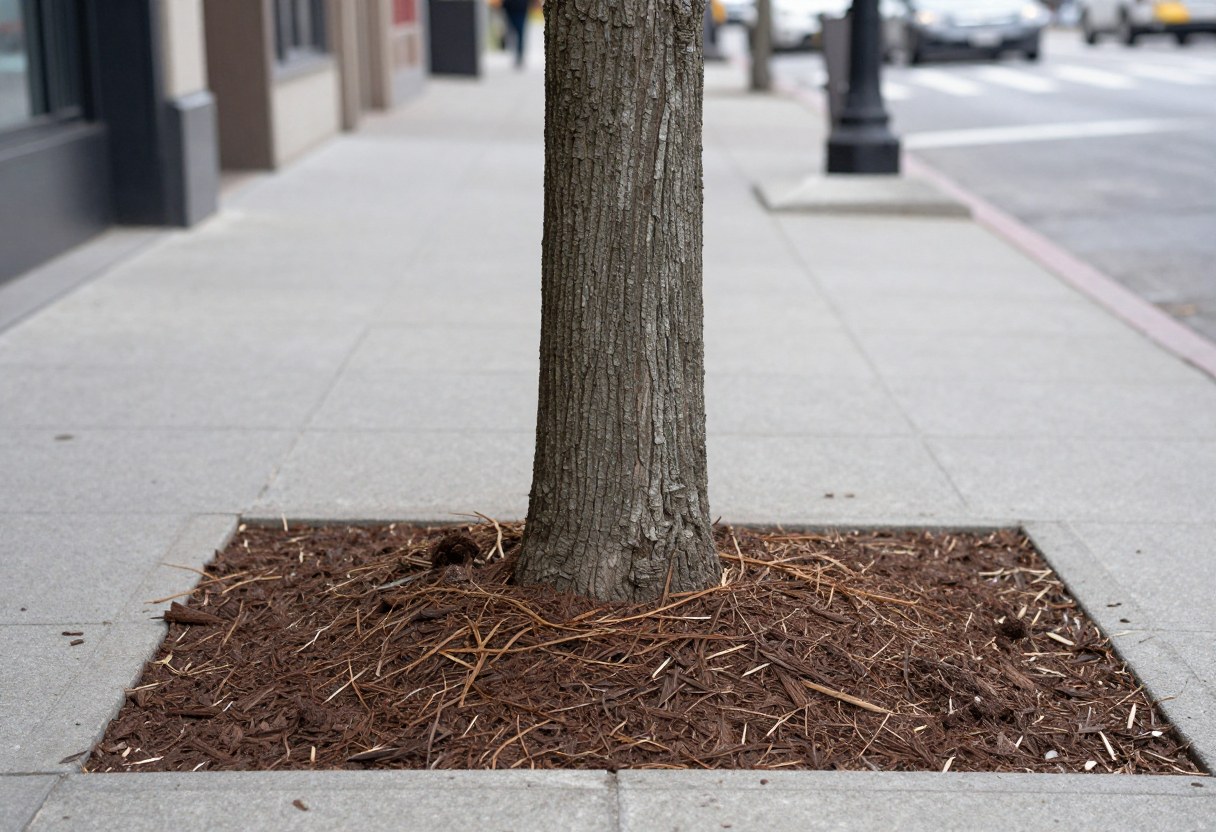
•Mulch correctly. Apply 2–3 inches of organic mulch in a ring 3–6 inches away from the trunk. Keep mulch away from the bark — 'mulch volcanoes' against trunks cause rot and pest problems. In urban settings, mulch retains moisture desperately needed by the root ball surrounded by heat-absorbing pavement.
•Stake only if necessary. Stakes are often counterproductive — a tree that sways develops stronger trunk wood. Only stake if the tree would be physically displaced by wind or pedestrian contact. If you must stake, use soft ties and remove stakes after 1 year maximum.
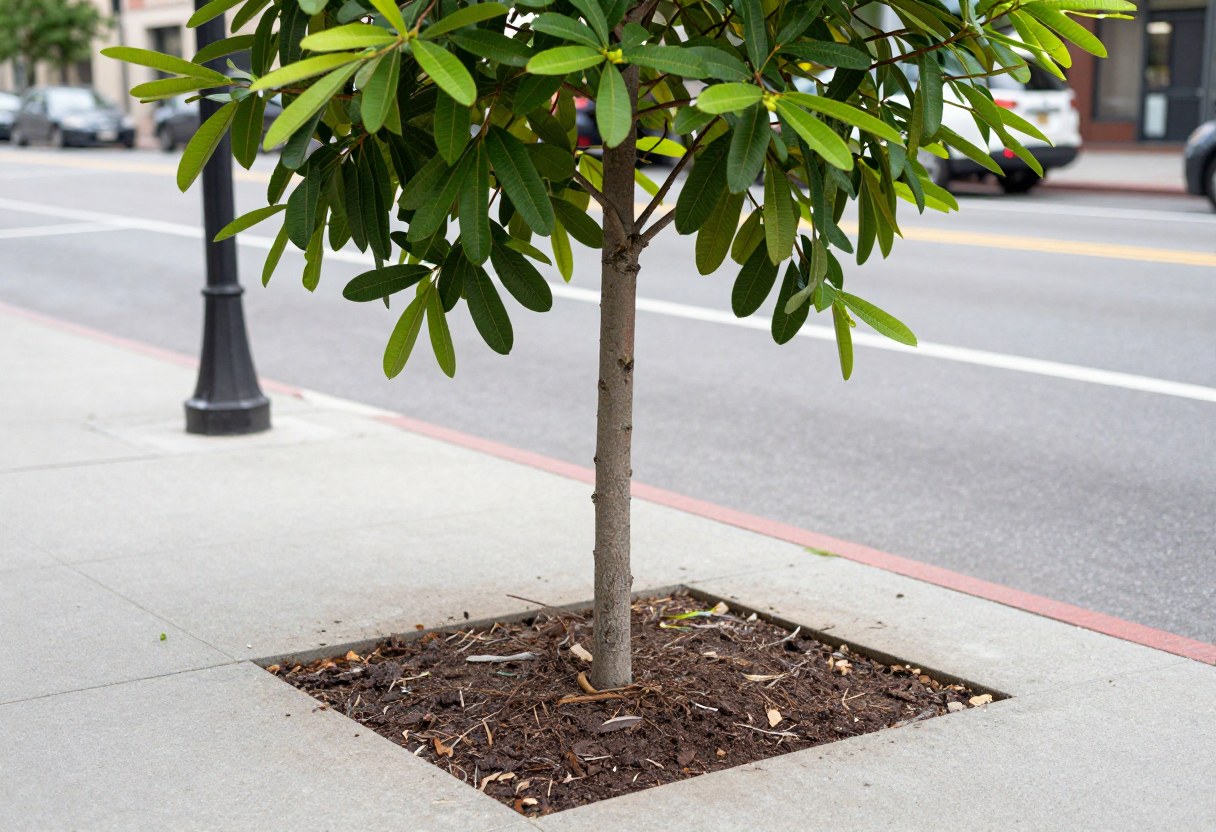
The trunk flare must sit at or slightly above grade — urban trees planted too deep decline slowly over years, often without an obvious cause.
Urban Tree Care: Getting Through the Critical First Years
The establishment period — typically the first 2–3 years — is when urban trees are most vulnerable and most in need of your attention. Once established, many street trees become self-sufficient. But get the early care wrong, and you've wasted a significant investment.
Watering: The Urban Tree's #1 Survival Need
Urban trees face a cruel double bind: heat-stressed environments dramatically increase their water needs, while surrounding pavement sheds water away rather than storing it for roots. Supplemental watering is non-negotiable for the first 2 growing seasons.
Year 1 Watering Protocol
•Week 1–4: Water every 2–3 days, deeply. The goal is to soak the root ball down 12+ inches, not just wet the surface.
•Week 5–12: Water once or twice per week; more during heat waves
•Month 3–12: Once per week during dry periods; check soil moisture before watering
•Key technique: Use a slow drip or soaker approach rather than a quick blast — fast water runs off the compacted surrounding soil without penetrating the root ball
Year 2 Watering
•Deep water during dry spells (2+ weeks without meaningful rain)
•Monitor for heat stress symptoms: wilting during day that doesn't recover overnight, scorch on leaf edges, premature leaf drop
•Many urban trees are now connected to tree watering bags (those green plastic bags that look like tree skirts) — these work well for slow-release watering
Mulch Maintenance: A Year-Round Priority
Mulch is the easiest, highest-ROI maintenance action for urban trees. Replenish the ring every spring — aim for 2–3 inches of wood chip or bark mulch in a 3–4 foot diameter ring. In hot urban environments, mulch can reduce soil temperature by 10–15°F and cut watering needs significantly.
⚠️
Watch Out: Never let mulch pile against the trunk. This is 'mulch volcano' syndrome, and it's responsible for countless premature tree deaths — it traps moisture against bark, promotes fungal disease, and provides cover for rodents that girdle the trunk. The mulch ring should look like a donut, not a volcano.
Fertilizing Urban Trees
Urban soils are often nutritionally depleted. But timing matters more than frequency for fertilizing street trees.
•Year 1: No fertilizer. Focus on establishment. Heavy fertilizing before root systems are established pushes foliar growth the roots can't support.
•Year 2+: Apply a slow-release balanced fertilizer (10-10-10 or similar) in early spring. Scatter under the canopy drip line — not against the trunk.
•Signs of nutrient deficiency: Chlorotic (yellowing) leaves, small leaf size, unusually slow growth. Have soil tested before applying specific nutrients.
•Organic alternatives: Top-dressing with quality compost in spring provides nutrients while improving soil biology.
•Avoid fall fertilizing: This pushes tender new growth right before cold hardening begins.
Pruning Urban Street Trees
Urban trees need more careful pruning than residential trees because the consequences of failure — a branch falling on a pedestrian or car — are serious. The goal is structural pruning to develop a strong, clearance-meeting canopy, not decorative sculpting.
•Clearance pruning: Street trees typically need 14 feet of clearance for vehicles, 8 feet for pedestrians. Maintain these minimums.
•Structural pruning: During the first 5–10 years, work to develop a single central leader and well-spaced scaffold branches. Remove co-dominant leaders early — two equal-diameter stems competing for dominance will eventually fail.
•Best timing: Late winter or early spring for most species when trees are dormant
•Never top a tree: Topping destroys structure, creates weak regrowth, exposes wounds to decay, and produces an ugly, unsafe tree. If a tree is outgrowing its space, the wrong tree was selected.
•Hire an ISA Certified Arborist for significant work: Tree care is a profession. In a liability-conscious urban environment, proper credentials and insurance matter.
Salt Management: Protecting Trees in Winter
If your street tree is in a zone where salt is heavily applied, there are practical mitigation strategies:
•Install physical barriers (burlap screens, temporary fencing) on the salt-spray side of the tree during winter
•Apply gypsum to soil in spring — it displaces sodium ions and improves soil structure after salt accumulation
•Deep water in early spring to flush accumulated salts through the root zone
•Advocate for your municipality to use less-corrosive de-icing alternatives like calcium magnesium acetate in sensitive areas
•Select salt-tolerant species for high-salt exposure locations: Honey Locust, Ginkgo, Black Tupelo, Kentucky Coffee Tree
The highest-ROI maintenance action for an urban tree — 2-3 inches of mulch can cut soil temperature by 10-15°F and meaningfully reduce watering needs.
Urban Tree Troubleshooting Guide
Urban trees face a unique set of problems. Here's how to diagnose and respond to the most common issues.
Symptom
Likely Cause(s)
Response
Yellowing leaves (chlorosis)
Poor drainage, compacted soil, salt damage, or iron/manganese deficiency
Soil test; improve drainage; deep water to flush salts; apply chelated iron if needed
Browning leaf margins
Salt damage, drought stress, or wind desiccation
Deep water; gypsum application in spring; physical salt barriers in winter
Wilting that doesn't recover overnight
Severe drought stress; root damage; girdling roots
Deep water immediately; inspect root collar for girdling; assess soil compaction
Premature fall color (August/September)
Drought stress or root damage — tree is shutting down early
Emergency deep watering; inspect root zone; contact arborist
Slow growth or no growth
Compacted soil, wrong species for site, root problems, or insufficient soil volume
Contact local extension service; may require pesticide treatment; serious cases require removal
Surface roots cracking pavement
Insufficient soil volume — roots are escaping the tree pit
Install root barriers; consider expanding soil volume with structural soil beyond tree pit; pavement repair
Dieback from top down
Drought stress, root damage, or verticillium wilt
Contact arborist; assess water access; soil fungal test if wilt suspected
General poor appearance despite care
Wrong species for site, or cumulative stressor overload
Reassess species match; consider replacement with better-suited tree
The Diversity Imperative: Don't Put All Your Canopy in One Basket
Here is one of the most important lessons in urban forestry history, written in the graves of millions of dead trees: monoculture urban forests are catastrophically fragile.
American cities once planted American Elms almost exclusively — the tree was gorgeous, fast, and seemed perfect for streets. Dutch Elm Disease arrived in the 1930s and wiped out an estimated 100 million trees over the following decades. Today, Emerald Ash Borer is doing the same thing to the cities that responded to the elm disaster by planting too many ash trees.
The rule that urban foresters now apply: no single species should represent more than 10–15% of a city's street tree population. No single genus more than 20–25%. If your block has 10 trees and they're all Honey Locusts, they're all vulnerable to any future pest or disease that targets Honey Locusts.
🌳
Pro Tip: When planning a street tree installation or replacing trees along a corridor, intentionally mix species. Even when one species clearly performs best for your site, planting three or four species in rotation gives you insurance against the next elm disease or ash borer scenario — whatever it turns out to be.
Urban Tree Planting Quick-Start Checklist
Use this checklist before purchasing or planting any urban street tree:
☐
Confirmed USDA Hardiness Zone for my location
☐
Assessed sun exposure at planting site (full/partial)
☐
Checked overhead utilities — used appropriate tree height
☐
Called 811 to mark underground utilities
☐
Measured tree pit dimensions and available root space
☐
Evaluated soil type and drainage (clay, sandy, compacted)
☐
Selected tree species suited to identified stressors (salt, drought, compaction, etc.)
☐
Confirmed mature width won't conflict with sidewalk, curb, or buildings
☐
Chose appropriate soil system (open strip, structural soil, or soil cells)
☐
Sourced a container-grown specimen (preferred for urban planting)
☐
Planned watering for the first 2 growing seasons
☐
Ordered organic mulch (no dyed wood chips near tree trunk)
☐
Checked local ordinances on permits for street tree planting
☐
Considered diversity — not planting same species as adjacent trees
Plant Once. Benefit for Generations.
A street tree planted today — the right species, in the right site, with the right soil system — will still be shading sidewalks, filtering air, and managing stormwater long after every other element of that streetscape has been replaced. London Plane Trees lining Parisian boulevards have been growing since Napoleon's era. Elms planted in colonial-era New England still stand in protected corners of university campuses. When you plant the right urban tree and give it what it needs to establish, you're not making a landscaping decision — you're making a century-long infrastructure investment.
The concrete jungle is tough. But the right tree is tougher. Pick wisely, plant correctly, and the city will be a little greener, cooler, and more livable because of what you put in the ground today.
Happy planting! 🏙️🌳🏙️
🌿 Get Seasonal Gardening Tips
New guides, planting reminders, and growing tips — straight to your inbox.
No spam. Unsubscribe anytime.
About the Author
David Rodgers is the Founder & Head Gardener of Planting Atlas. With over 40 years of hands-on gardening experience in Oklahoma's Zone 7 climate, he researches, writes, and personally tests every guide on the site.
David draws from real backyard trials, soil testing, and trusted sources like Oklahoma State University Extension and USDA data to deliver practical, zone-specific advice that actually works.